
When Does a Max-Funded IUL Actually Make Sense?

If you’re a high earner who’s already maxed out qualified plans and can commit to steady premiums for 10 to 20 years, a max-funded Indexed Universal Life policy, funded up to but never over the Modified Endowment Contract (MEC) limit, can build meaningful tax-advantaged cash value for retirement. The core constraint is non-negotiable: cross the MEC line and you lose the tax treatment that makes this strategy worth doing in the first place.
The mechanism runs through 26 U.S.C. § 7702, which qualifies the contract as life insurance, and Section 7702A, which sets the funding ceiling that keeps policy loans tax-free.
Before you fund anything, get three numbers from a carrier illustration:
- Your MEC ceiling for the death benefit you’re considering
- A premium amount you can sustain without fail for a decade or two
- The minimum non-MEC death benefit that keeps you under that ceiling
Quick math check: A policy designed with too little death benefit relative to premium trips the 7-pay test in year one. There’s no fixing it after the fact. The design has to be right before the first dollar goes in.
Key Takeaways
A max-funded IUL strategy works by funding premiums up to but never over the MEC ceiling, sizing the death benefit at its non-MEC minimum, and monitoring both figures every year to protect tax-free loan access.
| Point | Details |
|---|---|
| Stay under the MEC ceiling | Fund premiums right up to, but never over, the 7-pay limit under Section 7702A. |
| Size the death benefit deliberately | Use carrier modeling to find the minimum non-MEC death benefit for your target premium. |
| Time the Option B to Option A switch | Start with Option B for lower cost of insurance, then switch to Option A once cash value is substantial. |
| Expect a long break-even window | Early costs and surrender charges typically mean 10 to 20-plus years before meaningful distributable value. |
| Work with Progressiveplanner for implementation | The Dual Purpose Retirement Strategy™ models MEC limits, monitors funding annually, and plans death benefit timing. |
Table of Contents
- What Is a Max-Funded IUL Funding Strategy?
- What Do Section 7702 And The MEC Test Mean For Your Funding?
- How Do You Structure The Premium And Death Benefit Design?
- How Does Cash Value Grow, And How Do You Access It?
- How Long Until An IUL Pays Off, And What Does It Cost?
- Who Should Consider This Strategy, And Who Shouldn’t?
- How Does The Dual Purpose Retirement Strategy™ Apply This?
- What Should You Bring To A Planning Meeting?
- Ready To Model Your Own IUL Funding Numbers?
- Frequently Asked Questions
- Sources
What Is a Max-Funded IUL Funding Strategy?
A max-funded IUL funding strategy means paying premiums as close to the legal maximum as the MEC rules allow, while keeping the death benefit at the smallest amount that still qualifies the contract as life insurance. Standard IUL policies typically size the death benefit for protection needs first and let premium follow. Max-funding flips that logic: the death benefit gets sized around the premium you want to pay, not the other way around.
That distinction changes everything about how the policy performs. A max-funded IUL treats the death benefit as scaffolding, just enough to keep the IRS happy, so more of every dollar goes toward cash value instead of insurance costs.
Three terms matter here, and carriers use them inconsistently enough to confuse people:
- Planned premium is the amount you tell the carrier you intend to pay each year. It’s a target, not a legal ceiling.
- Target premium is a carrier-specific benchmark tied to commission schedules and policy costs. It has nothing to do with your MEC limit.
- Guideline premium relates to the Section 7702 test that keeps the contract classified as insurance at all. The 7-pay premium is the separate, usually lower number that determines MEC status under Section 7702A.
The guideline premium and the 7-pay premium are the two figures that actually govern your funding strategy. Everything else is carrier terminology dressed up to look official.
What Do Section 7702 And The MEC Test Mean For Your Funding?
Section 7702 sets the guideline premium and cash value corridor tests that qualify a contract as life insurance under federal tax law. Section 7702A layers a second, stricter test on top: the 7-pay test, which caps how much premium can go into the policy during its first seven years relative to the death benefit.
The 7-pay test works like this: the IRS calculates the maximum premium that could be paid over seven years for a given death benefit and still keep the policy from resembling an investment vehicle wearing a life insurance costume. Pay more than that cumulative limit in any of the first seven years (or after a “material change” like a death benefit increase) and the policy becomes a Modified Endowment Contract permanently. There’s no cure period, no do-over. IRS Revenue Ruling 2005-6 lays out exactly how carriers and policyholders should apply this mechanic.
MEC status doesn’t touch the death benefit or the tax-free growth of cash value. It changes how you’re allowed to access the money:
- Withdrawals and loans from a MEC are taxed on a last-in-first-out basis, meaning gains come out first and get taxed as ordinary income.
- Distributions before age 59½ from a MEC can trigger a 10% federal penalty on the taxable portion.
- Once a policy is classified as a MEC, it stays a MEC for the rest of its life, even if you later reduce funding.
This is why every max-funded strategy has to be modeled with headroom below the 7-pay limit, not right up against it. Carrier illustration software should flag this automatically, but the responsibility for staying under the ceiling sits with you and whoever is running your numbers.
How Do You Structure The Premium And Death Benefit Design?
Getting the structure right up front saves years of correcting course later. Here’s the sequence that actually works.
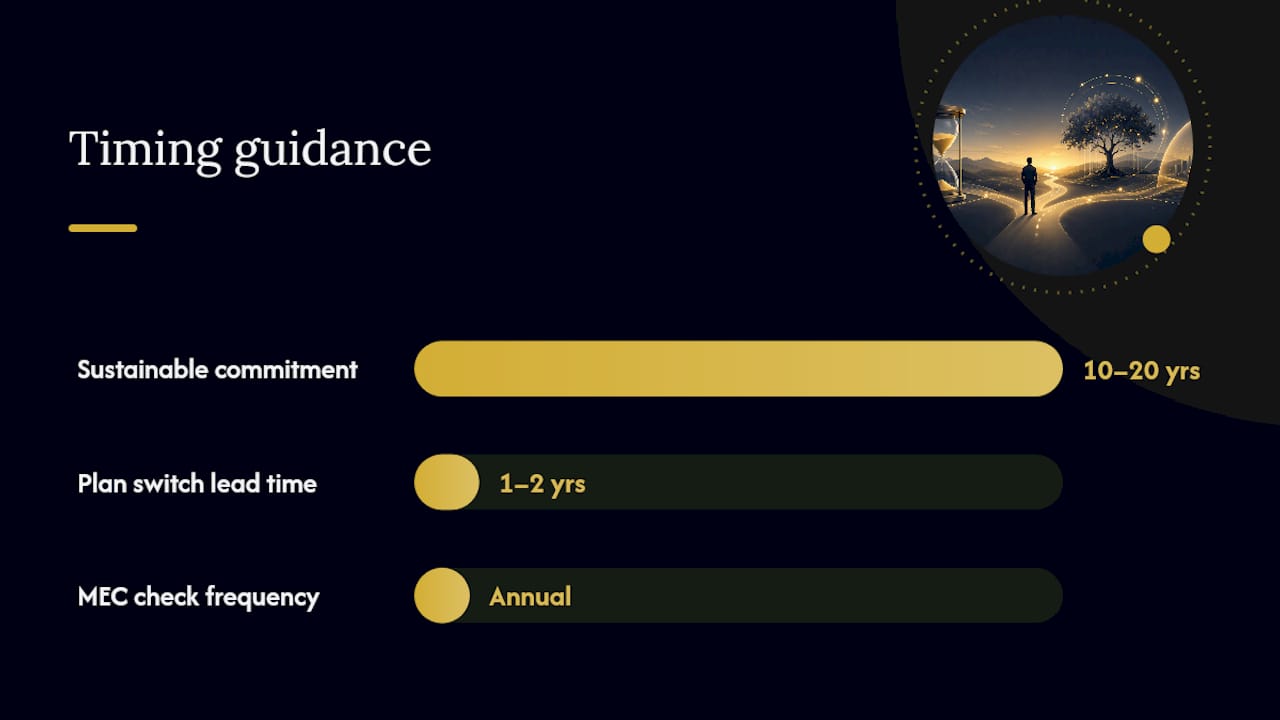
- Set a sustainable annual premium. Pick an amount you could keep paying through a job change, a market downturn, or a rough year, not just what looks good in a best-case illustration. Ten to twenty years is the realistic commitment window.
- Run the minimum non-MEC death benefit calculation. Carrier software or an advisor plugs your premium into the 7702A formula and returns the smallest legal death benefit that keeps you a non-MEC policy. This is the number that actually drives your policy’s efficiency.
- Decide how much headroom to build in. A death benefit set exactly at the minimum non-MEC threshold leaves zero room for a future lump sum, an inheritance, or a bonus year. Many designs add a blended term rider instead of raising the permanent death benefit outright, since term riders cost less per dollar of coverage and preserve more premium for cash value.
- Start with Option B, plan the shift to Option A. Death benefit Option B pays the base death benefit plus accumulated cash value; Option A pays a level death benefit only. Option B during funding years keeps the net amount at risk, and the cost of insurance tied to it, lower relative to your growing cash value. Once accumulation is substantial, switching to Option A reduces ongoing cost-of-insurance drag because the insurer’s exposure shrinks as your cash value effectively offsets part of the death benefit. This structuring approach is one of the more reliable ways to protect accumulated value heading into distribution years.
Pro Tip: Don’t switch from Option B to Option A the moment your advisor mentions it. Model both the timing and the underwriting implications first. Some carriers require evidence of insurability to reduce net amount at risk in certain ways, so plan the switch a year or two ahead rather than reactively.
After the initial design, funding isn’t a set-it-and-forget-it decision. Run an annual MEC check to confirm you still have room under the 7-pay limit, especially after any premium increase or death benefit change. Review the illustration against actual credited rates, not just the original projection. And if you receive an unplanned lump sum, resist the urge to dump it into the policy without checking the material change rules first. A large unscheduled deposit can retest the 7-pay limit and push you into MEC territory overnight.
How Does Cash Value Grow, And How Do You Access It?
Cash value in an IUL grows based on the performance of a chosen index, usually something like the S&P 500, filtered through three mechanics: the cap, the participation rate, and the floor.
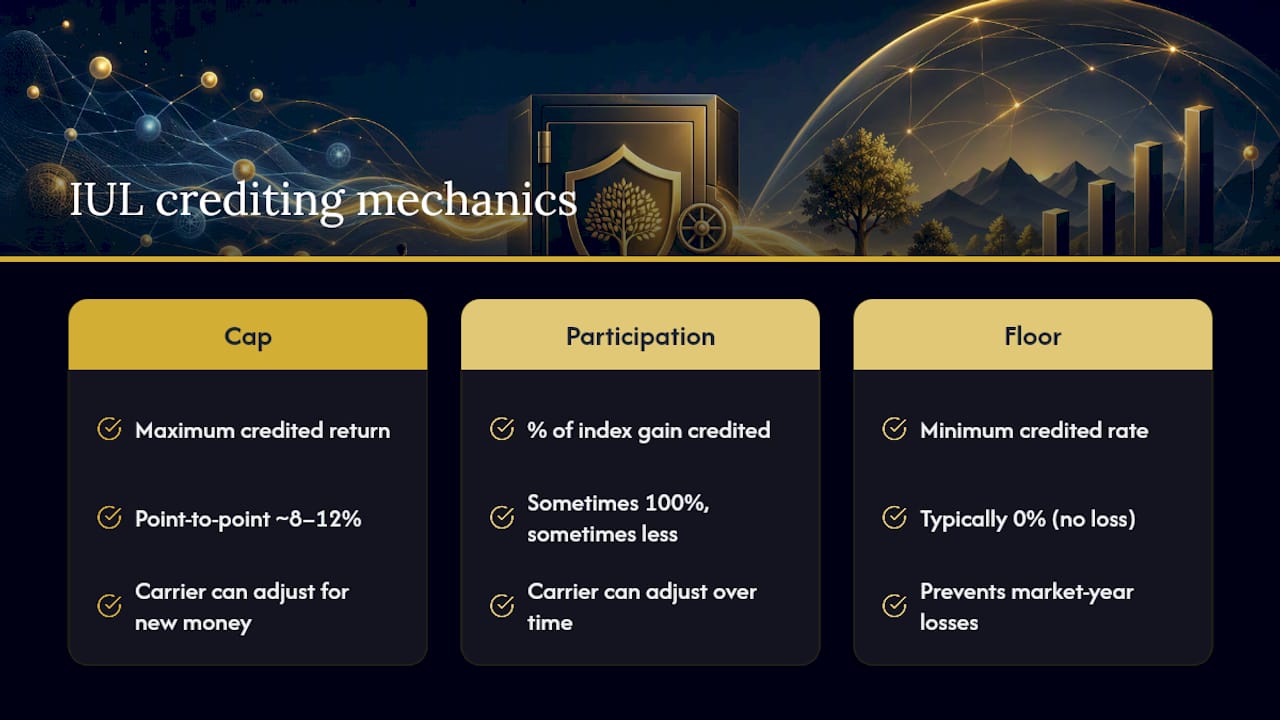
The cap is the maximum credited return in a given period, regardless of how well the index performs. The participation rate determines what percentage of the index’s gain counts toward your credited interest, sometimes 100%, sometimes less. The floor, typically 0%, means a bad index year doesn’t erase your cash value the way a real market investment would. You don’t lose ground, but you also don’t capture the index’s full upside. Caps and participation rates aren’t fixed for the life of the policy. Carriers can and do adjust them for new premium going forward, and point-to-point caps on S&P 500-linked accounts have ranged roughly 8% to 12% in recent years, depending on the carrier and market conditions.
Accessing cash value happens two ways: withdrawals and policy loans. Withdrawals reduce your cost basis and death benefit permanently. Policy loans borrow against the cash value using it as collateral, and in a non-MEC policy, loans are typically tax-free as long as the policy stays in force. Carriers offer fixed-rate loans or indexed participating loans, where the loan balance still participates in index crediting, sometimes creating a favorable spread, sometimes an unfavorable one depending on how the loan rate and credited rate compare that year.
The real risk sits with policy lapse. If loan balances plus interest exceed cash value and the policy lapses, the outstanding loan amount above cost basis becomes taxable income all at once, a genuinely unpleasant surprise for someone expecting tax-free retirement income.
How Long Until An IUL Pays Off, And What Does It Cost?
Cost of insurance charges, policy loads, and surrender charges hit hardest in the early years, and that drag is why max-funded IULs are a long-game strategy, not a five-year plan. Break-even windows commonly run 10 to 20-plus years depending on funding level and design, with aggressive accumulation strategies often landing on the longer end of that range.
Cost of insurance rises with age. If funding drops off in later years, whether from job loss, retirement timing, or just funding fatigue, rising COI can eat into cash value faster than credited interest replaces it, occasionally threatening the policy’s sustainability.
| Policy Year Range | Typical Cost Drag | What’s Happening |
|---|---|---|
| Years 1 to 20 | Highest | Front-loaded charges and surrender fees dominate |
| Years 6 to 10 | Moderate, declining | Surrender charges phase out on most designs |
| Years 10 to 20 | Lower, cash value compounding | Break-even typically occurs in this window |
| Years 20 and beyond | Rising COI risk if underfunded | Cost of insurance increases with age |
Build your projections around conservative credited-rate assumptions, not the illustrated maximum, and revisit the numbers every year rather than trusting a decade-old illustration to still reflect reality.
Who Should Consider This Strategy, And Who Shouldn’t?
The strongest candidates are high-income earners who’ve already maxed out 401(k) and IRA contributions, have a genuinely long time horizon, carry stable and predictable cash flow, and can pass underwriting in reasonably good health. This isn’t a strategy for money you might need in three years.
Watch for these warning signs before committing:
- A time horizon under 10 years, since early-year costs will eat most of the upside.
- Income that varies significantly year to year, since missed premiums can jeopardize non-MEC status or policy sustainability.
- A need for a large immediate death benefit rather than a minimized one, which conflicts with max-funding’s whole design.
- High-interest debt still outstanding, which almost always deserves attention before additional insurance premium.
If max-funding doesn’t fit, reasonable alternatives include prioritizing 401(k) and IRA contributions first, blending a smaller permanent policy with term coverage for pure protection, or funding an IUL more conservatively without pushing toward the MEC ceiling. A quick suitability conversation with a source like Haven Mark Advisers on general risk considerations can help frame the decision, even though U.S. tax rules govern the actual policy design.
How Does The Dual Purpose Retirement Strategy™ Apply This?
Progressiveplanner’s Dual Purpose Retirement Strategy™ layers IUL funding into a broader retirement income plan built around a specific idea: the same dollar can work twice. Instead of treating an IUL as a standalone accumulation vehicle, the strategy positions it alongside existing qualified accounts so a single funding decision supports two separate income streams in retirement, one tax-deferred, one built for tax-advantaged access through policy loans.
The value isn’t in picking a bigger cap rate or a flashier index. It’s in the design work: confirming your death benefit sits at the right minimum non-MEC level, checking your MEC room every year, and knowing exactly when the Option B to Option A switch should happen for your specific funding timeline.
Progressiveplanner’s role in this process is operational: running illustration modeling against conservative credited-rate scenarios, monitoring MEC status annually, and mapping out death benefit switch timing before it becomes urgent. It’s a planning discipline, not a promise of a specific outcome.
What Should You Bring To A Planning Meeting?
Before you sit down with anyone about this strategy, get clear on four things: how much room is left in your qualified plans, what premium you can reliably fund for the next 10 to 20 years, your target retirement age, and how much death benefit you actually need versus want.
The most common trade-off I see is between headroom and efficiency. Clients want flexibility for future lump sums, but every dollar of extra death benefit above the non-MEC minimum is a dollar not compounding as cash value. Progressiveplanner typically resolves this with a modest term rider rather than inflating the permanent death benefit outright. It preserves flexibility without permanently dragging on cost of insurance.
Model your numbers against a conservative credited rate, not the illustrated best case, and put an annual review on your calendar before you sign anything.
Ready To Model Your Own IUL Funding Numbers?
Running your own MEC ceiling and sustainable premium calculation on paper is one thing. Watching it play out against 10, 15, and 20 year credited-rate scenarios with someone who does this daily is another. Progressiveplanner’s Dual Purpose Retirement Strategy™ takes the funding decisions covered above, sustainable premium, minimum non-MEC death benefit, Option B to Option A timing, and turns them into an actual illustration built around your income and retirement timeline, not a generic example.

Progressiveplanner works with clients across the United States to build illustration models that show the MEC ceiling for your target premium, monitor your funding against that limit as circumstances change, and plan the death benefit switch before cost of insurance starts working against you. If you’ve already maxed your 401(k) or IRA and want to know what a max-funded IUL would actually look like with your numbers, schedule a retirement income review and get a specific illustration instead of a rule of thumb.
Frequently Asked Questions
What makes an IUL “max-funded” instead of a standard policy? A max-funded IUL pushes premium contributions as close to the MEC ceiling as possible while keeping the death benefit at its legal minimum, prioritizing cash value growth over insurance protection.
Can I fix a policy that accidentally became a MEC? No. Once a policy fails the 7-pay test and becomes a Modified Endowment Contract, that classification is permanent, even if you later reduce funding.
Is a policy loan from a max-funded IUL really tax-free? Yes, as long as the policy remains non-MEC and stays in force. If the policy lapses with an outstanding loan balance, the amount above cost basis becomes taxable.
How long before a max-funded IUL becomes worthwhile? Most designs need 10 to 20-plus years to clear early cost of insurance and surrender charge drag, depending on funding level and how aggressively the policy is structured.
Who should avoid this strategy entirely? Anyone with a short time horizon, unstable income, high-interest debt, or a genuine need for a large immediate death benefit should look at alternatives before committing to max-funding.
This article is general information, not a substitute for advice from a qualified financial advisor. Consult a qualified financial professional about your own circumstances before acting on anything here.
Sources
- Govinfo
- IRS Revenue Ruling 2005-6 (rr-05-6.pdf)
- Max-funded IUL guide (MoneyGeek)
- How to properly structure an IUL for tax-free growth (LegalClarity)