
Roth IRA Income Limits: 2025 vs. 2026 Explained

Here’s the direct answer: whether you can contribute to a Roth IRA depends entirely on your modified adjusted gross income (MAGI) and filing status, and the ceiling just moved up for 2026. If your 2026 MAGI is under the IRS-defined thresholds for single and married filing jointly, you can contribute the full amount. Above those ranges, your allowed contribution gradually decreases until you are no longer eligible for direct contributions.
The dollar limit itself also rose. For 2026, you can put in up to $7,500 if you’re under 50, or $8,600 with the catch-up contribution if you’re 50 or older, according to the IRS notice on 2026 retirement account limits.
- Under the phase-out floor: contribute the full 2026 limit ($7,500 or $8,600 if 50+).
- Inside the phase-out range: your max contribution is reduced proportionally. Use IRS Worksheet 2-2 in Publication 590-A or a broker calculator.
- Above the ceiling: you can’t contribute directly, but a backdoor Roth conversion is still legal.
- Made an excess contribution already? Withdraw it plus earnings before your tax filing deadline to sidestep the 6% excise tax.
Key Takeaways
Roth IRA eligibility for 2026 depends on your MAGI falling under $153,000 (single) or $242,000 (married filing jointly), with contributions capped at $7,500 or $8,600 for those 50 and older.
| Point | Details |
|---|---|
| 2026 phase-out ranges rose | Single/HOH moved to $153,000–$168,000; married filing jointly moved to $242,000–$252,000. |
| Contribution limits increased | 2026 caps are $7,500 under 50 and $8,600 with the 50+ catch-up, up from $7,000/$8,000 in 2025. |
| MAGI starts with AGI | Add back student loan interest and foreign income exclusions to get your Roth-specific MAGI. |
| Excess contributions cost 6% annually | Withdraw the excess plus earnings before your filing deadline to avoid the excise tax entirely. |
| High earners have options | Progressiveplanner’s Dual Purpose Retirement Strategy™ offers a tax-advantaged path once you’re phased out of direct Roth contributions. |
Table of Contents
- Roth IRA Income Limits and Phase-Out Ranges for 2026 and 2025
- How Do You Calculate MAGI for Roth Eligibility?
- Roth IRA Contribution Limits and Catch-Up Amounts for 2025 and 2026
- How Does the Phase-Out Range Reduce Your Contribution?
- What Are Your Options if Your Income Is Too High?
- What Happens If You Overcontribute to a Roth IRA?
- How to Open a Roth IRA and Make a Contribution
- How Progressive Planner Thinks About Roths and Retirement Strategy
- A Second Path When You’ve Outgrown Roth Limits
- Frequently Asked Questions
- Sources
Roth IRA Income Limits and Phase-Out Ranges for 2026 and 2025
The government adjusts Roth IRA phase-out ranges almost every year for inflation, and 2026 brought a meaningful bump across every filing status except one. Here’s how the numbers stack up.
| Filing Status | 2025 Phase-Out Range | 2026 Phase-Out Range |
|---|---|---|
| Single or head of household | $153,000–$168,000 | $153,000–$168,000 |
| Married filing jointly | $242,000–$252,000 | $242,000–$252,000 |
| Married filing separately (lived with spouse) | $0–$10,000 | $0–$10,000 |
That married filing separately row isn’t a typo. It has stayed at $0 to $10,000 for years because Congress never indexed it to inflation, and it applies only if you lived with your spouse at any point during the year. Miss that detail and you could accidentally overcontribute.
A few things worth flagging:
- The 2026 adjustments came straight from the IRS’s annual cost-of-living announcement, so treat irs.gov as the tiebreaker if a calculator or article shows a different number.
- Single filers gained $3,000 of extra room at the top of the range compared to 2025; married joint filers gained $6,000.
- If you’re married filing separately and didn’t live with your spouse all year, you use the single filer thresholds instead.
How Do You Calculate MAGI for Roth Eligibility?
Your MAGI for Roth purposes starts with the adjusted gross income (AGI) shown on your Form 1040, then adds back a handful of specific deductions and exclusions, per IRS guidance on modified adjusted gross income. It is not the same number used for every other tax credit, so don’t reuse a MAGI figure from a student loan calculator.
Here’s the actual process:
- Start with AGI from Form 1040, line 11.
- Add back student loan interest deduction, if you claimed one.
- Add back the foreign earned income exclusion and foreign housing exclusion or deduction, if applicable.
- Add back excluded foreign housing costs.
- Subtract any income from a Roth IRA conversion (conversions don’t count toward the MAGI test).
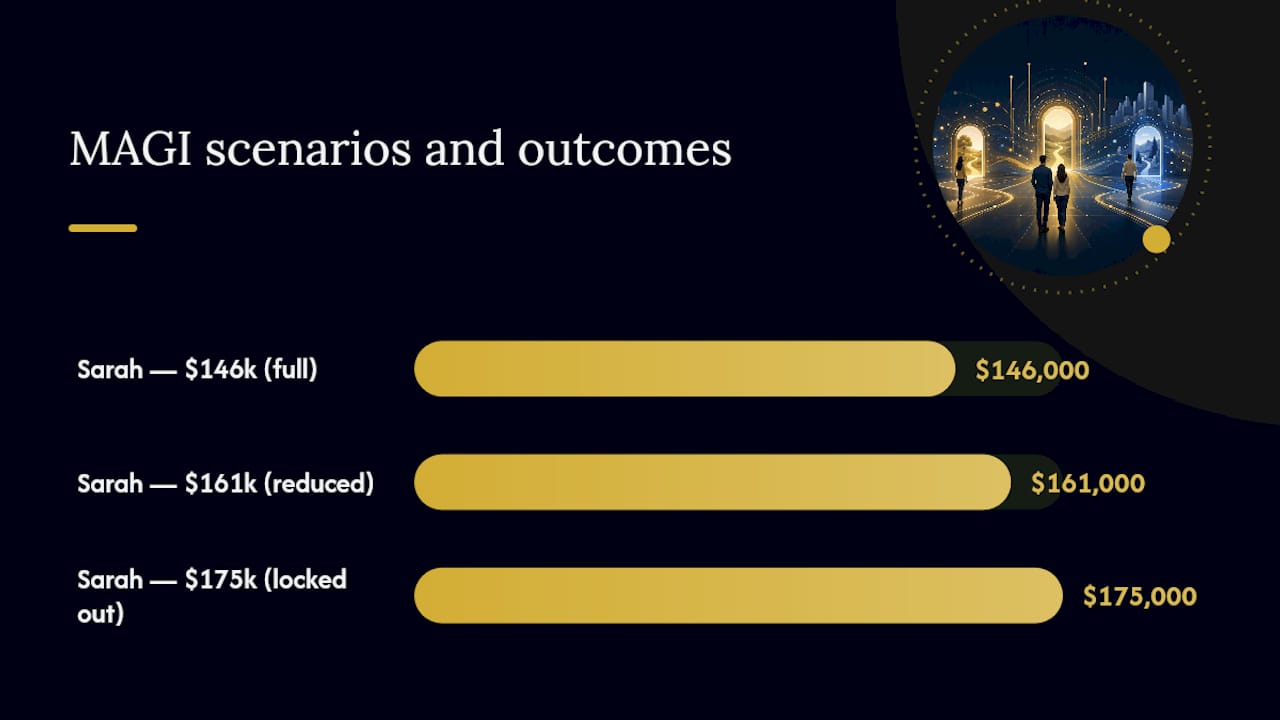
Worked example: Sarah is single, has an AGI of $145,000, and claimed $1,000 in student loan interest. Her MAGI is $146,000, comfortably under the $153,000 floor for 2026, so she can contribute the full $7,500. Now imagine her AGI was $160,000 instead. Her MAGI of $161,000 lands inside the $153,000–$168,000 phase-out band, meaning she gets a reduced contribution. At $175,000 AGI, she’s above the ceiling entirely and locked out of direct contributions.
Pro Tip: Pull last year’s return and estimate this year’s MAGI in October or November, not April. That gives you time to adjust 401(k) contributions or itemize deductions before the phase-out catches you off guard.
Roth IRA Contribution Limits and Catch-Up Amounts for 2025 and 2026
The dollar cap on Roth contributions moved for the first time in three years. Here’s what applies to each tax year:
- 2025: $7,000 if you’re under 50; $8,000 if you’re 50 or older (a $1,000 catch-up).
- 2026: $7,500 if you’re under 50; $8,600 if you’re 50 or older (a $1,100 catch-up).
The larger catch-up amount reflects a SECURE 2.0 provision that now indexes the IRA catch-up contribution to inflation, which is why it grew faster than the base limit this year.
One rule trips up more people than the phase-out math: the $7,500 (or $8,600) limit is a combined cap across every traditional and Roth IRA you own, not a separate allowance for each account. Split $4,000 into a traditional IRA and $3,500 into a Roth, and you’ve used your full 2026 limit. The IRS also caps your contribution at 100% of earned income if you earned less than the annual limit. You have until the federal tax filing deadline, typically mid-April of the following year, to make a contribution for a given tax year.
How Does the Phase-Out Range Reduce Your Contribution?
The IRS doesn’t just cut you off at the top of the range. It reduces your allowed contribution on a sliding formula, and the math is straightforward once you’ve done it once.
- Subtract the phase-out floor from your MAGI (MAGI minus $153,000 for single filers in 2026, or $242,000 for married joint filers).
- Divide that result by the width of the range ($15,000 for single/HOH, $10,000 for married filing jointly).
- Multiply that fraction by your contribution limit ($7,500 or $8,600).
- Subtract that number from your full contribution limit to get your reduced amount.
- Round up to the nearest $10, per IRS rules; if the result is under $200, you can still contribute $200.
Example 1, single filer: MAGI of $160,000 in 2026. $160,000 minus $153,000 equals $7,000. Divide by $15,000, giving 0.467. Multiply by $7,500, giving $3,500. Subtract from $7,500, leaving a reduced limit of about $4,000.
Example 2, married filing jointly: Combined MAGI of $247,000 in 2026. $247,000 minus $242,000 equals $5,000. Divide by $10,000, giving 0.5. Multiply by $7,500, giving $3,750. Subtract from $7,500, leaving a reduced limit of about $3,750 per spouse (each spouse’s contribution is separately capped and separately calculated).

Pro Tip: Don’t trust mental math on this one. Fidelity’s Roth IRA calculator and the IRS Worksheet 2-2 in Publication 590-A both handle the rounding automatically, and a $50 miscalculation can turn into an excess-contribution headache later.
What Are Your Options if Your Income Is Too High?
Earning your way out of direct Roth eligibility doesn’t lock you out of Roth accounts entirely. It just changes the route you take to get money in.
- Backdoor Roth conversion. Contribute to a traditional IRA (which has no income limit for nondeductible contributions), then convert those funds to a Roth IRA shortly after. You’ll owe tax on any earnings between contribution and conversion, but the contribution itself, if nondeductible, isn’t taxed again.
- Roth conversions from other accounts. Unlike direct contributions, conversions from a traditional IRA or old 401(k) have no MAGI limit. You’ll pay ordinary income tax on the converted amount, so timing conversions in lower-income years matters.
- Spousal IRA. If one spouse doesn’t work, the working spouse’s income can fund a Roth IRA in the nonworking spouse’s name, as long as combined MAGI still falls under the married filing jointly threshold.
- Max out employer plans first. A 401(k) or 403(b) has no income limit and a much higher contribution cap, making it the default overflow option for high earners already phased out of Roth.
The backdoor strategy works cleanly only if you have no other pretax traditional IRA balances. If you do, the pro-rata rule forces you to treat the conversion as partly pretax and partly after-tax, which can trigger an unexpected tax bill on the whole rollover.
Anyone weighing traditional IRA assets against alternatives, including physical metals held inside a self-directed IRA, should understand this pro-rata exposure before opening a new traditional account for backdoor purposes.
What Happens If You Overcontribute to a Roth IRA?
Contribute more than your allowed limit, whether from a math error or a late-year raise you didn’t account for, and the IRS applies a 6% excise tax on the excess amount for every year it stays in the account, per Publication 590-A. That tax repeats annually until you fix it, so a $2,000 excess contribution left alone for three years costs $360 in cumulative penalties.
Correction options, in order of preference:
- Withdraw the excess plus any earnings before your tax filing deadline (including extensions). Done correctly, this avoids the 6% tax entirely.
- Recharacterize the excess as a traditional IRA contribution, where eligibility rules allow it.
- Apply the excess to next year’s contribution limit if you missed the withdrawal deadline, though you’ll still owe the 6% tax for the year(s) it sat uncorrected.
Example: You contributed $7,500 for 2026 but your MAGI phase-out only allowed $4,000. The $3,500 excess, if left in the account past the deadline, triggers a $210 excise tax. Pull it out with earnings before you file, and you owe nothing extra.
How to Open a Roth IRA and Make a Contribution
Opening an account takes less time than most people expect, especially through large custodians like Fidelity or Vanguard.
- Choose a custodian and open a Roth IRA account online.
- Confirm you have earned income for the year (wages, self-employment income, not investment income).
- Calculate your MAGI using your most recent pay stubs or tax return.
- Set your contribution amount based on your phase-out status.
- Select investments inside the account.
- Schedule the transfer, either as a lump sum or recurring deposits.
- Deadline: contributions for a given tax year are due by the federal filing deadline the following April, extensions don’t apply to IRA contributions.
- Keep your contribution confirmation and Form 5498 from your custodian for your tax records.
How Progressive Planner Thinks About Roths and Retirement Strategy
A Roth earns its place in a retirement plan when you expect your tax rate to be higher in retirement than it is now, or when you simply want a pool of tax-free income to offset required distributions from other accounts. That’s real tax diversification, and it’s worth pursuing up to the limits above.
But a Roth is one tool, not the whole toolbox. For clients who are already phased out of direct contributions, or who want downside protection that a market-based Roth account can’t offer, we often walk through the Dual Purpose Retirement Strategy™, which uses Indexed Universal Life policies to generate two tax-advantaged income streams from the same savings. It’s not a replacement for maxing out what you’re eligible for. It’s what comes next once you’ve hit the ceiling.
A Second Path When You’ve Outgrown Roth Limits
If your income has climbed past the Roth phase-out ceiling, you’re not stuck with just a backdoor conversion or a traditional 401(k). Progressiveplanner’s Dual Purpose Retirement Strategy™ takes the same retirement dollars and puts them to work twice, generating two tax-advantaged income streams instead of one, without the MAGI restrictions that box out high earners from direct Roth contributions.

This approach uses Indexed Universal Life policies to build cash value with downside protection built in, so a market downturn in the years before retirement doesn’t wreck your income plan the way it can with a portfolio tied purely to the market. It tends to fit best for high-income earners already phased out of Roth eligibility, and for people within a decade of retirement who want more certainty in their projected income. If that sounds like where you are, the next step is a free retirement income review at Progressiveplanner, where you can see how the Dual Purpose Retirement Strategy™ compares against your current 401(k) or IRA projections.
Frequently Asked Questions
What is the Roth IRA income limit for 2026? Single filers phase out between $153,000 and $168,000 in MAGI; married couples filing jointly phase out between $242,000 and $252,000.
Can I still contribute to a Roth IRA if I’m over the income limit? Not directly, but a backdoor Roth conversion remains legal for any income level, subject to the pro-rata rule if you hold other pretax IRA funds.
How much can I contribute to a Roth IRA in 2026? Up to $7,500 if you’re under 50, or $8,600 if you’re 50 or older, assuming your MAGI is under the phase-out floor.
Does contributing to a 401(k) affect my Roth IRA income limit? No. Your Roth MAGI is based on your tax return income, not your account balances, though 401(k) contributions can lower your AGI and therefore your MAGI.
What happens if I contribute too much to my Roth IRA? You owe a 6% excise tax annually on the excess amount until you withdraw it and any earnings, or apply it to a future year’s contribution.
This article is general information, not a substitute for advice from a qualified financial advisor. Consult a qualified financial professional about your own circumstances before acting on anything here.
Sources
- 401(k) limit increases to $24,500 for 2026, IRA limit increases to $7,500 | Internal Revenue Service
- Roth IRA income limits for 2026 | Fidelity
- Roth IRA income limits | Vanguard