
IUL Cap Rates: What Limits Your Cash-Value Growth

An IUL cap rate is the maximum interest an indexed universal life policy can credit in a given period. It directly limits your cash-value upside even when the index it tracks posts a much bigger gain. If the S&P 500 climbs 20% but your cap is 10%, your policy credits 10%. Nothing more.
- Typical 2026 new-issue ranges: roughly 8% to 13% on one-year S&P 500 point-to-point strategies, depending on carrier.
- Caps are usually non-guaranteed and can move at renewal; the floor, often 0%, is the part that’s typically locked in by contract.
Pro Tip: Ask any carrier for their renewal cap history going back at least ten years before you sign anything. A single current cap tells you almost nothing about where that number is headed.
Key Takeaways
IUL cap rates cap your credited interest regardless of index performance, and because caps typically drift lower over time, any retirement plan built on today’s cap alone understates real long-term risk.
| Point | Details |
|---|---|
| Cap defines your ceiling | Credited interest never exceeds the cap, even if the linked index gains far more. |
| Floor is usually guaranteed | A 0% floor is typically contractual; the cap itself is usually not. |
| Current ranges run 8% to 13% | New-issue S&P 500 point-to-point caps commonly fall in this range in 2026. |
| Caps compress over decades | A 150 basis-point drop in credited rate can cut 25-year accumulation by roughly 30%. |
| Progressiveplanner stress-tests caps | Its Dual Purpose Retirement Strategy™ models conservative, cap-compressed scenarios before projecting income. |
Table of Contents
- What Is an IUL Cap Rate, Exactly?
- How Do Cap, Participation, and Floor Work Together?
- Why Do Carriers Change Cap Rates Over Time?
- What Cap Rates Are Common Right Now?
- How Much Does a Lower Cap Actually Cost You Over 30 Years?
- What Should You Ask an Agent Before Buying an IUL?
- How Progressiveplanner Uses Cap Mechanics in Retirement Planning
- Why Cap Behavior Deserves More Attention Than It Gets
- Get a Modeled Review of Your IUL Cap Assumptions
- Frequently Asked Questions
- Sources
What Is an IUL Cap Rate, Exactly?
The cap rate is the ceiling on credited interest. The participation rate determines how much of the index’s move counts toward your credit (100% participation with a 10% cap means you get up to that 10%, no more). A spread, used by some products instead of a cap, is a flat percentage subtracted from the index return before crediting.
Here’s a simple example: the S&P 500 returns 18% in a year. Your policy has a 10% cap. You get credited 10%, not 18%.
- The floor is usually guaranteed in the contract.
- The cap is “current,” meaning the carrier declares it, and can change.
- Never confuse the illustrated cap on your policy proposal with a locked-in promise.
How Do Cap, Participation, and Floor Work Together?
Every crediting calculation runs through a mix of four levers: the cap, the participation rate, the spread (if used), and the floor. Carriers combine these differently depending on the index strategy on a given rider.
- Capped strategies offer predictability but hard ceilings.
- Participation/spread strategies can outperform in strong years but carry more variability.
- Some carriers blend both across multiple index accounts within the same policy.
The trade-off is straightforward: a capped account trades some upside for a simpler, more predictable ceiling, while an uncapped participation strategy trades that predictability for a shot at higher credits in strong years, at the cost of a spread that eats into modest ones.
Why Do Carriers Change Cap Rates Over Time?
Carriers fund index crediting by buying options tied to the index, not by holding equities outright, which means dividends never factor into your credited return. When option costs rise, or when interest rates in the general account shift, insurers adjust the caps they can afford to offer.
Caps are typically declared fresh each crediting period. New-issue caps (what’s quoted to a brand-new applicant) and in-force caps (what existing policyholders actually get renewed at) frequently diverge.
- Ask for the carrier’s renewal cap history in writing, not verbally.
- Ask specifically which elements are contractually guaranteed versus merely “current.”
- Request the same documentation for any comparable product you’re considering.
Pro Tip: A carrier that won’t produce a written renewal history is telling you something. Legitimate carriers publish this data, and resources like Advisor Share’s renewal cap download track it across the top 18 carriers.
What Cap Rates Are Common Right Now?
Competitive new-issue caps in 2026 generally run 8% to 13% on annual point-to-point S&P 500 strategies, with many carriers clustering around 8% to 12%. Contractual minimum caps usually set a guaranteed floor below which a carrier cannot drop the cap at renewal, though exact percentages vary by policy.
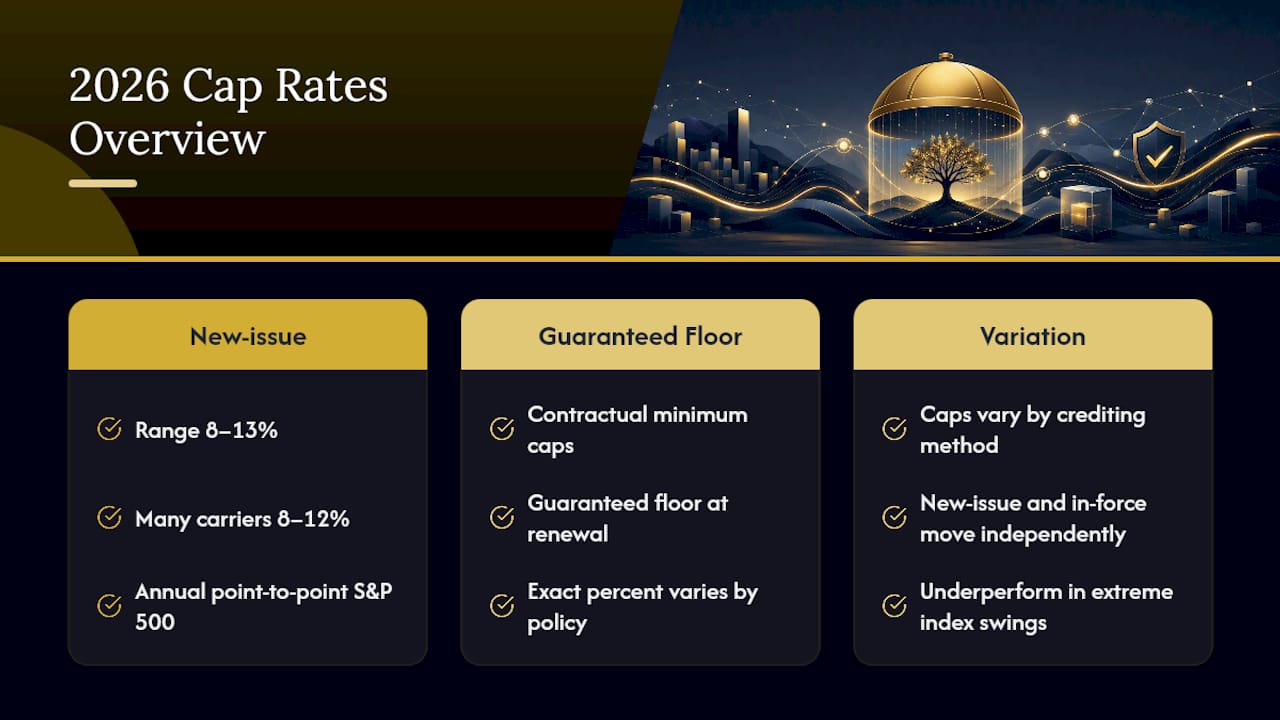
They can shine in moderate-growth years but underperform a simple capped account when index swings are extreme in either direction.
Don’t assume the cap quoted to you today survives the life of your policy. New-issue and in-force caps move independently, and caps vary by index crediting method within the same product line.
How Much Does a Lower Cap Actually Cost You Over 30 Years?
Small cap differences compound into large gaps. Consider $100,000 in cash value credited annually over 25 years:
- At a steady 7% average credited rate, that balance grows to roughly $543,000.
- At 5.5%, it grows to roughly $378,000, a difference of about 30% in accumulated value from a gap of just 150 basis points.
That’s the mechanism behind what’s often called cap compression: caps drift down gradually on in-force blocks as insurers manage option budgets and long-term liabilities, and small annual reductions stack up over decades.
One more thing worth knowing: illustrated rates are constrained by regulation. Actuarial Guideline AG 49-B limits how optimistic an illustration can look, and new-issue caps industry-wide have fallen from roughly 12% to 13% in 2019 to about 8% to 12% today. Even a compliant illustration can still smooth over real structural differences between products, so treat any single-scenario projection as a best case, not a forecast.
What Should You Ask an Agent Before Buying an IUL?
Bring a checklist, not just questions off the top of your head.
- Current new-issue cap on every index strategy offered.
- Ten-year (or longer) renewal cap history for that specific product.
- What is contractually guaranteed (usually the floor and a minimum cap) versus what is merely current.
- Available index crediting options and how spread or participation math actually applies.
- An illustration showing a stress-tested scenario at a reduced cap, not just today’s rate.
Ask directly: “What was this exact product’s cap five years ago, and what is it today?” A vague answer, or a refusal to provide it in writing, is a red flag. So is any illustration relying on rates above what current regulatory guidance would support without documented justification.
Pro Tip: If an agent only guarantees the floor and can’t produce cap history, ask why. That gap is exactly where unrealistic projections hide.
How Progressiveplanner Uses Cap Mechanics in Retirement Planning
Progressiveplanner’s Dual Purpose Retirement Strategy™ uses IUL cash-value growth alongside its downside protection to build two tax-advantaged income streams from the same dollar of savings. That only works if the underlying cap assumptions are realistic.
- We model cap sensitivity scenarios, not just a single optimistic projection.
- We request carrier renewal cap history before recommending a product.
- We build plan assumptions around conservative, stress-tested crediting rates.
A retirement plan built on today’s best-case cap is a plan built on sand. The real work is testing what happens if that cap drifts lower for twenty years, and building income projections that still hold up.
Why Cap Behavior Deserves More Attention Than It Gets
Most people research the death benefit and skip past the cap footnote. That’s backward. Caps drift, often quietly, and a plan built on this year’s number without stress-testing for compression is optimistic by design, not by accident. Treat every illustrated cap as a starting assumption, never a promise.

Get a Modeled Review of Your IUL Cap Assumptions
Most retirement calculators run one scenario and call it a plan. Progressiveplanner does the opposite: we build your projections around cap uncertainty from the start, not as an afterthought.

A retirement income review models your Dual Purpose Retirement Strategy™ plan under multiple cap scenarios, including reduced credited rates over time, so your projected income isn’t resting on a single best-case number. We document every assumption in writing, including which elements are guaranteed and which are current, so you know exactly what you’re planning around before you commit. Understanding the insurer economics behind option costs and hedging, covered well in resources like this interest coverage ratio guide, helps explain why caps move the way they do. If you already hold a 401(k), IRA, or similar account and want to see how cap compression would affect a Dual Purpose plan, request a modeled retirement income review and get a written breakdown of your options.
Frequently Asked Questions
What is a good average return to expect from an IUL policy? There’s no single “good” number since credited returns depend on the specific cap, floor, and index strategy chosen, but returns are generally bounded by a cap around 8% to 12% and protected by a 0% floor. Historical index performance above the cap doesn’t pass through to you.
What are the downsides of IUL cap rates? The main downside is that caps limit your upside precisely in the years the index performs best, and caps can decline at renewal, which is why in-force caps often drift lower than new-issue quotes suggest over the life of a policy.
How much does an IUL policy typically cost? Cost varies heavily by age, gender, health, and coverage amount. MoneyGeek’s analysis of quotes for $500,000 of coverage shows an average monthly premium of $335 for a 40-year-old woman and $408 for a 40-year-old man, though your own quote will differ based on underwriting.
Can an IUL cap rate change after I buy the policy? Yes. Carriers typically declare caps each crediting period, and they can adjust the cap on your in-force policy at renewal, though not below the contractual minimum cap stated in your policy.
This article is general information, not a substitute for advice from a qualified financial advisor. Consult a qualified financial professional about your own circumstances before acting on anything here.
Sources
- Complete Guide to Indexed Universal Life Insurance (IUL)
- Indexed Universal Life Real Returns vs Illustrations: What IUL Actually Delivers in 2026 - Real Cost Report
Always request a carrier’s written renewal cap history and full policy illustration before comparing products.