
Asset Location Strategy: Boost Your After-Tax Returns

A smart asset location strategy places your least tax-efficient holdings, such as taxable bonds, REITs, and high-turnover active funds, inside tax-advantaged accounts, while keeping tax-efficient index funds and growth equities in taxable or Roth accounts. That single discipline can add up to 0.3% in annual after-tax returns for well-diversified investors, according to Vanguard simulations. It sounds modest, but compounded over 20 or 30 years, it becomes real money.
The bottom line, before you read another word:
- Allocation first, location second. Never distort your target stock/bond mix just to chase a tax placement win.
- Who benefits most: investors with meaningful balances in both taxable and tax-advantaged accounts, a long time horizon, and a mixed allocation that includes bonds or income-generating assets.
- Immediate action: look at where your next contribution is going and whether it is landing in the right account type for the asset class you are buying.
Key Takeaways
Asset location strategy adds the most after-tax value when you hold a balanced allocation, maintain meaningful balances in both taxable and tax-advantaged accounts, and give the strategy a long time horizon to compound.
| Point | Details |
|---|---|
| Allocation comes first | Never distort your target stock/bond mix to chase a tax placement win. |
| Bonds belong in tax-deferred accounts | Sheltering ordinary income from bonds in a Traditional IRA or 401(k) is the highest-priority location move for most investors. |
| Up to 0.3% annual benefit | Vanguard simulations show asset location can add up to 0.3% per year in after-tax returns for well-diversified investors. |
| Contribution sequencing beats selling | Use new contributions to improve location; avoid triggering capital gains just to reposition existing holdings. |
| Progressiveplanner adds a tax-free income stream | The Dual Purpose Retirement Strategy™ creates a second tax-free bucket via an IUL policy, giving retirees more flexibility to manage bracket exposure and RMDs. |
Table of Contents
- What asset location strategy is and how your accounts are taxed
- How much asset location can actually change your returns
- Rules of thumb for placing common asset classes
- How to implement asset location across your accounts
- Trade-offs and mistakes that can erase the benefit
- A worked example showing the real numbers
- When asset location probably is not worth the effort
- Next steps and when to bring in a professional
- How Progressiveplanner views asset location within retirement strategy
- See how Progressiveplanner can model your after-tax retirement income
- Sources
What asset location strategy is and how your accounts are taxed
Asset location and asset allocation are related but distinct decisions. Asset allocation answers how much of your portfolio goes into stocks, bonds, real estate, and cash. Asset location answers which account holds each of those pieces. You can have a perfectly calibrated 60/40 portfolio and still leave thousands of dollars in unnecessary taxes on the table by putting the wrong assets in the wrong accounts.
Asset location complements asset allocation by adding a second lever: tax diversification. Think of it as sorting your holdings across three tax buckets.
Tax-now (taxable brokerage accounts). You pay taxes on dividends and interest each year, and capital gains taxes when you sell. Unrealized gains grow tax-deferred until sale, and you get a stepped-up cost basis at death.
Tax-later (Traditional 401(k) and Traditional IRA). Contributions reduce taxable income today. IRS rules under 26 U.S. Code § 408 govern contribution limits, deductibility, and required minimum distributions (RMDs), which begin at age 73 under current law.
Tax-free (Roth IRA and Roth 401(k)). Contributions come from after-tax dollars, but qualified withdrawals, including all growth, are completely tax-free. No RMDs apply to Roth IRAs during the owner’s lifetime, which makes them especially powerful for long-horizon growth assets.
HSA (Health Savings Account). The triple tax advantage, pre-tax contributions, tax-free growth, and tax-free withdrawals for qualified medical expenses, makes the HSA arguably the most tax-efficient account available. Invested HSA funds that are not needed for near-term medical costs can function like a stealth Roth IRA for healthcare expenses in retirement.
529 plans follow a similar tax-free growth model for education expenses and are worth noting for completeness, though they sit outside most retirement location decisions.
A few tax terms that drive every location decision: ordinary income is taxed at your marginal bracket rate; qualified dividends and long-term capital gains get preferential rates; tax-loss harvesting lets you realize losses in a taxable account to offset gains; basis determines your taxable gain on sale; and RMDs force withdrawals from pre-tax accounts starting at age 73, which can push retirees into higher brackets if those accounts hold too much.
How much asset location can actually change your returns
The benefit is real but not unlimited. Vanguard’s research frames asset location as a complementary strategy to allocation, one that adds modest, persistent after-tax gains under realistic assumptions. The conditions that maximize the benefit are a balanced allocation (meaningful exposure to both equities and bonds), roughly comparable balances across taxable and tax-advantaged accounts, and a long time horizon.
Statistic: Vanguard simulations show asset location can add up to 0.3% per year in after-tax returns for certain well-diversified investors. The FPA’s difference-location framework found average after-tax gains of roughly 20 basis points per year versus pro-rata placement across their modeled scenarios.
What drives the size of the benefit? Four factors dominate.
Marginal tax rate. The higher your bracket, the more you save by sheltering ordinary income from bonds or REITs inside a tax-deferred account.
The benefit scales with how much you can actually move around.
Time horizon. Compounding amplifies small annual differences.
Asset tax efficiency. A total stock market index fund that distributes mostly qualified dividends and rarely turns over is already fairly tax-efficient in a taxable account. A high-yield bond fund that throws off ordinary income every month is not. The wider the gap in tax efficiency between your asset classes, the more location decisions matter.
Rules of thumb for placing common asset classes
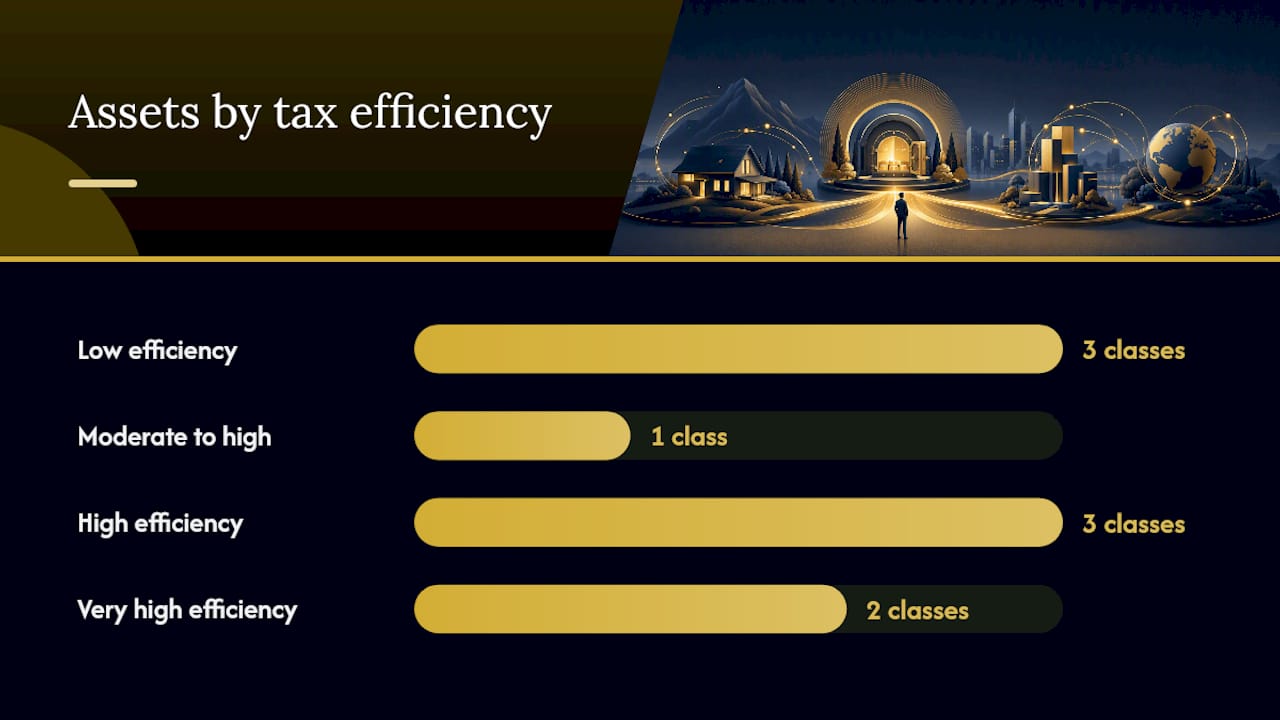
The core principle: place your least tax-efficient assets in tax-advantaged accounts first, and let tax-efficient assets occupy taxable space. Bogleheads’ tax-efficient fund placement guidance and the academic model from UT Dallas both converge on the same general hierarchy, with bonds in tax-deferred and equity in taxable being optimal under many realistic assumptions.
| Asset Class | Primary Tax Type | Tax Efficiency | Preferred Location |
|---|---|---|---|
| Taxable bonds (core, high-yield) | Ordinary income | Low | Tax-deferred (Traditional 401k/IRA) |
| REITs | Ordinary income (non-qualified dividends) | Low | Tax-deferred or Roth |
| High-turnover active equity funds | Short-term capital gains + ordinary income | Low | Tax-deferred |
| Municipal bonds | Tax-exempt interest | High (for high brackets) | Taxable account |
| U.S. equity index funds (total market, S&P 500) | Qualified dividends + long-term gains | High | Taxable account |
| Tax-managed or low-turnover ETFs | Qualified dividends + long-term gains | Very high | Taxable account |
| International equity funds | Qualified dividends + foreign tax credit | Moderate to high | Taxable (to claim foreign tax credit) |
| Growth equities (no dividends) | Long-term capital gains only | Very high | Taxable or Roth |
| High-growth assets (small-cap, aggressive equity) | Long-term capital gains | High | Roth (maximize tax-free compounding) |
A few placement notes worth calling out:
Municipal bonds flip the usual logic. Their interest is already exempt from federal tax, so holding them inside a tax-deferred account wastes the shelter. They belong in taxable accounts, but only when your marginal rate is high enough that the after-tax yield beats a comparable taxable bond. At lower brackets, a taxable bond fund in a tax-deferred account often wins on yield.
International equity funds carry a foreign tax credit you can only claim if the fund is held in a taxable account.
REITs distribute most of their income as non-qualified dividends taxed at ordinary rates, which makes them a strong candidate for tax-deferred or Roth accounts. Roth is especially attractive for REITs if you expect them to compound significantly over time.
Pro Tip: A high-turnover active fund with a short-term capital gains distribution history belongs in a tax-deferred account even if it holds equities. The asset class label matters less than the actual tax drag. Check the fund’s annual distribution history before deciding where to hold it.
How to implement asset location across your accounts
Set your overall asset allocation first. Location is a refinement layer, not a starting point. If you try to optimize placement before knowing your target mix, you will end up with a portfolio shaped by tax convenience rather than your actual risk tolerance and goals.
Once your allocation is set, work through these steps:
-
List every account and its tax category. Write down each account (taxable brokerage, Traditional IRA, Roth IRA, 401(k), HSA), its current balance, and whether it is tax-now, tax-later, or tax-free.
-
Calculate your combined allocation across all accounts. Add up all equity and bond holdings regardless of which account holds them. This is your true portfolio allocation, and it must match your target before you do anything else.
-
Rank your asset classes by tax inefficiency. Use the table above as a starting point. Taxable bonds and REITs go to the top of the “shelter first” list; broad index ETFs go to the bottom.
-
Fill tax-advantaged space with your highest-priority assets. Start with your tax-deferred accounts (Traditional 401(k) and IRA) and load them with your most tax-inefficient holdings. If you have Roth space, prioritize high-growth assets there, since those gains will never be taxed.
-
Place remaining assets in taxable accounts. Whatever does not fit in tax-advantaged accounts lands in taxable. Favor index funds, tax-managed ETFs, and municipal bonds here.
-
Apply next-dollar rules going forward. When you make a new contribution, direct it to the account type that needs the asset class you are buying. This is often more practical than selling and repurchasing across accounts.
-
Rebalance tax-efficiently. Use new contributions to rebalance first. When you must sell, prefer selling in tax-advantaged accounts where there is no immediate tax consequence. In taxable accounts, pair gains with harvested losses where possible.
Timeline for review:
- Next contribution: apply next-dollar placement rules immediately.
- Quarterly: check whether drift has pushed any account significantly off target allocation; rebalance using contributions before triggering sales.
- Annually or after a life-stage change: review the full account inventory, update for new contribution limits (the IRS adjusts 401(k) and IRA limits periodically), and reassess whether your marginal tax rate has shifted.
Pro Tip: Tax-loss harvesting and across-account rebalancing work well together. If your taxable account holds a bond fund sitting at a loss, harvest that loss and simultaneously buy the equivalent in your IRA. You maintain your allocation, capture the loss, and improve location in one move. Just watch the wash-sale rule: avoid buying a substantially identical security in any account within 30 days before or after the sale.
Trade-offs and mistakes that can erase the benefit
The gains from optimal asset placement are real but fragile. Small errors can wipe out years of tax savings.
The biggest mistake: sacrificing allocation for location. If your tax-deferred account does not have a good bond fund option (high fees, limited choices), do not stuff it with bonds anyway just to hit the “correct” location. A high-fee bond fund in the right account can cost more than a low-cost bond fund in the wrong one. Vanguard’s research is explicit on this point: deviating from your target allocation to chase marginal tax gains is a common and costly error.
Other mistakes worth watching for:
- Triggering large capital gains to reposition assets. Selling a taxable account position with a large embedded gain just to move it to a better location can cost more in taxes than years of location benefit would recover. Use contribution sequencing instead, as Bogleheads guidance recommends.
- Ignoring state taxes. Federal tax rates drive most location analysis, but state income taxes can shift the math significantly. A state with no income tax reduces the value of tax-deferred sheltering; a high-tax state like California or New York amplifies it. If you move states, revisit your location plan.
- Neglecting RMD pressure. A large Traditional IRA or 401(k) balance will generate mandatory taxable income starting at age 73. Holding all your growth assets in pre-tax accounts can create an RMD problem in retirement that pushes you into higher brackets and increases Social Security taxation.
- Ignoring multiple taxable accounts with different cost bases. If you hold the same fund in two taxable accounts with very different cost bases, selling from the wrong one can trigger unnecessary gains. Track lot-level cost basis carefully.
- Chasing location in a short-horizon account. If you plan to spend the money in five years or fewer, the compounding math that makes location valuable simply does not have time to work.
Red flags that suggest you should pause before acting:
- Moving an asset would trigger a capital gain large enough to take years of location benefit to recover.
- Your taxable account balance is less than 10%–15% of your total portfolio, leaving little room for location decisions to matter.
- Your 401(k) plan has limited, high-cost fund options that make the “right” asset class expensive to hold there.
A worked example showing the real numbers
Over a 25-year horizon, placing bonds in a tax-deferred account instead of a taxable account can produce meaningfully more after-tax wealth, even with conservative assumptions.
Illustrative scenario (assumptions clearly labeled):
- Total portfolio: $500,000 split evenly between a taxable brokerage account and a Traditional IRA ($250,000 each).
- Target allocation: 60% U.S. equity index fund, 40% taxable bond fund.
- Expected annual returns: equity 7%, bonds 4% (pre-tax, illustrative only).
- Marginal federal tax rate: 32% on ordinary income; 15% on qualified dividends and long-term capital gains.
- Time horizon: 25 years.
Scenario A (poor location): Bonds held in taxable, equity held in IRA.
Scenario B (optimal location): Bonds held in IRA, equity held in taxable. The equity’s effective annual tax drag is substantially lower than the bond fund’s ordinary income drag.
The FPA’s difference-location framework found this type of repositioning produces average after-tax gains of roughly 20 basis points per year in modeled scenarios. Applied to $500,000 over 25 years, even 20 basis points annually compounds to a meaningful gap in end wealth. Vanguard’s simulations put the ceiling at 0.3% per year for well-diversified investors under favorable conditions.
The academic model from UT Dallas reaches the same directional conclusion: bonds in tax-deferred and equity in taxable is optimal under many realistic parameter sets, with exceptions when funds are highly tax-inefficient or when borrowing constraints apply.
Key research takeaways:
- Vanguard: up to 0.3% annual benefit, greatest when allocations and account balances are balanced and time horizon is long.
- FPA: roughly 20 basis points per year on average using the difference-location approach versus pro-rata placement.
- Academic models: bonds-in-tax-deferred, equity-in-taxable is the dominant result, with noted exceptions for highly tax-inefficient equity funds.
When asset location probably is not worth the effort
Not every investor benefits from a detailed location plan. The math only works when there is enough variation across account types and enough time for compounding to amplify the annual difference.
Skip the complexity if your situation matches any of these:
- Nearly all your savings are in pre-tax accounts. If your only accounts are a Traditional 401(k) and a small taxable brokerage, there is almost no room to optimize placement. The priority should be opening and funding a Roth IRA or HSA first.
- Your taxable account holds mostly cash or very short-term positions. Location decisions matter for long-held, income-generating assets. A taxable account used for near-term spending does not benefit from location planning.
- Your investment horizon is under ten years. The compounding effect of 20 basis points per year takes time to accumulate. A short horizon means the annual benefit never has time to add up to much.
- Moving assets would trigger large capital gains. If repositioning requires selling a taxable position with a large embedded gain, the immediate tax cost can exceed years of location benefit. Contribution sequencing is the better path.
- Your portfolio is nearly all equities. A 90/10 or 100% equity allocation leaves little tax-inefficient income to shelter. The bond or REIT component is what drives most of the location benefit.
- Your marginal tax rate is low. At the 12% or 22% bracket, the spread between ordinary income rates and qualified dividend/capital gains rates narrows considerably. The benefit of sheltering bond income shrinks accordingly.
When account balances are lopsided, the better move is usually to maximize tax-advantaged contributions before worrying about location. Maxing a Roth IRA ($7,000 per year in 2026, $8,000 if you are 50 or older) or a 401(k) ($23,500 in 2026, $31,000 with catch-up contributions) creates the account diversity that makes location decisions possible in the first place.
Next steps and when to bring in a professional
Start with the simple worksheet: list every account, its tax category, its current balance, and what it holds. Then check whether your combined allocation matches your target. If it does not, fix that first. Once allocation is right, apply the placement rules from the table above using new contributions before touching existing positions.
For many investors, that checklist is enough. But a few situations call for professional guidance:
- You expect a large tax cost to reposition existing holdings and want to model whether the long-term benefit justifies it.
- You hold assets across trusts, inherited IRAs, or multiple employer plans with different investment menus.
- You are within ten years of retirement and want a coordinated withdrawal strategy that sequences taxable, tax-deferred, and Roth accounts to manage bracket exposure and RMDs.
- You are considering a strategy that creates additional tax-diversified income streams, such as an IUL-based approach, and want to understand how it interacts with your existing account placement decisions.
- You have moved or plan to move to a different state and need to reassess how state income taxes affect your location plan.
For lifecycle considerations and how location decisions shift across different financial stages, resources like practical financial planning guides can offer useful framing, though U.S.-specific tax rules always govern the mechanics here.
This article is educational and does not constitute tax or investment advice. Consult a qualified tax professional or financial advisor for guidance specific to your situation. For primary rules on IRA taxation and RMDs, refer to IRS Publication 590-B and 26 U.S. Code § 408.
How Progressiveplanner views asset location within retirement strategy
Progressiveplanner treats asset location as a necessary but incomplete piece of retirement planning. Getting the placement right across taxable, tax-deferred, and Roth accounts is worth doing, and the evidence supports it. But placement alone does not solve the deeper problem most pre-retirees face: all their tax-advantaged savings sit in a single pre-tax bucket, which means every dollar they withdraw in retirement is taxed as ordinary income at whatever rate Congress sets at that moment.
That is the gap the Dual Purpose Retirement Strategy™ is designed to address. By incorporating an Indexed Universal Life (IUL) policy alongside existing retirement accounts, the strategy creates a second tax-advantaged income stream from the same savings dollar. The IUL’s cash value grows with downside protection and can be accessed in retirement as tax-free income through policy loans, which does not count as taxable income and does not trigger RMDs. That means a retiree can draw from the IUL in years when pulling from a Traditional IRA would push them into a higher bracket or increase Social Security taxation.

From a location perspective, this matters because the IUL functions as an additional tax-free bucket, complementing a Roth IRA but without the income limits that restrict Roth contributions for higher earners. The interaction with asset location decisions is direct: the more tax-free income sources you have in retirement, the more flexibility you have to let tax-deferred accounts grow, manage RMD exposure, and sequence withdrawals to minimize lifetime tax liability.
Pro Tip: When modeling asset location across accounts, include the IUL’s projected cash value as a tax-free bucket alongside your Roth IRA. Treating it as a third income stream in your withdrawal sequence can reduce the bracket pressure that large RMDs create in your late 70s and beyond.
See how Progressiveplanner can model your after-tax retirement income
Most retirement projections show you one number: what your 401(k) might be worth at 65. Progressiveplanner shows you something more useful, specifically what you can actually spend after taxes, across multiple income streams, in a coordinated withdrawal plan.

A personalized retirement review with Progressiveplanner covers your full account inventory, tax-aware placement suggestions, withdrawal sequencing across taxable and tax-free accounts, and a side-by-side comparison of your current trajectory versus what the Dual Purpose Retirement Strategy™ could produce. The review is built around your numbers, not a generic model.
If you have meaningful balances in pre-tax accounts and want to understand how adding a tax-free income stream could reduce your lifetime tax bill, request your free retirement income review at Progressiveplanner.com. A licensed advisor will walk through the numbers with you and show you exactly where asset location and income diversification can move the needle.
This is general educational content, not personalized tax or investment advice. Results vary based on individual circumstances, tax rates, and product terms.
Sources
The claims in this article draw from primary research, industry guidance, and IRS statutory references. Reading the original papers is worthwhile if you want to understand the modeling assumptions behind the benefit estimates.
- How asset location can boost after-tax returns | Vanguard
- Tax-efficient fund placement | Bogleheads
- Intertemporal asset allocation and location decisions (academic paper) | UTDallas
For detailed modeling assumptions behind the benefit estimates, read the Vanguard research paper and the FPA Journal article in full. The inputs (tax rates, return assumptions, time horizon, account balance ratios) drive the output significantly, and your numbers will differ from the published scenarios.
This article is general information, not a substitute for advice from a qualified financial advisor. Consult a qualified financial professional about your own circumstances before acting on anything here.