
IUL Pros and Cons for Retirement Planning in 2026

An IUL can be a genuinely useful tax-efficient retirement tool for certain high earners with a long time horizon. For everyone else, it tends to be an expensive detour.
Here is the short version before the full breakdown:
- Best for: High earners who have already maxed their 401(k) and IRA, need permanent life insurance coverage, and can commit to funding the policy for at least 10–15 years without touching the cash value early.
- Main downside: Fees are layered and often opaque, caps and participation rates limit how much of any market gain you actually keep, and the break-even point on a well-funded policy typically falls between 7 and 15 years from the start date.
- Minimum time horizon: 10–15 years. Shorter than that and the cost of insurance, surrender charges, and premium loads will likely consume more than the tax advantages deliver.
Two regulatory frameworks shape every IUL policy. The IRS 7-pay test determines whether a policy stays tax-advantaged or gets reclassified as a Modified Endowment Contract (MEC), which permanently changes how distributions are taxed. FINRA classifies IULs as insurance products, not securities, which means the investor protections that apply to brokerage accounts do not apply here. Both distinctions matter before you sign anything.
Key Takeaways
An IUL works best as a supplemental retirement tool for high earners with a 10–15-year horizon who have already maxed simpler tax-advantaged accounts, not as a standalone retirement strategy.
| Point | Details |
|---|---|
| Who benefits most | High earners who have maxed 401(k) and IRA and need permanent coverage with a 15-plus-year horizon. |
| Core advantage | Tax-deferred growth and tax-efficient policy loans can reduce ordinary income tax in retirement with no RMDs. |
| Main drawbacks | Fees (COI, loads, admin, asset charges), caps of 8%–12%, and a break-even window of 7–15 years erode early returns. |
| MEC risk is permanent | Overfunding in years 1–7 triggers MEC status, eliminating the tax-free loan advantage permanently. |
| Progressiveplanner’s approach | The Dual Purpose Retirement Strategy™ layers an IUL alongside existing retirement accounts to create two tax-advantaged income streams from the same savings. |
Table of Contents
- What draws people to IULs in the first place?
- How does an IUL actually credit interest to your policy?
- What are the real benefits of an IUL policy?
- What are the hidden costs and real drawbacks of an IUL?
- How does an IUL work as a Life Insurance Retirement Plan (LIRP)?
- Who is an IUL actually a good fit for?
- What are the simpler alternatives worth considering first?
- What questions should you ask an advisor before buying an IUL?
- How does Progressiveplanner use IULs in the Dual Purpose Retirement Strategy™?
- An honest perspective on when IULs make sense
- The Dual Purpose Retirement Strategy™ could be worth a closer look
- Sources
What draws people to IULs in the first place?
The pitch is genuinely appealing: participate in stock-market-linked gains without the risk of losing principal when the market drops. Add tax-deferred growth, flexible premiums, and a permanent death benefit, and you have a product that sounds like it solves several problems at once.
The core selling points that attract buyers:
- Index-linked upside with a floor: Your credited interest is tied to an index like the S&P 500, but a floor (commonly 0%–1%) means you are not credited a negative return in a down year. You do not own the index directly.
- Tax-deferred cash value growth: Cash value compounds without annual tax drag, similar to a 401(k) but without contribution limits tied to earned income.
- Tax-efficient access via policy loans: Properly structured policy loans are generally not treated as taxable income, which can make them a useful income source in retirement.
- Flexible premiums: Unlike whole life, you can adjust premium payments within limits, which appeals to business owners and earners with variable income.
- Permanent death benefit: Coverage does not expire at 20 or 30 years the way term does, which matters for estate planning and legacy goals.
A common use case: a physician or business owner earning $400,000 annually who has already maxed their 401(k) at the 2026 contribution limit of $23,500 and their IRA, and who wants a third bucket of tax-advantaged accumulation. For that profile, the IUL’s structure can make sense.
The marketing caveat worth knowing upfront: illustrations shown during the sales process typically use declared caps and participation rates at current levels, not guaranteed ones. Those rates can and do change. Investopedia notes that IULs combine index-linked upside with downside protection but that caps and participation rates reduce effective returns compared with direct market investing. The illustration is a projection, not a promise.
How does an IUL actually credit interest to your policy?
Credited interest in an IUL is not the same as owning an index fund. The insurer calculates it through a chain: take the index return, apply the participation rate, apply any cap or crediting method, then apply the floor.
A simple numeric example makes this concrete.
-
Index return: 10%
-
After participation rate (55%): 5.5%
-
Cap check: 5.5% is below the 8% cap, so credited interest = 5.5%
-
Index return: 10%
-
After participation rate (100%): 10%
-
Cap check: 10% exceeds the 6% cap, so credited interest = 6%
The cap is often the binding constraint in strong market years. In flat or modestly positive years, the participation rate matters more.
Common crediting methods you will encounter:
- Annual point-to-point: Compares the index value at the start and end of a 12-month period. Simple and widely used.
- Monthly cap: Credits the lesser of each month’s gain or a monthly cap, then sums 12 months. Can produce lower results in volatile markets.
- Monthly average: Averages the index value across 12 monthly snapshots. Smooths volatility but often captures less upside in a strong trending year.
- Spread/margin method: The insurer subtracts a fixed spread (say, 2%) from the index return before crediting. No separate cap, but the spread functions similarly.
- Declared-rate (fixed) account: A guaranteed declared rate, not index-linked. Useful for stability inside a policy.
One detail that surprises many buyers: IULs track price returns, not total returns. Dividends are excluded from the index calculation, which historically accounts for a meaningful portion of long-run equity returns.
Pro Tip: Before signing, request the insurer’s declared historical credit rates for the specific index account you are considering, broken down by worst, base, and best years. Also ask for the exact crediting method used in your illustration. If the agent cannot produce both, treat that as a red flag.
What are the real benefits of an IUL policy?
The top benefits are market-linked growth with downside protection, tax-deferred accumulation, tax-efficient access via loans, flexible premiums, and a permanent death benefit. Each one has a practical shape worth understanding.
- Downside protection: In a year the index drops 30%, your credited interest is 0% (assuming a 0% floor), not negative. You do not lose cash value due to market performance alone. This is structurally different from a variable universal life policy or a brokerage account.
- Tax-deferred growth: Cash value grows without annual income tax on gains, similar to a traditional IRA but without required minimum distributions (RMDs) at age 73.
- Tax-efficient retirement income: Withdrawals up to your cost basis are generally income-tax-free. Above that, properly structured policy loans can provide income without triggering a taxable event, provided the policy stays in force. This is the mechanism behind the Life Insurance Retirement Plan (LIRP) strategy.
- Flexible premiums: You can increase or reduce premiums within the policy’s parameters, which suits business owners whose cash flow varies year to year.
- Permanent death benefit: The death benefit passes to beneficiaries generally income-tax-free under current federal law, which makes IULs useful for estate planning.
On typical ranges: floors commonly run from zero to a low single-digit percentage and caps often fall in a single-digit to low double-digit percentage range, though both vary by carrier, index account, and market conditions. The insurer can adjust caps and participation rates at renewal, which is a risk most illustrations do not highlight prominently.
| Feature | Typical Range | Notes |
|---|---|---|
| Floor (minimum credited rate) | 0%–1% | Protects against negative index years |
| Cap (maximum credited rate) | 8%–12% | Varies by carrier and account; can change annually |
| Participation rate | 50%–100%+ | Applied before cap; some accounts offer 100%+ with a spread instead |
| Credited returns include dividends? | No | IULs track price return only |

One important distinction for readers comparing IULs to brokerage accounts: SIPC protection covers brokerage assets up to $500,000 in the event of a broker-dealer failure. IUL cash value is not SIPC-protected. It is backed by the insurer’s general account and subject to state insurance guaranty fund limits, which vary by state.
What are the hidden costs and real drawbacks of an IUL?
The combination of fees, caps, and rising cost of insurance typically reduces illustrated growth materially, especially in the early years. This is the part of the IUL conversation that agents sometimes gloss over.
Fee types that reduce your cash value:
- Cost of insurance (COI): Charged monthly to fund the death benefit. Rises with age, which is why underfunded policies can lapse in later years when COI becomes significant.
- Premium load: A percentage deducted from each premium before it enters the policy. Common range is 5%–10% of each dollar paid in.
- Administrative fees: Flat monthly or annual charges for policy maintenance.
- Asset-based charges (M&E fees): A percentage of cash value charged annually, similar in concept to a fund expense ratio.
- Surrender charges: If you exit the policy in the early years (often years 1–10 or longer), a surrender charge reduces the cash value you receive. These can be substantial in the first five years.
- Rider costs: Optional riders (waiver of premium, long-term care, etc.) add additional charges.
A sensitivity example shows why these matter. Assume a 45-year-old pays $20,000 per year into an IUL. The gap is not a rounding error.
Pro Tip: Ask for three illustrations: worst-case (using the guaranteed minimum crediting rate), base-case (current declared rates), and best-case. Then ask for an itemized fee schedule showing COI, premium loads, admin fees, and asset charges separately. If the agent provides only the base-case illustration, that is incomplete.
Investopedia’s analysis of IUL pros and cons confirms that high fees, caps, and complexity are the primary reasons effective returns often trail direct market investing over long periods.
How does an IUL work as a Life Insurance Retirement Plan (LIRP)?
An IUL can deliver tax-efficient retirement income when it is structured correctly, funded consistently, and kept in force for the long term. Those three conditions are harder to meet than they sound.
The mechanics of tax-efficient access follow a specific sequence. First, you withdraw up to your cost basis (total premiums paid), which is generally income-tax-free. After that, you switch to policy loans, which are not taxable income as long as the policy remains in force. The combination can produce a stream of retirement income that does not appear on your tax return, which is the core appeal of the LIRP strategy.
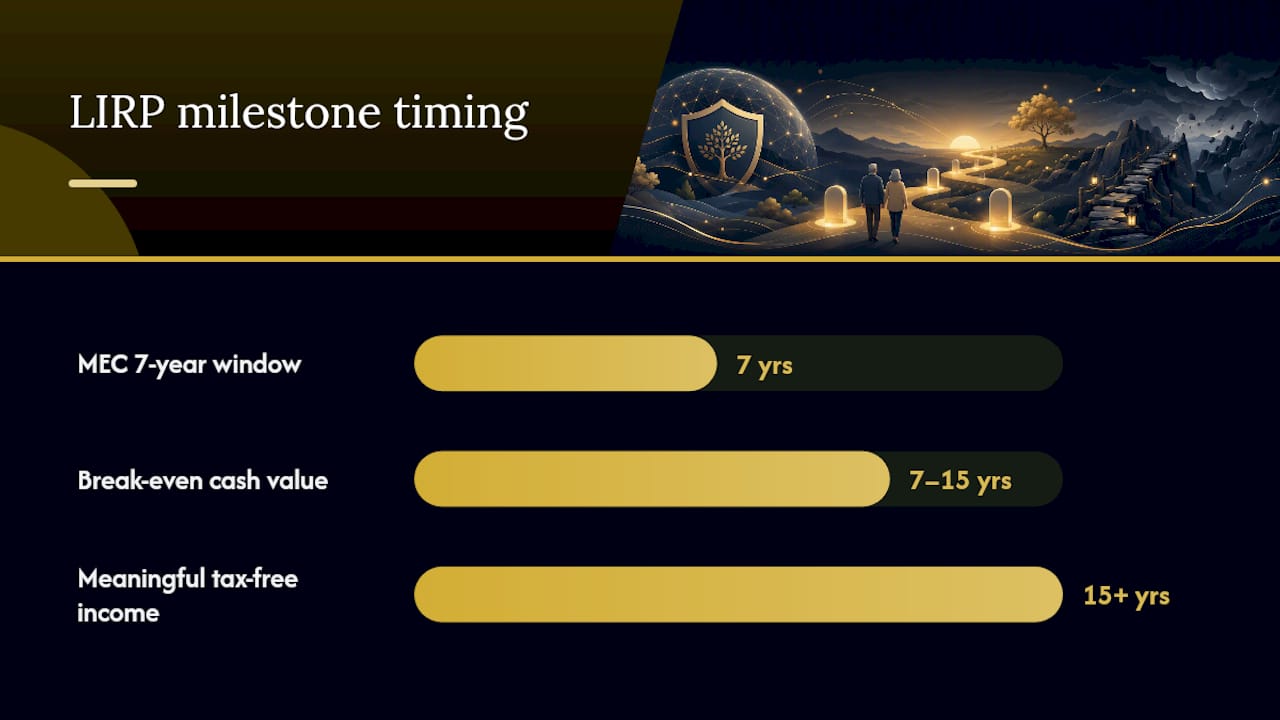
The timeline to meaningful cash value is the part most buyers underestimate. LegalClarity estimates break-even timing at 7–15 years for most LIRP structures, meaning the cash value does not exceed total premiums paid until somewhere in that window. For context, the 2026 401(k) contribution limit is $23,500 ($31,000 for those 50 and older). A saver who has not yet maximized that account is leaving a simpler, lower-cost tax advantage on the table.
| Milestone | Typical Timing |
|---|---|
| Surrender charges expire | Years 7–15 (varies by carrier) |
| Cash value exceeds total premiums paid | Years 7–15 (break-even) |
| Meaningful tax-free income available | Year 15+ |
| 401(k) max contribution (2026) | $23,500/year ($31,000 age 50+) |
The MEC risk is the most consequential tax guardrail. The IRS 7-pay test limits how much premium you can pay into a policy during its first seven years. Exceed that limit and the policy becomes a Modified Endowment Contract. Western & Southern explains that MEC status is permanent: once triggered, all distributions (loans and withdrawals) become subject to income tax and a 10% penalty before age 59½, eliminating the primary tax advantage of the LIRP structure.
Key points on tax access and MEC risk:
- Withdrawals up to cost basis: generally tax-free
- Policy loans above cost basis: not taxable if policy stays in force
- MEC reclassification: permanent, triggered by overfunding in years 1–7
- Policy lapse with outstanding loans: the loan balance becomes taxable income in the year of lapse
This is general information, not individual tax advice. Consult a licensed tax advisor for guidance specific to your situation.
Who is an IUL actually a good fit for?
The typical fit is a high earner who has already maxed employer plans and IRAs, needs permanent life insurance coverage, and can commit to consistent funding for a decade or more. This profile is narrower than most IUL marketing suggests.
Buyer profiles where an IUL tends to make sense:
- The maxed-out saver: A household earning $250,000+ that has fully funded the 401(k), IRA, and HSA and wants a fourth tax-advantaged bucket. The IUL’s lack of IRS contribution limits becomes genuinely useful here.
- The business owner with variable income: Flexible premiums let a business owner fund heavily in good years and reduce premiums in lean ones, within policy limits.
- The estate-planning client: Someone who needs permanent coverage to fund a trust, equalize an inheritance, or provide liquidity for estate taxes. The death benefit’s income-tax-free treatment under current law is the draw.
- The long-horizon planner: Anyone with a 15-plus-year runway before needing income. The longer the horizon, the more time the tax-deferred compounding has to offset the fee drag.
LegalClarity’s guidance reinforces that LIRPs are typically best for high-income earners who have exhausted simpler tax-advantaged accounts. That sequencing matters.
Pro Tip: Always capture your employer’s full 401(k) match first. Then max your IRA. Then consider an HSA if eligible. An IUL makes sense as a next layer, not a replacement for those steps. The tax advantages of an IUL are real, but they do not outweigh leaving free employer-match dollars behind.
What are the simpler alternatives worth considering first?
In many cases, term life insurance plus low-cost index fund investing, or simply maxing employer retirement plans, is a lower-cost path to the same retirement goal. That is not a knock on IULs specifically. It is a sequencing point.
Scenario-based comparisons:
- Young saver (25–40, no permanent coverage need): Term life for coverage, then max 401(k) and Roth IRA. The fee drag and break-even timeline of an IUL rarely justify the complexity at this stage.
- High earner who has maxed all tax-advantaged accounts: This is where an IUL or LIRP starts to compete. The tax-free loan access and no-RMD structure become meaningful advantages that a taxable brokerage account cannot replicate.
- Estate-planning client needing permanent coverage: Whole life offers guaranteed cash value growth and a guaranteed death benefit, with less complexity than an IUL. The tradeoff is lower potential upside and less premium flexibility.
- Aggressive growth seeker comfortable with market risk: A variable universal life (VUL) policy invests in subaccounts similar to mutual funds, offering higher potential returns than an IUL but with actual downside risk. No floor.
On whole life vs. IUL: whole life provides guarantees that an IUL does not. The IUL offers higher potential credited interest and more premium flexibility. Neither is universally better. The right choice depends on whether the buyer values certainty (whole life) or potential upside with some protection (IUL).
Charles Schwab’s guidance on using life insurance for retirement income cautions that many people are better served by employer plans and low-cost index funds before turning to insurance-based income strategies. That perspective is worth weighing.
Ethos also notes that LIRPs can be costly and are often not the best primary vehicle for most savers, particularly those who have not yet maximized simpler options.
One regulatory distinction worth noting: brokerage accounts holding index funds carry SIPC protection up to $500,000 per account in the event of broker-dealer failure. IUL cash value does not. State insurance guaranty funds provide a backstop for insurance products, but coverage limits vary by state and are generally lower.
What questions should you ask an advisor before buying an IUL?
The single most important deliverable from any IUL sales meeting is a complete set of independently modeled cash-flow illustrations covering worst, base, and best crediting scenarios. If you leave without that, you do not have enough information to decide.
Checklist for your advisor meeting:
- Crediting method and historical rates: What specific index account and crediting method does this illustration use? What were the declared credit rates for that account over the past 10–15 years, including the worst years?
- Itemized fee schedule: Show me COI, premium loads, admin fees, and asset-based charges as separate line items, not bundled.
- Break-even year: In which year does cash value first exceed total premiums paid under the base-case illustration?
- MEC/7-pay calculation: What is the maximum annual premium I can pay without triggering MEC status? Show me the 7-pay limit for this policy. The IRS 7-pay test and Western & Southern’s MEC explainer are useful references to understand what you are being shown.
- Surrender schedule: What are the surrender charges in years 1 through 15, and when do they fully expire?
- Loan interest terms: Is the loan interest fixed or variable? Is it charged against the cash value or billed separately? What happens to the policy if the loan balance grows faster than cash value?
- Insurer financial strength: What is the insurer’s AM Best rating? A policy is only as secure as the company backing it.
Pro Tip: Request an independent run of the illustration, or ask for a plain-English cash-flow table showing net cash value after all fees and any outstanding loans, year by year. A trustworthy agent will provide it without hesitation.
FINRA’s investor education resources explain how insurance products differ from securities and what consumer protections do and do not apply. Reading that context before your advisor meeting puts you in a stronger position to ask the right questions.
How does Progressiveplanner use IULs in the Dual Purpose Retirement Strategy™?
Progressiveplanner recommends IULs within the Dual Purpose Retirement Strategy™ specifically for clients who fit the profile: a long time horizon, retirement accounts already maximized, and a genuine need for permanent death benefit coverage. The strategy is built around making the same dollar serve two functions simultaneously.
The core idea is that a properly structured IUL creates a second tax-advantaged income stream alongside a 401(k) or IRA, rather than replacing it. In retirement, the client draws on both: taxable distributions from the 401(k) and tax-efficient policy loans from the IUL. The combination can reduce the effective tax rate on retirement income compared with drawing entirely from pre-tax accounts.
An illustrative comparison (not individualized advice):
- Sequence A: Max employer match, invest in low-cost index funds, retire with a single pre-tax income stream subject to ordinary income tax rates and RMDs beginning at age 73.
- Sequence B (Dual Purpose Strategy): Max employer match, fund 401(k) to the limit, then layer an IUL funded to just below the MEC threshold. In retirement, draw pre-tax income from the 401(k) and tax-efficient loans from the IUL, potentially reducing the portion of income subject to ordinary rates.
The projected income difference depends on individual tax rates, funding amounts, credited interest, and time horizon. Progressiveplanner provides personalized income comparisons through its free retirement-income review process.
Key points about how the strategy works in practice:
- IUL policies are placed through licensed insurance advisors; purchase requires working with a licensed agent.
- The strategy is designed for clients with a 15-plus-year horizon before needing income.
- Illustrations provided are projections, not guarantees. Actual credited interest depends on insurer-declared rates and index performance.
- Personalized advice requires a licensed advisor. The educational content on Progressiveplanner’s site is general information.
Pro Tip: When reviewing a Dual Purpose Strategy illustration, ask to see both income streams modeled side by side, with and without the IUL layer, under the same tax-rate assumptions. That comparison is the clearest way to evaluate whether the added complexity and cost justify the projected income difference for your specific situation.
An honest perspective on when IULs make sense
The IUL conversation tends to go wrong in one of two directions. Either the product gets oversold as a near-magical tax shelter that beats the market without the risk, or it gets dismissed entirely as a fee-laden insurance product that no sophisticated investor should touch. Both framings miss the point.
The cases where I typically see IULs add genuine value are narrow but real: a high earner who has genuinely exhausted simpler options, needs permanent coverage for estate or business reasons, and has the discipline to fund the policy consistently for 15 or more years without raiding it early. For that person, the tax-free loan access in retirement and the absence of RMDs are advantages that a taxable brokerage account cannot replicate.
The recurring mistake I see is treating the base-case illustration as a plan. The floor protects against negative years, but it does not protect against a decade of low positive returns combined with rising COI charges.
Red flags worth walking away from:
- The agent shows only the base-case or best-case illustration and resists producing a worst-case scenario.
- The fee schedule is not itemized. You are shown a net return without seeing the gross components.
- There is pressure to fund the maximum premium immediately without a clear MEC/7-pay analysis.
- The agent cannot explain the specific crediting method used in the illustration or provide historical declared rates.
An IUL is a long-term contract with a life insurance company. The insurer can adjust caps and participation rates. The COI rises with age. The surrender charges lock you in for years. None of that makes the product bad. It makes it a commitment that deserves more scrutiny than most buyers give it.
The Dual Purpose Retirement Strategy™ could be worth a closer look
If you have maxed your 401(k) and IRA and still want a tax-efficient income stream in retirement that does not trigger RMDs or add to your ordinary taxable income, the Dual Purpose Retirement Strategy™ from Progressiveplanner is worth a serious look.

The strategy pairs your existing retirement accounts with a properly structured IUL, creating two income streams from the same savings effort. One stream is pre-tax (your 401(k) or IRA), and the other is designed to be tax-efficient (policy loans from the IUL). The goal is to reduce the effective tax rate on your retirement income, not just accumulate more of it.
Progressiveplanner works with licensed insurance advisors to place IUL policies for qualified clients. The free retirement-income review compares your current projected income against a Dual Purpose Strategy projection, side by side, so you can see the potential difference before committing to anything. Schedule your free retirement income review to get a personalized comparison built around your numbers.
Disclosure: Progressiveplanner generates revenue through the placement of IUL policies and related financial products. All personalized advice requires a licensed insurance or financial advisor. The content on this site is general educational information, not individualized financial or tax advice.
Sources
The following primary and trusted-industry references back the factual claims in this article:
- Irs
- Finra
- Investopedia — Pros and Cons of Indexed Universal Life Insurance
- MoneyGeek — What Is a Life Insurance Retirement Plan (LIRP)?
- LegalClarity — What Is a Life Insurance Retirement Plan (LIRP)?
This article is general information, not a substitute for advice from a qualified financial advisor. Consult a qualified financial professional about your own circumstances before acting on anything here.