
Retirement Withdrawal Order: Tax-Smart Steps for Retirees

The most tax-efficient retirement withdrawal order starts with Required Minimum Distributions (RMDs) if you’re subject to them, then moves to taxable brokerage accounts, then tax-deferred accounts (traditional IRAs and 401(k)s), and finally Roth accounts. That sequence preserves tax-free growth the longest and keeps your ordinary income as low as possible in most years. Three situations commonly flip that order:
- RMDs override everything. Under current law, most account owners must begin RMDs at age 73. Missing one triggers a penalty of up to 25% of the amount not withdrawn, per IRS rules. Take them first, every year, no exceptions.
- Low-income years favor early tax-deferred withdrawals or Roth conversions. If your income drops below your normal bracket, pulling from a traditional IRA or converting to Roth at a lower marginal rate can permanently reduce lifetime taxes.
- Estate goals can justify holding taxable assets longer. Appreciated stocks held until death receive a step-up in basis, wiping out embedded capital gains for heirs. If leaving a taxable portfolio to heirs is a priority, you may want to draw from tax-deferred accounts before liquidating appreciated taxable holdings.
Table of Contents
- How does each account type affect your withdrawal order?
- What are the RMD rules and how do they change your sequencing?
- Which withdrawal strategy actually saves the most in taxes?
- How to build your annual withdrawal plan step by step
- When should you deviate from the standard withdrawal order?
- Worked examples: how sequencing choices affect real tax bills
- Key Takeaways
- The part most retirement guides get wrong
- How Progressiveplanner can help you sequence withdrawals more effectively
- Useful sources for further reading
How does each account type affect your withdrawal order?
The logic behind the standard sequence comes down to one question: when does the IRS collect its cut? Each account type answers that differently, and the differences drive everything.
Taxable brokerage accounts hold money you’ve already paid income tax on. When you sell, only the gain is taxable, and long-term capital gains rates (0%, 15%, or 20% depending on your income) are almost always lower than ordinary income rates. Dividends and interest are taxed annually regardless of whether you sell, so there’s no deferral benefit to holding cash or bond funds here. One underappreciated feature: assets held in a taxable account until death receive a step-up in basis, resetting the cost basis to the fair market value at the date of death. That can eliminate a large embedded gain entirely for your heirs, per IRS Publication 559.
Tax-deferred accounts (traditional IRAs, 401(k)s, 403(b)s) were funded with pre-tax dollars, so every dollar you withdraw is taxed as ordinary income. Withdraw $50,000 from a traditional IRA and it stacks on top of your other income just like a paycheck. Withdrawals before age 59½ typically carry a 10% early-distribution penalty on top of ordinary income tax, though the IRS lists specific exceptions to that penalty including disability, substantially equal periodic payments (SEPP/72(t)), and the Rule of 55 for employer plans. RMDs begin at age 73 for most owners, forcing distributions whether you need the income or not.
Roth accounts (Roth IRAs, Roth 401(k)s) flip the tax timing. You contribute after-tax dollars, and qualified withdrawals are completely tax-free. A withdrawal is “qualified” when you’re at least 59½ and the account has been open at least five years. Roth IRAs carry no lifetime RMD requirement for the original owner, which is why they’re the last account you want to touch. That combination of tax-free growth and no forced distributions makes Roth assets the most flexible money in retirement.
| Account Type | Tax on Contributions | Tax on Withdrawals | RMD Required? | Capital Gains Rate? |
|---|---|---|---|---|
| Taxable brokerage | After-tax | Only on gains (LTCG rates) | No | Yes (0/15/20%) |
| Traditional IRA / 401(k) | Pre-tax | Ordinary income | Yes (age 73) | No |
| Roth IRA | After-tax | Tax-free (if qualified) | No (owner) | No |
| Roth 401(k) | After-tax | Tax-free (if qualified) | Yes (pre-2024 rules may vary) | No |
Not every taxable asset behaves identically, either. Series I and EE savings bonds, for example, let you defer federal tax on interest until redemption and may qualify for a tax exclusion when used for education costs. That kind of nuance is worth knowing before you decide which taxable assets to sell first.
What are the RMD rules and how do they change your sequencing?
RMDs are the one element of withdrawal sequencing that isn’t optional. The IRS rollover and distribution rules are clear: once you hit the required beginning date, you must take the distribution or face a penalty.
Current starting age: Under the SECURE 2.0 Act, RMDs generally begin at age 73 for most account owners. (The age rises to 75 for those born in 1960 or later, though confirm the exact threshold with your tax advisor as implementation details continue to be clarified.)
How RMDs are calculated: Divide your account’s December 31 balance from the prior year by the IRS life-expectancy factor for your age from the Uniform Lifetime Table. At age 73, that divisor is roughly 26.5, meaning you’d withdraw about 3.8% of the balance. The divisor shrinks each year, so the percentage you must withdraw grows over time. A large traditional IRA balance that compounds untouched into your 70s can produce RMDs that push you into a higher bracket than you’d otherwise occupy.
First-year timing trap: You can delay your very first RMD until April 1 of the year after you turn 73. That sounds helpful, but it means taking two RMDs in one calendar year (the delayed first one plus the second-year RMD by December 31). Two RMDs in the same year can spike your taxable income, potentially triggering higher Medicare IRMAA premiums and pushing more of your Social Security into taxable territory. Most planners recommend taking the first RMD in the year you turn 73 to avoid that double-distribution year.
The RMD tax trap is real. A retiree who defers all traditional IRA withdrawals from age 65 to 73 might see their balance grow substantially, producing RMDs large enough to push them from the 22% bracket into the 24% or 32% bracket. Pre-RMD Roth conversions, done deliberately in low-income years, are the primary tool for reducing that forced income later.
Quick RMD checklist — accounts subject to RMDs:
- Traditional IRAs (including SEP and SIMPLE IRAs)
- 401(k), 403(b), and 457(b) plans (with some exceptions for still-working employees)
- Inherited IRAs (special rules apply; confirm with a tax professional)
- Roth 401(k)s (though the SECURE 2.0 Act eliminated Roth 401(k) RMDs starting in 2024)
Not subject to RMDs: Roth IRAs (for the original owner). The IRS rollover chart is also worth reviewing if you’re considering moving funds between account types, since some rollovers can affect RMD timing and eligibility.
Which withdrawal strategy actually saves the most in taxes?
There’s no single answer that works for every retiree, but understanding the tradeoffs between the four main approaches helps you pick the right one for your situation, or combine them.
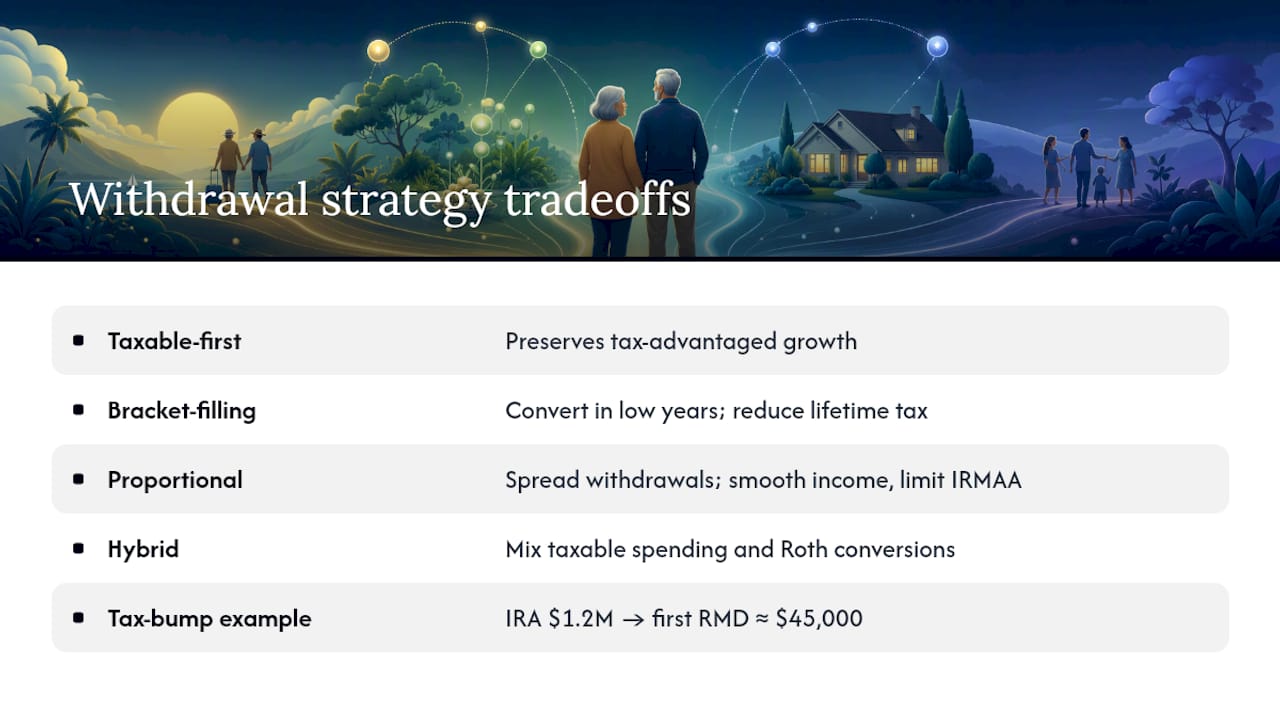
Taxable-first is the conventional starting point. You spend down brokerage accounts before touching IRAs or Roths, which lets tax-advantaged accounts keep compounding. The downside: you may burn through taxable assets during years when your income is low enough to convert traditional IRA dollars to Roth at a bargain rate. You also sell assets that might have been better held for heirs to capture the step-up in basis, as the Bogleheads draw-down framework notes.
Bracket-filling (tax-deferred-first or Roth conversion approach) deliberately pulls from traditional IRAs or converts to Roth in years when your marginal rate is low. The goal is to pay tax now at, say, 12% or 22% rather than later at 24% or 32% when RMDs force the income. This approach costs real money today but can produce significant lifetime tax savings. According to Morningstar’s tax-smart withdrawal framework, there is no cookie-cutter sequence; the right answer is a year-by-year decision that accounts for your current bracket, projected RMDs, and Social Security timing.
Proportional withdrawals spread distributions across all three account types each year, keeping each bucket from growing disproportionately and smoothing out taxable income. This approach is particularly useful for managing Medicare IRMAA thresholds, since a single large withdrawal from a tax-deferred account can trigger a premium surcharge that lasts two years.
Hybrid approaches combine elements of all three. A common version: use taxable accounts for baseline spending, execute Roth conversions up to the top of a favorable bracket, and leave Roth assets untouched for later years or heirs.
The tax-bump problem in plain numbers: Suppose a retiree has $800,000 in a traditional IRA at age 65 and takes nothing from it until RMDs begin at 73. If that balance grows to $1.2 million by age 73, the first RMD is roughly $45,000. Add Social Security of $30,000 (up to 85% of which may be taxable) and a small pension, and taxable income can easily exceed $90,000, landing squarely in the 22% or 24% bracket. Converting $20,000–$30,000 per year between ages 65 and 72 at a 12% marginal rate would have shrunk that IRA balance and the resulting RMDs permanently.
Pro Tip: Medicare IRMAA surcharges are based on your income from two years prior. A large Roth conversion or unexpected IRA withdrawal in one year can raise your Medicare Part B and Part D premiums two years later. Model the IRMAA thresholds before executing any large conversion.
How to build your annual withdrawal plan step by step
This process works best as an annual exercise, ideally in the fourth quarter when you can see your year-to-date income clearly.
-
Calculate your cash needs for the next 12–24 months. Set aside that amount in liquid accounts: high-yield savings, money-market funds, or short-term CDs. This buffer prevents forced selling during market downturns and removes the pressure to time withdrawals around volatility.
-
Map your predictable income. List every income source that arrives without you doing anything: Social Security, pensions, annuities, and any RMDs you’re required to take. Subtract that total from your annual spending target. The remainder is the gap you’ll fill from investment accounts.
-
Handle RMDs first if you’re 73 or older. Confirm the amount for each account, schedule the distributions, and count them toward your income gap. If your RMDs already cover your spending needs, you still must take them; consider reinvesting the excess in a taxable account or funding a qualified charitable distribution (QCD) to reduce taxable income.
-
Tap taxable accounts for the remaining gap. When selling, prioritize holdings with the highest cost basis first to minimize realized gains. Tax-loss harvesting, selling positions with embedded losses to offset gains elsewhere, can further reduce the tax bill. T. Rowe Price’s withdrawal guidance emphasizes that selling by cost basis and coordinating with Social Security timing are two of the highest-leverage moves available to retirees.
-
Use tax-deferred accounts to fill unused bracket space. If your income after Steps 2–4 leaves room in the 12% or 22% bracket, pull additional funds from a traditional IRA or execute a partial Roth conversion up to the bracket ceiling. This is the “Roth conversion bridge” strategy: convert in low-income years to pay tax at lower rates, shrink future RMDs, and build a tax-free reserve. The IRS rollover rules govern the mechanics of moving funds between accounts, so confirm the timing and paperwork with your custodian.
-
Preserve Roth assets for later. Roth IRAs are your most flexible asset: no RMDs, tax-free growth, and tax-free withdrawals for heirs under current law. Tap them only when your tax situation in a given year makes it clearly advantageous, such as a year with unusually high income where you need cash without adding to your ordinary income tax bill.
Implementation checklist:
- Q4 each year: review year-to-date income and project year-end bracket position
- Confirm RMD amounts and deadlines by October
- Model IRMAA thresholds before any large conversion or withdrawal
- Coordinate Social Security claiming age with your projected bracket in early retirement years
- Review rollover eligibility if consolidating accounts, using the IRS rollover chart as a reference
A reverse mortgage can also supplement income in certain situations, reducing the need to sell investments in down markets. If you own your home and are 62 or older, using a reverse mortgage for retirement income can provide liquidity without triggering a taxable event, which affects how aggressively you need to draw from investment accounts.
When should you deviate from the standard withdrawal order?
The default sequence is a starting point, not a law. Several situations call for a deliberate change.
- High-deduction years. Large medical expenses, charitable contributions, or business losses can drop your effective marginal rate significantly. That’s the year to pull more from a traditional IRA or execute a larger Roth conversion than you’d normally consider.
- Medicare IRMAA cliffs. IRMAA surcharges kick in at specific income thresholds (based on modified adjusted gross income from two years prior). Crossing a threshold by even $1 can add hundreds of dollars per month to Medicare premiums. In years where you’re close to a threshold, it may be worth taking less from tax-deferred accounts and drawing from Roth or taxable accounts instead.
- Estate planning with step-up in basis. If your heirs will face high marginal rates and you hold appreciated taxable assets, it can be more tax-efficient to convert traditional IRA dollars to Roth while you’re alive and let the taxable portfolio pass to heirs with a stepped-up basis, eliminating the embedded gain. IRS Publication 559 covers the tax treatment of inherited accounts in detail.
- Employer plan separation rules. The Rule of 55 allows penalty-free withdrawals from a 401(k) if you separate from service in or after the year you turn 55. This is an exception to the 10% early-distribution penalty, per IRS early-distribution rules, and can make a 401(k) a viable early-retirement income source before age 59½.
- Non-governmental 457(b) plans. These deferred compensation plans have unique distribution rules that differ from IRAs and 401(k)s. The IRS guidance on non-governmental 457(b) plans outlines when and how distributions must be taken, which can affect your overall sequencing if you hold one of these accounts.
- Net Investment Income Tax (NIIT). The 3.8% NIIT applies to net investment income for taxpayers above certain income thresholds ($200,000 single / $250,000 married filing jointly). Large capital gains from taxable account sales can trigger it. Spreading gains across multiple years or using tax-loss harvesting can keep income below the threshold.
Red flags that should prompt an immediate sequencing review:
- An inheritance that changes your estate picture
- Large medical bills that create deductible expenses
- A significant market decline that creates tax-loss harvesting opportunities
- A forced increase in RMDs due to account growth
- A change in Social Security or pension income
Worked examples: how sequencing choices affect real tax bills
These three scenarios use simplified numbers to illustrate the tax impact of different withdrawal approaches. They are not personalized advice.
Scenario A: Early retiree, ages 62–72 (pre-RMD gap years)
Maria retires at 62 with $400,000 in a taxable brokerage account, $600,000 in a traditional IRA, and $150,000 in a Roth IRA. She needs $60,000 per year and won’t claim Social Security until 67.
She draws $60,000 from taxable accounts for living expenses. Her taxable income is modest (mostly long-term capital gains), so she also converts $25,000 from her traditional IRA to Roth each year, staying within the 22% bracket. Over five years, she moves $125,000 into Roth at a relatively low rate, shrinking her future RMDs and building a larger tax-free reserve.
Scenario B: Retiree claiming Social Security at 67, pre-RMDs
James, 67, receives $28,000 per year in Social Security. Up to 85% of that ($23,800) is potentially taxable depending on his combined income. He needs an additional $40,000 from savings.
If he pulls $40,000 from a traditional IRA, his combined income pushes him to roughly $63,800 in taxable income, landing in the 22% bracket. If instead he draws $20,000 from taxable accounts (mostly return of basis, minimal gain) and $20,000 from his Roth IRA, his combined income drops significantly, potentially keeping more Social Security out of the taxable calculation and staying in the 12% bracket.
Scenario C: Age 73+ with large traditional IRA balances
Robert turns 73 with a substantial traditional IRA balance. His first RMD, combined with Social Security and pension income, places his taxable income in the mid federal tax brackets. Earlier Roth conversions could have reduced the IRA balance and resulting RMD amount, potentially keeping taxable income lower.
Had Robert converted $30,000 per year from ages 65 to 72 (eight years), his IRA balance at 73 might have been closer to $800,000, producing an RMD near $30,000. That alone could have kept him in the 22% bracket with room to spare and reduced the portion of Social Security subject to tax.
| Scenario | Key Move | Primary Tax Benefit |
|---|---|---|
| A: Early retiree (62–72) | Roth conversions during gap years | Locks in lower rates; shrinks future RMDs |
| B: Social Security at 67 | Mix taxable + Roth to limit combined income | Reduces taxable Social Security; stays in lower bracket |
| C: Age 73+ large IRA | Pre-RMD conversions (if done earlier) | Smaller RMDs; avoids bracket creep and IRMAA surcharges |
Key Takeaways
The most tax-efficient withdrawal order starts with RMDs, moves through taxable accounts, then tax-deferred accounts, and preserves Roth assets last, but low-income years and estate goals regularly justify deviating from that sequence.
| Point | Details |
|---|---|
| RMDs come first | Take required distributions at age 73 before any other sequencing decision to avoid penalties. |
| Taxable before tax-deferred | Draw from brokerage accounts first to let tax-advantaged balances keep growing. |
| Roth conversions in low-income years | Convert traditional IRA dollars to Roth during gap years to pay tax at lower rates and shrink future RMDs. |
| Review annually, not once | Reassess your sequence every year in Q4, factoring in bracket position, IRMAA thresholds, and Social Security income. |
| Progressiveplanner’s approach | The Dual Purpose Retirement Strategy™ coordinates IUL policies with tax-efficient withdrawal sequencing to create two income streams from the same savings. |
This article is general information, not personalized tax or financial advice. Confirm current IRS rules and your specific situation with a qualified tax professional or financial advisor.
The part most retirement guides get wrong
Most articles on withdrawal sequencing treat it as a one-time decision: pick the order, follow it, done. That framing misses the point almost entirely.
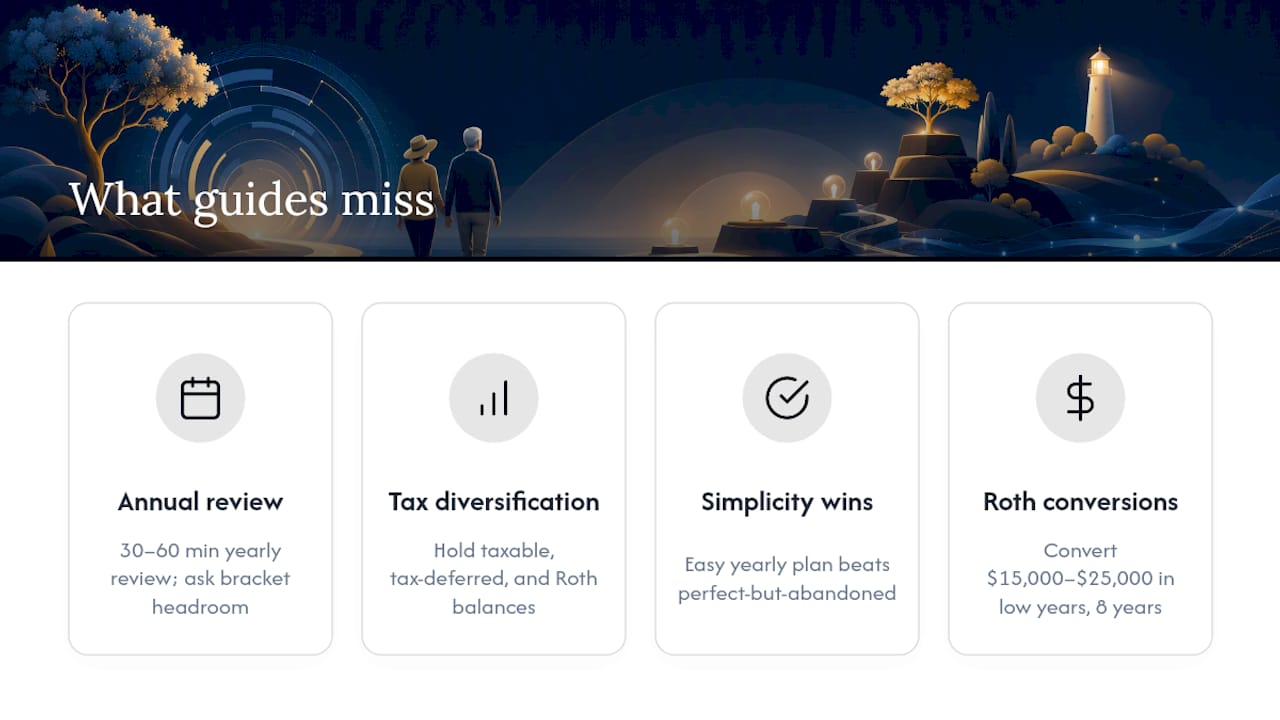
The real value in withdrawal planning isn’t the sequence itself. It’s the annual recalibration. Tax brackets shift, account balances change, Social Security timing changes the math, and Medicare IRMAA thresholds move. A retiree who set a withdrawal order at 65 and never revisited it is almost certainly leaving money on the table by 73.
What actually produces better lifetime outcomes is a small, deliberate review each year, maybe 30–60 minutes with a spreadsheet or a financial planner, where you ask: what is my bracket headroom right now, and am I using it? That question alone, asked consistently, can generate meaningful tax savings over a 20-year retirement. A Roth conversion of $15,000–$25,000 in a low-income year looks modest in isolation. Done for eight consecutive years before RMDs begin, it can permanently reduce forced distributions and the taxes attached to them.
Tax diversification, holding meaningful balances in taxable, tax-deferred, and Roth accounts simultaneously, is the structural feature that makes annual recalibration possible. Without it, you have no flexibility. With it, you can respond to a high-deduction year, an IRMAA cliff, or an unexpected inheritance without being locked into a single account type.
The other thing most guides underweight: behavioral sustainability. The mathematically optimal sequence is worthless if it’s too complicated to execute consistently. A plan that’s slightly less optimal but easy to follow every year beats a perfect plan you abandon after two.
How Progressiveplanner can help you sequence withdrawals more effectively
Most retirees optimize one income stream. Progressiveplanner’s Dual Purpose Retirement Strategy™ is built around a different premise: the same savings dollar can fund two tax-advantaged income streams simultaneously, pairing a traditional retirement account with an Indexed Universal Life (IUL) policy that builds cash value with downside protection.

That structure directly complements tax-efficient withdrawal sequencing. The IUL’s cash value grows tax-deferred and can be accessed tax-free through policy loans, giving you a third income source that doesn’t add to your ordinary income, doesn’t trigger IRMAA surcharges, and doesn’t count toward the combined income calculation that determines how much of your Social Security is taxable. Progressiveplanner’s advisors model personalized Roth-conversion scenarios, project RMD timelines, and coordinate Social Security claiming with your overall bracket strategy. The result is a withdrawal plan built around your specific accounts, income sources, and tax situation, not a generic sequence.
Schedule a complimentary retirement-income review at progressiveplanner.com to see how the Dual Purpose Retirement Strategy™ fits your withdrawal plan.
Useful sources for further reading
The following primary sources and planning references support the guidance in this article:
- Rollover Chart (PDF) | Internal Revenue Service
- A Tax-Smart Plan for In-Retirement Withdrawals in 3 Steps | Morningstar
- Retirement draw-down priority | Bogleheads
- How to make your retirement account withdrawals work best for you | T. Rowe Price