
Max Funded IUL: Tax-Efficient Cash Growth Strategy

A max funded IUL is an Indexed Universal Life insurance policy designed to accept the largest premium the IRS allows without triggering Modified Endowment Contract (MEC) status. The death benefit is set to the legal minimum for that premium level, so the bulk of each dollar you put in flows directly into tax-deferred cash value rather than paying for insurance coverage you don’t need. If you’re a high-income earner who has already maxed your 401(k) and Roth IRA and you’re looking for a third tax-efficient bucket with no federal annual contribution ceiling, this strategy is worth a serious look. If you’re early in your career, carrying high-interest debt, or need maximum death benefit protection, it probably isn’t.
Core benefits at a glance:
- Tax-deferred cash value growth with no federal annual contribution cap (unlike a 401(k) or IRA, carriers set maximums based on death benefit math)
- Tax-free income in retirement via policy loans, as long as the policy stays in force and is not a MEC
- A 0% floor that prevents negative index returns from being credited to your cash value
- No required minimum distributions (RMDs)
Core risks to weigh first:
- Crossing the MEC threshold by even one dollar permanently changes your tax treatment — and that status cannot be reversed
- Cost of insurance (COI) and administrative fees reduce net returns every year, including years when the index credits zero
- Carrier variability in caps and participation rates means illustrated returns are projections, not promises
Before you call an advisor, gather: recent retirement account statements, your last two years of W-2s or Schedule C income, a realistic annual premium you can sustain for at least 10–15 years, and a clear picture of your current death benefit needs. Those four inputs drive every design decision that follows.
Table of Contents
- What exactly is a max funded IUL?
- How do IRS rules set your funding limits?
- How does a max funded IUL actually grow your cash value?
- What does a sample max funded design actually look like?
- What are the real pros and cons of max funding an IUL?
- Who actually benefits from a max funded IUL?
- How do you design and monitor a max funded IUL correctly?
- How do you access cash value without triggering taxes?
- What are the most common traps and red flags?
- How does a max funded IUL compare to a Roth IRA, 401(k), or whole life?
- How does the Dual Purpose Retirement Strategy™ work?
- What should you do next if you want to pursue this?
- Key Takeaways
- Why most people get this strategy wrong
- Progressiveplanner’s Dual Purpose Retirement Strategy™
- Authoritative sources for further research
What exactly is a max funded IUL?
A max funded IUL is not a product name — it’s a design strategy applied to an Indexed Universal Life policy. The goal is to push premium as close as legally possible to the MEC threshold without crossing it, while simultaneously minimizing the death benefit to the lowest amount the IRS allows for that premium level. The result: more of your premium becomes cash value, and less of it pays for insurance costs.
A few terms you’ll see throughout this article:
- MEC (Modified Endowment Contract): A life insurance policy that has been funded too quickly relative to its death benefit. MEC status permanently changes how distributions are taxed.
- 7-pay test: The IRS calculation under Section 7702A that determines whether cumulative premiums in the first seven policy years exceed the MEC limit.
- Section 7702: The Internal Revenue Code provision that defines what qualifies as life insurance for tax purposes. A policy must pass Section 7702 tests to maintain its tax-advantaged status.
- Option A (level death benefit): The death benefit stays level; as cash value grows, the net amount at risk (pure insurance) shrinks, which lowers COI over time.
- Option B (increasing death benefit): The death benefit equals the base amount plus accumulated cash value, keeping the net amount at risk higher — and creating more room for premium contributions without triggering MEC.
- Indexed crediting: Interest credited based on the performance of an external index (commonly the S&P 500), subject to a cap, participation rate, or spread.
- Cap: The maximum interest rate credited in a given period, regardless of how high the index goes.
- Participation rate: The percentage of index gains credited to your policy (e.g., 80% participation on a 10% index gain = 8% credited).
- Spread: A deduction subtracted from index gains before crediting (e.g., a 2% spread on a 10% gain = 8% credited).
- 0% floor: The minimum credited rate; your cash value cannot lose value due to index performance alone.
A max funded IUL treats the death benefit as a variable to solve for, not a target to hit. You start with your premium budget, then compute the minimum death benefit that keeps the policy out of MEC territory. That inversion is what separates a well-designed policy from a standard IUL sold with a large face amount.
In a standard IUL sale, an advisor might lead with a $500,000 death benefit and fit premiums around it. In a max funded design, you lead with a $30,000 annual premium and compute the minimum death benefit that accommodates it. Same product, fundamentally different logic.

How do IRS rules set your funding limits?
The MEC threshold and the 7-pay test are the two gating rules that determine how much you can put into a policy while keeping its tax advantages intact. Cross either one and the policy becomes a MEC permanently.
Section 7702 establishes the corridor between cash value and death benefit that a policy must maintain to qualify as life insurance under the tax code. If cash value grows too close to the death benefit, the policy fails the corridor test and loses its insurance classification. Carriers handle this automatically by adjusting the death benefit upward when needed, but it’s worth understanding because it affects COI.
Section 7702A and the 7-pay test go further. The 7-pay test calculates a maximum cumulative premium for the first seven policy years based on the death benefit. Overfund by even one dollar above that threshold and the policy becomes a MEC — permanently. The status cannot be reversed.
A simplified example: Suppose the 7-pay limit for your policy is $28,000 per year. You can pay up to $196,000 cumulatively over seven years. Pay $196,001 in year three and you’ve triggered MEC status for the life of the policy.
What changes when a policy becomes a MEC:
- Distributions (loans and withdrawals) become subject to LIFO taxation — gains come out first, fully taxable as ordinary income
- Distributions before age 59½ carry an additional 10% penalty
- The primary tax advantage of the strategy — tax-free retirement income via loans — is eliminated
Carriers build safety margins into their illustrations, but those margins are not infinite. Annual premium increases, lump-sum additions, or policy changes (like reducing the death benefit) can all affect MEC room. Ongoing monitoring is not optional; it’s part of the design.
Key regulatory checkpoints:
- Confirm the 7-pay limit with the carrier before each premium payment
- Any material change to the policy (death benefit reduction, rider changes) can restart or affect the 7-pay calculation
- Keep a written record of cumulative premiums paid and remaining MEC room each year
How does a max funded IUL actually grow your cash value?
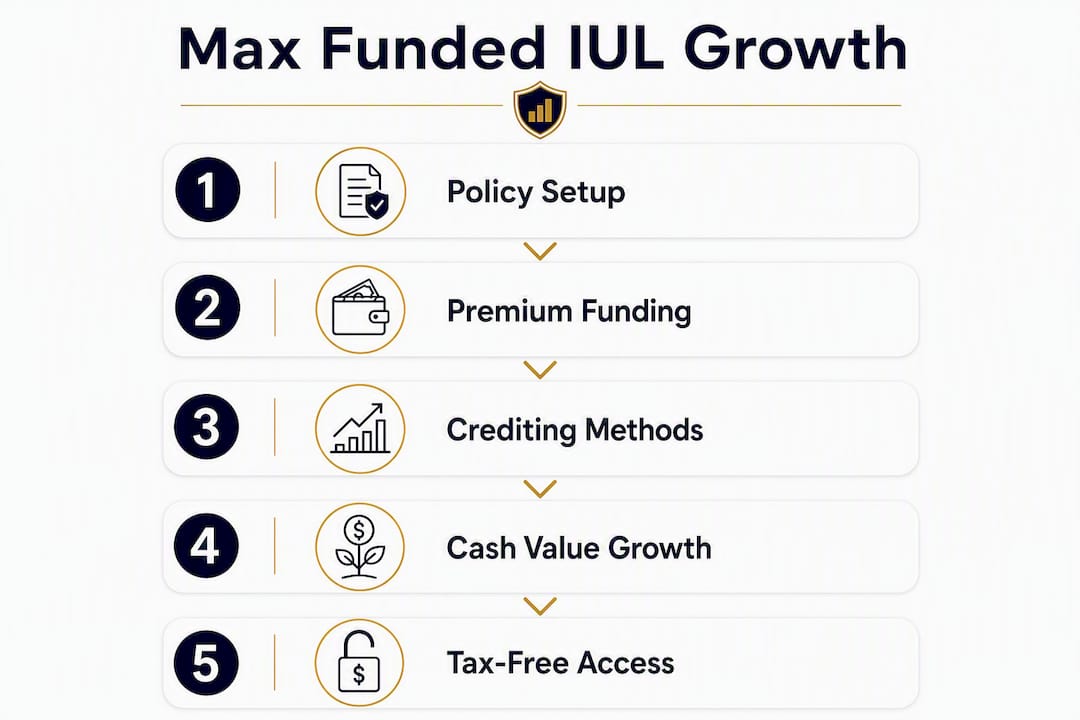
Most of each premium in a properly designed policy flows to cash value after COI and administrative fees are deducted, then earns interest through indexed crediting. That sequence matters because the smaller the death benefit relative to your premium, the lower the COI, and the more of each dollar compounds tax-deferred.
The premium flow, step by step:
- Premium arrives in the policy
- COI, administrative charges, and any rider fees are deducted
- Remaining amount is allocated to the indexed account(s)
- At the end of the crediting period, interest is calculated based on index performance, subject to caps, participation rates, or spreads
- Credited interest (minimum 0%) is added to cash value
- The cycle repeats
A minimum non-MEC death benefit design reduces COI as a percentage of premium and accelerates accumulation. The math is straightforward: lower net amount at risk means lower insurance charges, which means more of your credited interest stays in the account.
Common crediting methods:
- Annual point-to-point: Compares the index value at the start and end of a 12-month period. Simple, predictable, and the most common method.
- Monthly sum: Adds up monthly index changes (capped per month) over the year. Can outperform annual point-to-point in trending markets but can underperform in volatile ones.
- Volatility-controlled indices: Proprietary indices that adjust equity exposure based on realized volatility, often paired with higher caps or uncapped participation. These are carrier-specific and require careful evaluation of historical performance.
The 0% floor protects against negative index returns being credited to your account. But COI and fees continue even in years when the index credits zero, which means extended flat markets can still erode cash value in absolute terms. The floor is not a guarantee against loss — it’s a guarantee against index-related loss.
The Option B to Option A switch is one of the most impactful design decisions in a max funded strategy. Starting with Option B (increasing death benefit) creates more MEC room during the accumulation phase, allowing higher premium contributions. Switching to Option A at retirement reduces the net amount at risk, lowers COI, and increases distributable cash value. The timing of that switch should be documented in the original policy design, not left to chance.

Pro Tip: Prioritize crediting methods with stable, repeatable historical performance over those with the highest illustrated caps. A carrier that has consistently delivered 5–6% net crediting over a decade is more valuable than one projecting 8% with a cap history that has dropped materially since issue.
What does a sample max funded design actually look like?
A realistic illustration helps ground the mechanics. The numbers below are modeled projections with stated assumptions — not guarantees.
Sample policy assumptions:
| Parameter | Assumption |
|---|---|
| Insured age at issue | 45, preferred non-tobacco |
| Annual premium | $30,000 |
| Funding window | Years 1–10 |
| Initial death benefit option | Option B (increasing) |
| Planned Option B→A switch | Year 11 (start of distributions) |
| Illustrated net crediting rate | 6% (after charges) |
| COI basis | Current charges (not guaranteed) |
| Surrender charge period | 10 years |
Under these assumptions, a well-designed policy might show approximately $380,000–$420,000 in cash value at year 20 and $600,000–$700,000 at year 30, with annual tax-free loan income of $35,000–$45,000 available from year 11 onward. These are illustrative ranges, not carrier-specific projections.
Sensitivity to crediting and COI assumptions:
- If net crediting drops to 4% instead of 6%, year-30 cash value in modeled scenarios falls by roughly 25–35% — a meaningful difference that underscores why illustrated rates should be stress-tested
- If COI charges increase (carriers can raise current charges up to the guaranteed maximum), the drag on cash value compounds over time, particularly in the later years when the insured is older
- Design choice drives a large portion of performance differences — the same $30,000 annual premium with a higher death benefit can produce materially lower cash value outcomes
What to ask for in any illustration:
- After-charge net crediting rate, not gross index performance
- Projections at 0%, 4%, and 6% (or the carrier’s illustrated rate) net crediting
- Surrender charge schedule by year
- COI charges expressed as a dollar amount per year, not buried in aggregate “expense” lines
Illustrations are projections built on assumptions. Surrender charges typically decline over 10–15 years, and early large withdrawals or policy lapses with outstanding loans can create taxable gains and potential penalties. Treat any illustration as a planning tool, not a performance forecast.
What are the real pros and cons of max funding an IUL?
Advantages:
- No federal annual contribution cap — Unlike a 401(k) or Roth IRA, the IRS does not set a flat dollar limit on IUL premiums. The limit is determined by the death benefit math, which means high earners can contribute substantially more than tax-qualified plan limits allow.
Disadvantages:
When the advantages outweigh the disadvantages: You’re a high earner with a long horizon (15+ years), you’ve maxed employer plans, you have stable cash flow, and you want tax-free retirement income that isn’t subject to RMDs or future tax rate increases.
When they don’t: You need maximum death benefit, you have irregular income, your horizon is under 10 years, or you’re not prepared to monitor the policy annually.
Who actually benefits from a max funded IUL?
The ideal candidate has high, stable income — often above $150,000 household — has already maxed employer retirement plans, can commit to consistent funding for 10–20+ years, and is in good health with strong insurability. That profile is specific for a reason: the strategy’s economics only work when premiums flow in reliably and the policy has time to compound.
Strong candidate profile:
- Household income above $150,000 with predictable cash flow
- 401(k) and Roth IRA already maxed for the year
- 15–25+ year horizon before needing distributions
- Good health and insurable at preferred or standard rates
- Existing liquidity reserve outside the policy (6–12 months of expenses)
- Clear retirement income goal that current qualified plans won’t fully cover
Common disqualifiers:
- Time horizon under 10 years (surrender charges and COI front-loading make early exit painful)
- High-interest consumer or business debt that should be paid first
- Irregular income that creates a real risk of missed premiums
- Primary need is maximum death benefit for family protection (a term policy is cheaper for that job)
- No existing retirement accounts (fund the 401(k) match first — it’s free money)
Quick self-screening checklist:
- Have you maxed your 401(k) and Roth IRA contributions this year?
- Can you commit to a specific annual premium for at least 10 years without financial strain?
- Do you have 6–12 months of liquid savings outside this policy?
- Is your health likely to qualify you for preferred or standard insurance rates?
- Is your primary goal tax-efficient retirement income rather than death benefit?
If you answered yes to all five, a max funded IUL deserves a serious look. If you answered no to any of the first three, address those gaps before considering this strategy.
How do you design and monitor a max funded IUL correctly?
Start with your funding capacity, not the death benefit. Treat the death benefit as an output computed from your premium budget, not a target you set first. That single inversion separates a well-designed policy from a standard sale.
Step-by-step design process:
- Determine your annual premium or lump-sum capacity. Be conservative. The premium you commit to should be sustainable even in a bad income year.
- Choose your funding window. Front-loading over 4–7 years can lower lifetime costs as a percentage of cash value compared to spreading contributions over 20+ years. A 10+ year window is more common and more forgiving of income variability.
- Select Option B as the initial death benefit option. This creates MEC room during the accumulation phase and allows higher premium contributions.
- Compute the minimum non-MEC death benefit using carrier software for your chosen premium and funding window. This is a carrier-specific calculation — do not estimate it manually.
- Decide on headroom. Setting the death benefit slightly above the minimum gives you flexibility to add premium in future years without triggering MEC. The tradeoff is modestly higher COI early on.
- Evaluate riders. A term rider can provide additional death benefit protection without inflating the permanent base, keeping COI lower while meeting family protection needs. Adding a large permanent death benefit to meet protection needs harms cash value growth efficiency — a term rider solves that problem cleanly.
- Document the Option B→A switch timing. Decide at inception when you plan to switch to Option A (typically at the start of distributions). Put it in writing.
Pro Tip: Plan modest extra death benefit at inception if you want the ability to add premium later. Headroom costs a little more in COI upfront, but it preserves flexibility that is nearly impossible to create after the fact without risking MEC.
Annual monitoring checklist:
- Check remaining MEC room before each premium payment
- Review indexed crediting history against illustrated assumptions
- Track COI charge trends year over year
- Review outstanding loan balances and loan interest accrual
- Confirm surrender charge schedule and remaining years
- Set explicit review triggers: if net crediting falls below your assumed rate for three consecutive years, request a full in-force illustration and design review
How do you access cash value without triggering taxes?
Access typically begins with withdrawals up to your cost basis (the total premiums paid), which come out tax-free under FIFO (first-in, first-out) rules for non-MEC policies. Once you’ve withdrawn your basis, you switch to policy loans, which are generally not taxable income as long as the policy stays in force and is not a MEC.
| Feature | Policy Loan | Withdrawal |
|---|---|---|
| Tax treatment (non-MEC) | Generally tax-free; not reported as income | Tax-free up to basis (FIFO); gains taxable above basis |
| Tax treatment (MEC) | LIFO — gains out first, fully taxable; 10% penalty if under 59½ | LIFO — gains out first, fully taxable; 10% penalty if under 59½ |
| Effect on death benefit | Reduces death benefit by loan amount | Permanently reduces cash value and death benefit |
| Lapse risk | High if loan balance grows faster than cash value | Lower, but large withdrawals reduce the buffer |
| Interest mechanics | Loan interest accrues; offset partially by credited rate on collateral | No interest; permanent reduction |
| Reversibility | Repayable; death benefit restored on repayment | Permanent |
The tax trap most people miss: if a policy lapses with an outstanding loan balance, the entire loan amount becomes taxable income in the year of lapse — even though you never received that money as cash. That event can produce a large, unexpected tax bill with no cash to pay it.
Practical risk controls for loan strategies:
- Maintain a collateral buffer: keep cash value at least 20–30% above the outstanding loan balance
- Run in-force illustrations annually showing your current loan balance, projected loan interest, and remaining cash value under low-crediting scenarios
- Document a repayment strategy or a plan to reduce loan draws if cash value growth slows
- Never take loans to the point where a single bad crediting year could trigger a lapse
MEC status is the other major trap. Once a policy is a MEC, distributions are taxed under LIFO rules — gains come out first, fully taxable as ordinary income, plus a 10% penalty if you’re under 59½. The tax-free loan advantage disappears entirely. That’s why MEC monitoring is not a one-time event at policy issue; it’s an annual discipline.
What are the most common traps and red flags?
The three most common traps are relying on overly aggressive illustrated crediting rates, corking the policy with zero headroom, and ignoring COI escalation as the insured ages. Each one is avoidable with the right design and monitoring discipline.
Red flags to watch for:
- Illustrations that show only one crediting scenario (typically the highest)
- No documented plan for the Option B→A switch
- Carrier cap history that has dropped materially since policy issue, with no acknowledgment in the illustration
- Rider charges buried in aggregate expense lines rather than disclosed separately
- An advisor who cannot or will not show you after-charge net crediting assumptions
- No annual MEC monitoring process offered as part of the service
Questions to ask any advisor before signing:
- “Show me the 0%, 4%, and 6% net crediting scenarios side by side.”
- “What is the current MEC room, and how much headroom does this design include?”
- “When and how will we switch from Option B to Option A, and what triggers that decision?”
- “What are total annual charges expressed as a percentage of cash value in years 1, 10, and 20?”
- “What is the carrier’s cap history on this index over the past 10 years?”
- “What happens to my policy if I miss two consecutive premium payments?”
An advisor who deflects or can’t answer questions 1, 3, and 4 is not the right person to design this policy. The design is the product — not the carrier name on the cover page.
How does a max funded IUL compare to a Roth IRA, 401(k), or whole life?
A max funded IUL is not a replacement for a 401(k) or Roth IRA. It solves a different problem: unlimited after-tax contributions, tax-free loans, and downside protection for high earners who have already exhausted tax-qualified plan space. The right sequence is employer match first, Roth when eligible, then IUL as a supplemental tax-efficient bucket.
| Dimension | Max Funded IUL | Roth IRA | 401(k) | Whole Life |
|---|---|---|---|---|
| Best for (use case) | High earners needing supplemental tax-free income; no contribution ceiling | Tax-free growth; income limits apply | Employer match; pre-tax deferral | Guaranteed cash value; conservative accumulation |
| Tax treatment | Tax-deferred growth; tax-free loans (non-MEC) | Tax-free growth and withdrawals | Pre-tax contributions; taxable at withdrawal | Tax-deferred growth; tax-free loans |
| Liquidity / cash access | Policy loans and withdrawals; surrender charges early | Contributions withdrawable anytime; gains at 59½ | Penalties before 59½; RMDs at 73 | Policy loans; slower early accumulation |
| Typical costs | COI + admin fees; increase with age | Fund expense ratios only | Fund fees + plan admin | Higher guaranteed COI; lower variability |
| Premium / contribution flexibility | High; adjustable within MEC limits | Fixed annual limit (varies by plan and year) | Fixed annual limit ($23,500 in 2026) | Less flexible; fixed scheduled premiums typical |
| MEC / regulatory risk | High if misfunded; permanent consequence | None | None | Low; no MEC equivalent |
When to prioritize each vehicle:
- Max funded IUL: — Add this as a third bucket once the first two are maxed, you have a long horizon, and your income is high enough that future tax rates are a real concern.
The IUL’s edge over whole life in a max funded design is the potential for higher credited interest in strong market years, combined with the 0% floor. The tradeoff is COI variability and carrier discretion over caps.
How does the Dual Purpose Retirement Strategy™ work?
The Dual Purpose Retirement Strategy™ from Progressiveplanner is a structured approach that uses a max funded IUL to create two tax-advantaged income streams from the same savings dollar. One stream comes from qualified accounts (401(k), IRA) that continue to grow and distribute on their own schedule. The second comes from IUL cash value accessed via tax-free policy loans. The same annual savings budget funds both, rather than concentrating everything in a single tax bucket.
The Dual Purpose Retirement Strategy™ is built on a specific sequencing principle: qualified accounts handle pre-tax deferral and employer match, while the IUL handles supplemental after-tax accumulation with no RMD pressure and no exposure to future ordinary income tax rates on distributions. The two streams are designed to complement each other, not compete.
How Progressiveplanner implements the strategy:
- Funding sequencing: qualified plan contributions are optimized first, then IUL premium is sized to the client’s remaining cash flow capacity
- Policy design: Option B during accumulation, documented Option B→A switch at the planned distribution start date
- Rider selection: term riders for death benefit needs that exceed the minimum non-MEC base, keeping COI efficient
- Carrier selection: evaluated on cap history, COI schedule transparency, and financial strength ratings
- Monitoring: annual in-force illustration reviews, MEC room checks, and loan balance reporting
What a Progressiveplanner consultation includes:
- Retirement income gap analysis comparing projected qualified plan income to target retirement spending
- IUL illustration review with multiple crediting scenarios (0%, 4%, and illustrated rate)
- Premium plan aligned to the client’s funding capacity and MEC limits
- Carrier comparison based on cap history and COI transparency
- Written Option B→A switch plan and annual monitoring agreement
What should you do next if you want to pursue this?
The immediate steps are straightforward: gather your financial documents, determine a sustainable annual premium, and schedule a design call with a licensed advisor who specializes in max funded IUL structures. The design call is where the real work happens — the documents you bring determine how accurate the first illustration will be.
Onboarding checklist:
- Gather your most recent 401(k) and IRA statements, including current balances and annual contribution amounts
- Pull your last two years of tax returns or W-2s to establish verifiable income
- Determine a realistic annual premium you can sustain without financial strain, even in a slower income year
- Identify your target withdrawal age and estimated annual retirement income need
- Clarify your current death benefit needs (dependents, mortgage, business obligations)
- List any must-have riders (disability waiver of premium, chronic illness, overloan protection)
Documents to request from your advisor at the first meeting:
- Carrier illustrations showing 0%, 4%, and the carrier’s illustrated crediting rate scenarios
- Exact COI schedule by age, expressed in dollar amounts per year
- Surrender charge table by policy year
- Written Option B→A switch plan with trigger conditions
- Carrier cap history for the specific index and crediting method being illustrated
- Total annual charges as a percentage of cash value in years 1, 10, and 20
The advisor who can produce all of those documents without hesitation is the one worth working with. The ones who can’t are selling a product, not designing a strategy.
Key Takeaways
A max funded IUL works best as a supplemental tax-efficient income bucket for high earners who have already maxed qualified plans, can commit to consistent funding for 15+ years, and need a vehicle with no contribution ceiling and no RMDs.
| Point | Details |
|---|---|
| Design drives performance | Death benefit is an output, not an input; minimize it to maximize cash value efficiency. |
| MEC risk is permanent | One dollar over the 7-pay limit changes tax treatment forever; annual monitoring is non-negotiable. |
| Sequence contributions correctly | Fund 401(k) match and Roth IRA first; use a max funded IUL as a supplemental third bucket. |
| Stress-test every illustration | Always request 0%, 4%, and illustrated-rate scenarios; never evaluate a policy on one crediting assumption. |
| Progressiveplanner’s approach | The Dual Purpose Retirement Strategy™ structures IUL alongside qualified accounts to create two tax-advantaged income streams from the same savings dollar. |
Why most people get this strategy wrong
The conventional wisdom on IUL is that it’s either a miracle retirement vehicle or a fee-laden trap. Both framings miss the point. The strategy’s outcome depends almost entirely on design quality and ongoing monitoring, not on whether IUL as a category is “good” or “bad.”
What most articles won’t tell you: the biggest risk in a max funded IUL is not a market crash. The 0% floor handles that. The real risk is a policy that was designed for a premium level the client couldn’t sustain, or one where the Option B→A switch was never documented and never executed. Those are advisor failures, not product failures. A policy that lapses in year 15 with a large outstanding loan balance produces a taxable event that can wipe out years of tax-deferred growth in a single year.
The other thing worth saying plainly: illustrated crediting rates are not conservative estimates. They are projections at a rate the carrier considers “reasonable” — which often means the rate the index would have produced historically, before charges, in a favorable period. Carriers have reduced caps materially on many products since issue. Asking for cap history is not paranoia; it’s due diligence.
The Dual Purpose Retirement Strategy™ from Progressiveplanner is built around exactly this kind of design discipline: sizing the premium to what the client can actually sustain, documenting the switch timing, and running annual in-force reviews. That process doesn’t make the strategy risk-free, but it does address the failure modes that actually end policies badly.
Progressiveplanner’s Dual Purpose Retirement Strategy™
Most retirement planning puts every dollar in one tax bucket. The Dual Purpose Retirement Strategy™ from Progressiveplanner changes that by making the same savings dollar work in two places at once: a qualified account that builds pre-tax wealth, and a max funded IUL that generates tax-free loan income with no RMD pressure. For high earners who have maxed their 401(k) and Roth IRA and are looking for a third tax-efficient income stream, this is the structure worth examining.

A Progressiveplanner consultation includes a retirement income gap analysis, a carrier comparison based on cap history and COI transparency, a full illustration review at multiple crediting scenarios, and a written monitoring plan. You leave with a clear picture of what the strategy can realistically deliver, what it costs, and exactly how it will be managed year over year.
If you’re ready to see how a max funded IUL fits your specific retirement picture, request a Dual Purpose Retirement Strategy™ review and get a personalized illustration built around your income, timeline, and retirement income target.
Authoritative sources for further research
The rules governing max funded IUL design come from federal tax law and IRS guidance. When reviewing a carrier illustration or running an in-force review, cross-reference these primary sources to verify the regulatory framework your advisor is working within.
- IRS Section 7702 — Definition of Life Insurance (U.S. Code, Title 26): The foundational statutory definition of what qualifies as life insurance for tax purposes, including the corridor and cash value accumulation tests.
- IRS Revenue Ruling 2005-6: IRS guidance on life insurance contract definitions relevant to Section 7702 compliance.
- MoneyGeek — Max Funded IUL: How It Works and When It Makes Sense: Practical overview of contribution mechanics and tax treatment.
- Starwest Insurance — How to Overfund Your IUL Correctly: Step-by-step design guidance on minimum death benefit and MEC avoidance.
- SmartAsset — What Is Max Funded IUL Insurance?: Accessible explanation of the strategy’s structure and purpose for financial planning contexts.
How to use these sources in an advisor meeting: Bring the Section 7702 and 7702A statutory references when reviewing any illustration that shows a death benefit reduction or policy change. Ask the advisor to confirm that the proposed design passes both the corridor test and the 7-pay test under current IRS guidance. If the illustration software is carrier-proprietary, request a written confirmation that the design complies with Section 7702A at the illustrated premium level.
This article is general educational information, not personalized financial, tax, or legal advice. Tax rules and insurance regulations can change; confirm current requirements with a licensed financial advisor, tax professional, or attorney before implementing any strategy.