
IUL vs VUL: Which Fits Your Retirement Plan?

IUL is the better starting point for most retirement-focused buyers. VUL belongs in the hands of investors who want direct market exposure, can tolerate real cash-value losses, and have the funding discipline to keep the policy alive through a prolonged downturn. The structural reason is simple: an Indexed Universal Life policy credits interest linked to an index but never lets the market take your cash value negative, while a Variable Universal Life policy puts your money directly into subaccounts that move with the market, no floor attached.
Three factors drive the decision more than anything else:
- Market exposure: IUL uses index-crediting formulas with a floor (typically 0%) to limit downside; VUL has none.
- Fee layers: VUL stacks subaccount expense ratios on top of the mortality and admin charges both products carry.
- Funding discipline: Both policies lapse if cash value runs dry, but VUL’s direct market exposure makes underfunding during a bear market far more dangerous.
Table of Contents
- What does “universal life” mean for both IUL and VUL?
- How does IUL work, and what does index crediting actually mean?
- How does VUL work, and what are subaccounts?
- IUL vs VUL: a head-to-head comparison
- Why illustrations can mislead you on both products
- Tax treatment, policy loans, and what can trigger a taxable event
- When does IUL make more sense, and when does VUL win?
- How to evaluate an illustration and what to ask your agent
- Which should you choose? A practical verdict
- How the Dual Purpose Retirement Strategy™ applies IUL in practice
- Key Takeaways
- What actually tips the balance in practice
- Progressiveplanner’s retirement income review
- Useful sources and further reading
What does “universal life” mean for both IUL and VUL?
Universal Life (UL) is permanent life insurance with two defining features: flexible premiums and a cash-value account that grows tax-deferred. Every dollar you pay above the cost of insurance goes into that account. You can raise or lower premiums within limits, and you can access accumulated cash through loans or withdrawals.
The cost of insurance (COI) is deducted monthly from the cash value. It rises with age, which is the mechanical reason both IUL and VUL carry lapse risk if the policy is underfunded. Both products also share the same tax framework: cash value grows tax-deferred under IRC Section 7702, death benefits pass income-tax-free to beneficiaries, and policy loans are generally not taxable while the contract stays in force.
One shared risk that catches buyers off guard is Modified Endowment Contract (MEC) status. If you fund a policy too aggressively in the early years, the IRS reclassifies it as a MEC, and withdrawals and loans become taxable and potentially subject to a 10% penalty before age 59½. Funding design matters from day one.
How does IUL work, and what does index crediting actually mean?
IUL does not invest in the stock market. The carrier holds your cash value in its general account and uses a portion of the interest earned to purchase index options, typically on the S&P 500. At the end of each crediting period (usually one year), the policy credits interest based on how the chosen index performed, subject to three parameters:
- Floor: The minimum credited rate, most commonly 0%. A negative index year credits zero, not a loss.
- Cap: The maximum credited rate. If the cap is 10% and the index returns 18%, you receive 10%.
- Participation rate: The percentage of index gain applied before the cap. A 70% participation rate on a 12% index return yields 8.4% before the cap is applied.
Illustrative example: Index returns 15%. Participation rate is 80%. Cap is 11%. Calculation: 15% × 80% = 12%, then capped at 11%. Credited interest: 11%.
IUL’s index-crediting formula means you trade some upside for protection on the downside. In a year the S&P 500 drops 30%, your cash value credits 0% instead of losing 30%. That floor is the product’s core value proposition for retirement planning.
Pros of IUL:
- Downside protection via the 0% floor
- Tax-deferred cash value growth
- Flexible premium structure
- Death benefit with adjustable face amount
- No securities license required to purchase or sell
Cons of IUL:
- Caps and participation rates limit gains in strong bull markets
- Non-guaranteed illustrated rates can be set unrealistically high
- COI rises with age, increasing the drag on cash value
- Carriers can lower caps or participation rates over time (cap compression)
- Lapse risk if the policy is underfunded even with the floor in place
Cap compression deserves special attention. Carriers are not contractually obligated to hold caps steady, and in low-interest-rate environments they have historically reduced them. An illustration showing a 10% cap today does not guarantee that cap in year 15.
How does VUL work, and what are subaccounts?

Variable Universal Life puts your cash value to work differently. Instead of a carrier general account, the money goes into separate subaccounts that function like mutual funds. You choose the allocation: equity funds, bond funds, money market funds, or some mix. Those subaccounts move directly with market returns, which means gains are uncapped and losses are real.
Pros of VUL:
- Uncapped investment upside
- Policyholder controls asset allocation
- Potential for higher long-term accumulation in strong markets
- Same tax-deferred growth and tax-free death benefit as IUL
- Can be structured for aggressive accumulation with heavy funding
Cons of VUL:
- No floor: market losses reduce cash value directly
- Higher aggregate fees due to subaccount expense ratios layered on top of COI and admin charges
- Greater lapse risk in prolonged downturns
- Requires a securities-licensed agent to sell
- More complex to manage and monitor over time
The late-life lapse danger is the risk most buyers underestimate. If you are 65, your COI is high, and a bear market has cut your subaccount value by 40%, the policy may not have enough cash to cover monthly charges. Sustained market declines can erode subaccount values to zero, leaving you with no death benefit and a potential tax bill on any outstanding loans.
VUL also carries a regulatory distinction: selling it requires securities registration and FINRA supervision. That is not a minor footnote. It shapes who can legally present it to you and, as discussed later, creates a real distribution bias in the market.
IUL vs VUL: a head-to-head comparison
| Dimension | IUL | VUL |
|---|---|---|
| Risk and volatility | Low to moderate; index-linked with 0% floor | High; direct market exposure, no floor |
| Upside potential | Capped by participation rates and caps | Uncapped; limited only by subaccount performance |
| Downside protection | 0% floor prevents negative credits | None; cash value falls with markets |
| Fees and charges | COI, admin fees, rider charges | COI, admin fees, rider charges, plus subaccount expense ratios |
| Premium flexibility | Flexible within policy limits | Flexible within policy limits |
| Death benefit options | Level or increasing; adjustable face amount | Level or increasing; adjustable face amount |
| Liquidity | Loans and withdrawals; surrender charges apply | Loans and withdrawals; surrender charges apply |
| Tax treatment | Tax-deferred growth; tax-free death benefit; MEC rules apply | Tax-deferred growth; tax-free death benefit; MEC rules apply |
| Ideal buyer | Conservative to moderate; retirement income focus | Aggressive; long time horizon; high funding discipline |
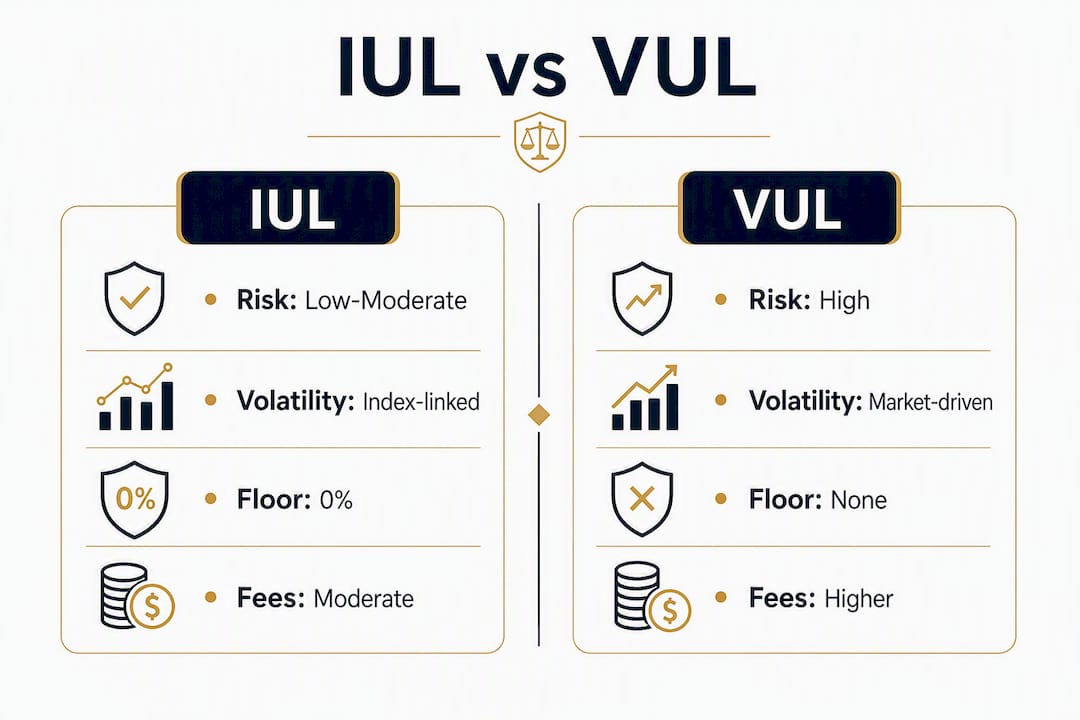
A few of those rows need unpacking beyond the table.
On fees, the gap between IUL and VUL is real but context-dependent. A VUL with low-cost index subaccounts (expense ratios under 0.20%) narrows the cost difference considerably compared to one loaded with actively managed funds at 1%+ expense ratios. Always ask for the total internal cost of the subaccounts you are actually being shown.
On upside potential, the IUL cap matters most in strong bull markets. During a year when the S&P 500 returns 25%, an IUL with a 10% cap and 100% participation credits 10%. A VUL fully invested in an S&P 500 subaccount credits something close to 25% minus the expense ratio. Over a decade of strong markets, that gap compounds into a meaningful difference in cash value.
Bull vs. bear market cycles shift the calculus. In a sustained bull market, VUL tends to accumulate faster. In a flat or declining market, IUL’s floor keeps cash value intact while VUL erodes. The problem is that no one knows which environment the next 20 years will bring, which is why funding discipline and stress-testing matter more than picking the “winner” based on recent market history.
Why illustrations can mislead you on both products
Both IUL and VUL illustrations are built on assumptions, and those assumptions are where projections go wrong.
The main cost layers in any illustration are:
| Cost Layer | IUL | VUL |
|---|---|---|
| Mortality (COI) | Yes, rises with age | Yes, rises with age |
| Administrative fees | Yes | Yes |
| Rider charges | If elected | If elected |
| Subaccount expense ratios | No | Yes (varies by fund) |
| Spread/cap/participation drag | Yes (implicit) | No |
A 20-year illustration that assumes a steady 7% credited rate for IUL or a steady 8% subaccount return for VUL will look compelling. Run the same policy at 4% for years 1–10 and 8% for years 11–20, and the cash value in year 20 is dramatically lower because the COI has been eating into a smaller base during the lean years.
Insurers commonly present illustrated (non-guaranteed) projections; consumers should always ask for the guaranteed column alongside the illustrated one. The guaranteed column shows what happens if the carrier credits only the contractual minimum. For most IUL policies, that minimum is the floor rate, often 0–1%. For VUL, the guaranteed column reflects the minimum death benefit, not a cash-value floor.
Pro Tip: Ask for at least three scenarios: the illustrated rate, a rate 2–3 percentage points lower, and the guaranteed minimum. If the policy lapses in the stress scenario, the funding level is too low.
The NAIC’s Life Insurance Illustrations Model Regulation (Model #582) sets standards for what carriers must disclose, but it does not prevent agents from leading with the optimistic scenario. You have to ask for the rest.
Tax treatment, policy loans, and what can trigger a taxable event
The tax advantages of both IUL and VUL rest on three pillars:
- Tax-deferred growth: Cash value accumulates without annual income tax, unlike a taxable brokerage account.
- Tax-free death benefit: Beneficiaries receive the death benefit income-tax-free under IRC Section 101(a).
- Tax-advantaged loans: Policy loans are generally not taxable while the policy remains in force and is not a MEC, because a loan is not a distribution.
The loan mechanic is powerful but carries a hidden risk. Loan interest accrues and, if unpaid, compounds against the cash value. If the outstanding loan balance plus accruing interest exceeds the cash value, the policy lapses. A lapse with an outstanding loan triggers a taxable event: the IRS treats the loan balance as a distribution, and you owe income tax on any amount above your cost basis.
MEC status changes the rules entirely. Once a policy is classified as a MEC, withdrawals and loans are taxed on a last-in-first-out basis (gains come out first), and distributions before age 59½ carry a 10% penalty. The MEC test is based on the seven-pay limit, a calculation tied to the death benefit and premium schedule. Funding aggressively to maximize cash value without triggering MEC status requires careful design from the start.
Surrender charges are a separate liquidity consideration. Most policies carry surrender charge periods of 10–15 years. Accessing cash value during that window reduces what you receive. Both IUL and VUL carry these charges; the schedule varies by carrier and product.
Pro Tip: If you plan to use policy loans for retirement income, model the loan repayment schedule explicitly. An unmanaged loan that compounds for 10 years can quietly consume the cash value that was supposed to fund your retirement.
When does IUL make more sense, and when does VUL win?
Retirement income supplement (IUL typically fits better)
A 52-year-old with a 401(k) and a 13-year runway to retirement wants to add a tax-advantaged income layer that will not collapse in a bad market year. The 0% floor means a 2008-style downturn does not wipe out the cash value they plan to draw on at 65. IUL’s structure aligns with that goal: predictable downside protection, tax-free loan access in retirement, and a death benefit that covers estate needs.
Aggressive accumulation with a long time horizon (VUL can win)
A 35-year-old with high income, strong funding discipline, and a 30-year horizon may accumulate more in a properly structured VUL. Independent reviewers have found that in many accumulation-focused cases, a properly structured VUL outperformed the IUL that was sold, particularly when the VUL used low-cost index subaccounts and was funded heavily enough to absorb market volatility without lapsing. The key phrase is “properly structured.” A VUL that is underfunded or loaded with high-expense-ratio subaccounts often underperforms.

Estate planning (either can work; structure matters more)
For high-net-worth buyers using life insurance primarily for estate liquidity, the death benefit is the product. Both IUL and VUL can serve this purpose. The choice between them often comes down to the client’s preference for managing subaccount allocations versus accepting index-crediting mechanics.
When neither product fits
- You need low-cost, passive investing only. A term policy plus a taxable index fund account will almost always beat either product on net accumulation when the insurance need is temporary.
- You cannot commit to consistent, adequate funding. Both products lapse if cash value runs dry, and the consequences (lost coverage, potential tax bill) are severe.
- You need guaranteed cash value at a specific date. Neither IUL nor VUL offers a true guarantee on cash value accumulation.
How to evaluate an illustration and what to ask your agent
- Request the guaranteed column. Every illustration must show what happens at the contractual minimum credited rate. If the agent only shows you the illustrated column, ask again.
- Ask for stress-test scenarios. Request projections at the illustrated rate minus 2% and at the guaranteed minimum. If the policy lapses in either scenario under your proposed funding level, increase premiums or reduce the death benefit.
- Demand a line-item fee disclosure. Ask for the COI schedule, admin fees, rider charges, and, for VUL, the expense ratios of every subaccount in the proposed allocation.
- Confirm securities licensing for VUL. Selling VUL requires securities registration and FINRA supervision; many life agents are not licensed to offer it. Ask the agent directly whether they hold a Series 6 or Series 7 license. If they cannot show VUL, they may be steering you toward IUL by default, not by analysis.
- Verify no MEC breach under proposed funding. Ask the agent to confirm that the premium schedule does not trigger MEC status. Get it in writing.
- Ask about cap history for IUL. Request the carrier’s historical cap rates for the specific product over the past 10 years. A carrier that has repeatedly compressed caps is a red flag.
Red flags to watch for:
- Agent cannot present VUL because they lack a securities license, yet never mentions this limitation
- Illustration shows only one scenario at an optimistic credited rate
- COI increases with age are not shown or are minimized in the presentation
- Caps and participation rates in the illustration are at the current maximum with no acknowledgment they can change
- Agent cannot explain the difference between illustrated and guaranteed values
Pro Tip: FINRA’s BrokerCheck tool lets you verify whether an agent holds the securities licenses required to sell VUL. A quick search at finra.org takes two minutes and removes any ambiguity.
Which should you choose? A practical verdict
IUL is the better fit for most retirement-income buyers: the floor limits downside, the tax-free loan structure supports income planning, and the product does not require the funding discipline or market tolerance that VUL demands. VUL is the better fit for buyers with a long time horizon, high and consistent funding capacity, and a genuine appetite for market risk, provided they work with a securities-licensed advisor who stress-tests the illustration properly.
Immediate next steps:
- Check licensing first. Before any product discussion, confirm whether the advisor holds the licenses to present both IUL and VUL. If not, get a second opinion from someone who does.
- Stress-test every illustration. Request the guaranteed column and at least one scenario 2–3 percentage points below the illustrated rate before signing anything.
- Schedule a planning review if you are using cash value for retirement income. The funding level, loan strategy, and MEC limits all interact. A one-time illustration review is not enough; the policy needs to be monitored annually.
How the Dual Purpose Retirement Strategy™ applies IUL in practice
Progressiveplanner’s Dual Purpose Retirement Strategy™ is built around a specific insight: the same dollar can serve two tax-advantaged functions simultaneously. Rather than sheltering savings in a single bucket like a 401(k) or IRA, the strategy uses an IUL policy alongside existing retirement accounts to create two separate income streams, both structured to minimize future tax exposure.
The IUL component does the work that a traditional account cannot: it grows tax-deferred, provides a death benefit, and allows tax-free loan access in retirement without triggering required minimum distributions. The 401(k) or IRA handles the accumulation phase with pre-tax dollars; the IUL handles the distribution phase with tax-free loans. Together, they address two of the most common retirement risks: future tax liability and market-driven income disruption.
Key features of the strategy as Progressiveplanner applies it:
- IUL’s 0% floor protects cash value during market downturns, preserving the income base
- Tax-free policy loans in retirement supplement taxable distributions and reduce overall tax burden
- Downside protection supports income resiliency across different market environments
- The strategy is designed to avoid MEC status, keeping loan access tax-advantaged
This is not a generic IUL sale. It is a structured approach to retirement income that requires careful illustration design, MEC monitoring, and annual policy reviews. Progressiveplanner’s consultations include all of that.
Key Takeaways
IUL suits most retirement-income buyers because its 0% floor and tax-free loan structure protect cash value and income, while VUL fits aggressive accumulators with long horizons and high funding discipline.
| Point | Details |
|---|---|
| IUL’s floor is the core advantage | A 0% floor prevents negative credits in down markets, protecting retirement income base. |
| VUL carries higher fees | Subaccount expense ratios layer on top of COI and admin charges, raising the total cost. |
| Illustrations can mislead | Always request the guaranteed column and stress-test scenarios before committing to either product. |
| Licensing shapes what you’re shown | Agents without securities licenses cannot offer VUL; confirm FINRA registration before any comparison. |
| Progressiveplanner’s approach | The Dual Purpose Retirement Strategy™ uses IUL to create two tax-advantaged income streams from the same savings. |
What actually tips the balance in practice
Most clients who come to this comparison already know they want some form of permanent life insurance with a cash-value component. The real question is not IUL versus VUL in the abstract; it is whether the specific policy being presented is structured to survive the scenarios that actually end these policies: underfunding, market downturns in the case of VUL, and cap compression in the case of IUL.
The single most common mistake is not choosing the wrong product type. It is choosing the right product type and then funding it too conservatively because the agent illustrated it at an optimistic rate that made the required premium look lower than it should be. A VUL that lapses at 72 because a bear market hit at 68 is not a VUL problem. It is a funding and stress-testing problem that could have been caught at the illustration stage.
The licensing issue is the other thing that rarely gets said plainly: most life agents are not securities-registered, which means most clients never see a real VUL comparison. That is not a conspiracy; it is a distribution reality. But it means that if you are a good candidate for VUL, you may need to seek out a securities-licensed advisor specifically, rather than waiting for one to appear in your inbox. The checklist in this article exists precisely because the market does not always surface the right comparison on its own.
Progressiveplanner’s retirement income review
Two tax-advantaged income streams from the same savings sounds like a planning concept. Progressiveplanner turns it into a specific, illustrated plan built around your existing 401(k) or IRA and an IUL policy structured to complement it.

A retirement income review with Progressiveplanner includes a side-by-side illustration of your current trajectory versus the Dual Purpose Retirement Strategy™, a MEC compliance check on the proposed funding schedule, a stress-test showing how the IUL performs at multiple credited-rate scenarios, and a clear breakdown of all internal policy costs. You leave with a concrete comparison, not a sales pitch.
If you are within 10–20 years of retirement and want to know whether an IUL-based strategy can reduce your future tax exposure while protecting your income from market volatility, schedule a personalized retirement income review with Progressiveplanner today.
Useful sources and further reading
The sources below were used in this article. Each covers a distinct angle on the IUL vs VUL comparison.
- IRC Section 7702 — govinfo.gov: The primary legal definition of life insurance for tax purposes. Start here if you want to understand the statutory basis for tax-deferred growth and MEC rules.
- IRS Revenue Ruling 2005-6 — irs.gov: IRS guidance on policy loan treatment and the tax consequences of lapse with outstanding loans. Relevant if you plan to use loans for retirement income.
- FINRA on indexed products — finra.org: FINRA’s investor guidance on index-linked insurance and annuity products, including cap and participation rate mechanics. Useful for understanding the regulatory perspective on illustrated returns.
- IUL vs VUL — Diversified Quotes: Practitioner-level walkthrough of index crediting mechanics, cap compression risk, and lapse scenarios. Best for readers who want a detailed operational comparison.