
Life Insurance for Retirement: A Practical Guide for Savers

A properly structured permanent life insurance policy can supplement retirement income for specific households — but it is not the right move for everyone, and the difference between a well-designed plan and a costly mistake often comes down to a few technical details most salespeople skip.
The core case for using life insurance as a retirement tool rests on two pillars: tax-deferred cash-value growth and the ability to access that cash via policy loans that are typically income-tax-free, as long as the policy stays in force. The American College of Financial Services notes that death benefits are generally income-tax-free, giving heirs a predictable net-of-tax inheritance that IRAs and 401(k)s cannot match. That legacy advantage, combined with a buffer against sequence-of-returns risk, is what makes a Life Insurance Retirement Plan (LIRP) worth a serious look for savers who have already maxed out their Roth IRA and 401(k).
Who should probably skip it: anyone who needs low-cost death protection only, anyone who cannot commit to higher premiums for a decade or more, and anyone who has not yet contributed the maximum to their tax-advantaged accounts. For everyone else, the next step is to request a policy illustration, check your insurability, and compare the projected cash value against what a Roth IRA or annuity would deliver. Progressiveplanner’s Dual Purpose Retirement Strategy™ is one structured way to run that comparison with an advisor.
Table of Contents
- What is a Life Insurance Retirement Plan (LIRP)?
- How LIRPs build and deliver retirement income
- Which policy types work best for retirement?
- U.S. tax rules and regulatory limits you need to know
- Benefits and drawbacks of using life insurance for retirement income
- How much does a LIRP cost, and when should you start?
- When do alternatives beat a LIRP?
- Are you a good candidate? A checklist and red flags
- How Progressiveplanner’s Dual Purpose Retirement Strategy™ works
- Key Takeaways
- The real reason tax diversification matters more than most advisors admit
- What a Progressiveplanner retirement income review actually looks like
- Sources and further reading
What is a Life Insurance Retirement Plan (LIRP)?
A LIRP is not a separate product category. It is any permanent life insurance policy that you intentionally fund above the minimum required premium so that the cash-value component can serve as a supplemental retirement savings vehicle. Aflac’s explainer puts it plainly: part of every premium goes toward building cash value that you can access later, while the rest maintains the death benefit.
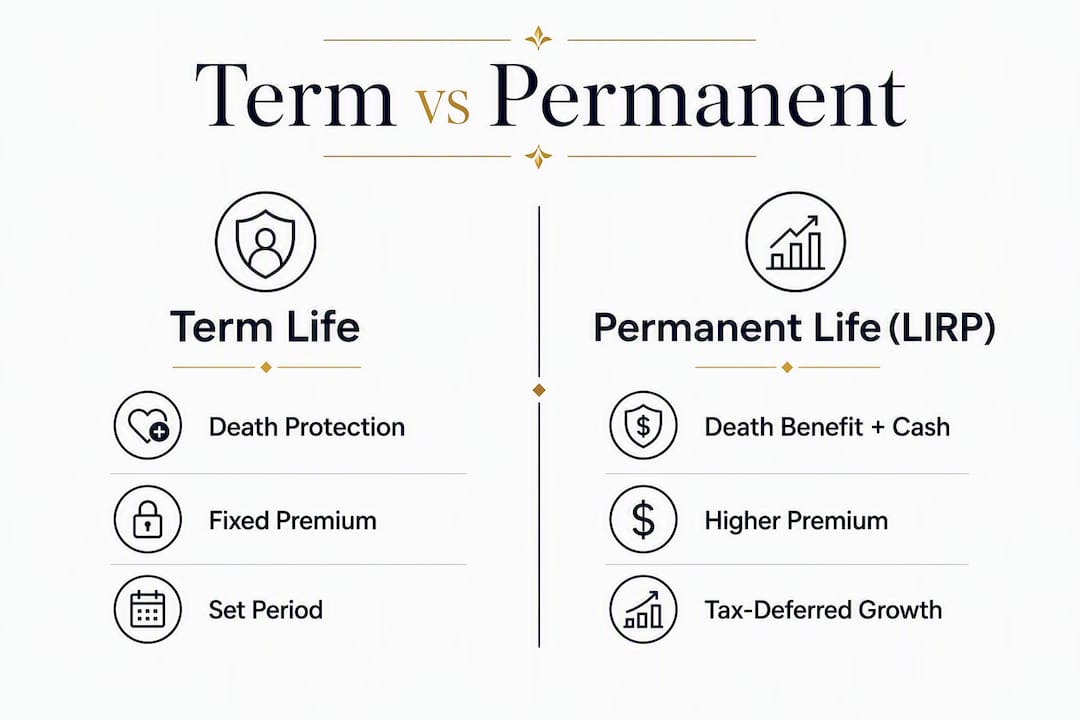
The contrast with term life is stark. Term insurance is pure death protection. You pay a fixed premium for a set period, and if you outlive the term, you get nothing back. There is no cash value, no retirement income, and no legacy asset beyond the death benefit itself. That simplicity is also term’s biggest advantage: it is cheap, which means the dollars you do not spend on premiums can go into a Roth IRA or brokerage account.
Permanent policies flip that equation. You pay more, but a portion of every premium accumulates as cash value, grows tax-deferred, and can be accessed during your lifetime. The trade-off is real: higher premiums, more complexity, and a longer time horizon before the cash value becomes meaningful.
| Feature | Term Life | Permanent Life (LIRP) |
|---|---|---|
| Purpose | Pure death protection | Death benefit + cash-value accumulation |
| Cost profile | Lower premiums | Higher premiums |
| Tax behavior | Death benefit income-tax-free | Growth tax-deferred; loans typically income-tax-free |
| Cash-value access | None | Withdrawals up to basis; policy loans |
| Typical candidate | Those needing affordable coverage | Savers seeking tax-diversified retirement income |
One important framing note: Aflac’s guidance is clear that life insurance should not be the primary source of retirement funding for most people. Think of a LIRP as a third bucket alongside your 401(k) and Roth IRA, not a replacement for either.
How LIRPs build and deliver retirement income
Cash value builds from three sources: the portion of your premium allocated to the accumulation account, credited interest or dividends (depending on policy type), and the compounding effect of tax-deferred growth over time. Early in the policy, a larger share of each premium covers the cost of insurance and administrative fees, so cash value builds slowly. That lag is why timing matters so much.

Accessing cash value: loans vs. withdrawals
MassMutual’s retirement guide draws a clear line between the two access methods:
- Withdrawals up to your cost basis (total premiums paid) come out income-tax-free. Anything above basis is taxable as ordinary income.
- Policy loans are not treated as taxable income while the policy remains in force. The insurer lends you money against your cash value, and you pay interest. The loan reduces your death benefit dollar-for-dollar until repaid.
- Loan interest accrues whether you pay it or not. Unpaid interest compounds and can erode cash value faster than most illustrations show in the base case.
- Lapse risk is the hidden danger: if outstanding loans plus unpaid interest exceed the cash surrender value, the policy lapses and the entire gain becomes taxable in the year of lapse.
The buffer-asset mechanism
The most compelling retirement use case for cash-value life insurance is as a buffer asset against sequence-of-returns risk. When markets drop in the first few years of retirement, selling equities at depressed prices locks in losses and permanently reduces the portfolio’s recovery potential. A retiree with a funded LIRP can instead take a tax-free policy loan to cover living expenses, leave the investment portfolio untouched, and repay the loan once markets recover. That sequencing can meaningfully extend portfolio longevity.
Pro Tip: When the goal is retirement income rather than death benefit maximization, ask your advisor to design the policy with the lowest allowable death benefit relative to your premium. This shifts more of each dollar into cash value faster. Paid-up additions (PUAs) in whole life, or aggressive overfunding in an IUL, are the mechanics that make this work. A policy designed for maximum death benefit will underperform as a retirement vehicle.
Which policy types work best for retirement?
Four permanent policy types show up most often in retirement-income conversations. Each credits cash value differently, and those differences have real consequences over a 20-year accumulation horizon.
Indexed Universal Life (IUL)
IUL credits interest based on the performance of a market index, typically the S&P 500, subject to a cap (often in the range of 10–12%) and a floor (usually 0%). You do not participate in the index directly; the insurer uses options to replicate the return. In a flat or down year, you credit 0% rather than losing value. In a strong year, you earn up to the cap. That asymmetry is the main selling point for retirement use: you get some upside without the downside. Progressiveplanner’s Dual Purpose Retirement Strategy™ centers on IUL for exactly this reason.
Whole Life
Whole life offers guaranteed cash-value growth and dividends from participating policies. The growth rate is lower than what an IUL might credit in a strong market, but it is also more predictable. Mutual companies like Northwestern Mutual and MassMutual have paid dividends consistently for decades, though dividends are never guaranteed. InsuranceNewsNet’s buffer-asset analysis makes an important point: two whole life policies with identical premiums can produce dramatically different cash-value outcomes depending on how the policy is designed. A cash-value-first design using paid-up additions will outperform a death-benefit-maximizing design by a wide margin.
Universal Life (UL)
Standard universal life credits interest at a declared rate set by the insurer, subject to a contractual minimum. It offers more premium flexibility than whole life but less growth potential than IUL. For retirement use, UL is generally the weakest of the three unless you are primarily seeking flexibility in premium timing rather than growth.
Variable Life (VL)
Variable life puts cash value into subaccounts that function like mutual funds. The upside potential is highest, but so is the downside: a bad market year can reduce cash value and, if severe enough, threaten the policy’s in-force status. Variable policies are securities regulated by the SEC and FINRA, which means the advisor selling them must hold a securities license. For retirement use, variable life introduces the same sequence-of-returns risk that a LIRP is supposed to hedge against, which is a meaningful structural tension.
U.S. tax rules and regulatory limits you need to know
The tax advantages of a LIRP are real, but they come with guardrails. Understanding these rules before you fund a policy is not optional.
Tax-deferred growth means you owe no income tax on credited interest, dividends, or index gains while they remain inside the policy. That compounding without annual tax drag is one of the main advantages over a taxable brokerage account.
Withdrawals and loans follow different rules:
- Withdrawals come out tax-free up to your cost basis (total premiums paid). Gains above basis are ordinary income.
- Policy loans are not taxable income as long as the policy remains in force and does not become a Modified Endowment Contract (MEC).
- Loan interest accrues and must be monitored. If cumulative loans and unpaid interest approach the cash surrender value, the policy can lapse and trigger a tax bill on all previously deferred gains.
MEC rules are the most important regulatory limit for anyone funding a LIRP aggressively. The IRS uses a “7-pay test” to determine whether a policy has been overfunded relative to its death benefit. If you exceed the MEC threshold, the policy loses its favorable loan treatment: withdrawals and loans become taxable on a last-in, first-out (LIFO) basis, and a 10% penalty applies before age 59½. Structuring premium payments carefully to stay just below MEC limits is one of the core design tasks in a well-built LIRP.
Lapse consequences deserve a separate callout. MassMutual’s guidance is direct: if a policy lapses with outstanding loans exceeding the cost basis, that excess becomes taxable income in the year of lapse. This is not a theoretical risk. Retirees who take large loans in their 70s and then face rising cost-of-insurance charges can find themselves in exactly this situation if the policy is not actively monitored.
Actionable reminder: Before signing any policy, ask for an illustration that shows projected cash value, outstanding loan balances, and loan interest under a downside crediting scenario (not just the base case). Also confirm the MEC breakpoint for your planned premium level, and consult a tax advisor about how policy income would interact with your other retirement income sources.
Benefits and drawbacks of using life insurance for retirement income
The case for it
- Tax diversification. A LIRP adds a third tax bucket alongside pre-tax accounts (401(k), traditional IRA) and post-tax accounts (Roth IRA). Policy loans are typically income-tax-free, which gives you flexibility to manage taxable income in retirement.
- Income-tax-free death benefit. The American College confirms that life insurance death benefits are generally income-tax-free, making them more efficient as an inheritance than a traditional IRA or 401(k), where beneficiaries pay income tax on distributions.
- Sequence-of-returns buffer. A funded LIRP lets you take tax-free loans during market downturns instead of selling equities at depressed prices. That buffer can protect portfolio longevity in the critical early years of retirement.
- Legacy certainty. Retirees who have a dedicated legacy asset often feel freer to spend down other accounts, which research from The American College links to higher retirement satisfaction.
The case against it
- High early cost. Meaningful cash value requires meaningful premiums. A policy funded at the minimum will not produce usable retirement income. The cost of insurance, administrative fees, and rider charges all come out before cash value accumulates.
- Complexity and illustration risk. Policy illustrations can be built with aggressive crediting assumptions that look great on paper but underperform in practice. An IUL illustration at a 7% assumed crediting rate looks very different from one at 4%.
- Lapse risk. If you stop paying premiums or borrow too aggressively, the policy can lapse and produce a surprise tax bill. This risk grows as cost-of-insurance charges increase with age.
- Long time horizon required. Most LIRPs need 10–15 years of consistent funding before the cash value is large enough to serve as a meaningful income source.
A realistic scenario: Consider a couple in their early 50s who fund an IUL for 15 years before retirement. During a market downturn in their first two retirement years, they take policy loans to cover living expenses rather than selling equities. Their investment portfolio stays intact through the recovery. When markets rebound, they resume drawing from the portfolio and allow the policy loans to reduce the death benefit. The mechanism works, but it requires the policy to have been funded consistently and the loan balances to remain well below the cash surrender value throughout.
How much does a LIRP cost, and when should you start?
There is no universal monthly premium figure for a LIRP. Charles Schwab’s retirement guidance makes this point directly: meaningful cost estimates require your age, underwriting class, desired face amount, and target cash-value funding level. Anyone quoting you a generic monthly figure without an illustration is guessing.
That said, the cost drivers are well understood:
- Age at purchase. Younger buyers pay lower cost-of-insurance charges, which means more of each premium goes to cash value. The American College notes that buying permanent coverage earlier generally reduces cost and improves early cash-value growth.
- Underwriting class. A preferred-plus rating can produce dramatically lower premiums than a standard rating for the same face amount. Health conditions, family history, and lifestyle all factor in.
- Face amount. A higher death benefit means higher cost-of-insurance charges, which compete with cash-value accumulation. For a LIRP, you generally want the lowest face amount that keeps the policy out of MEC territory at your target premium.
- Rider costs. Accelerated death benefit riders, chronic illness riders, and long-term care riders all add cost. Some are worth it; others dilute cash-value growth without adding proportional value.
- Funding level. Overfunding (paying above the base premium, up to the MEC limit) accelerates cash-value growth. Underfunding slows it and can leave the policy vulnerable to lapse.
Timeline expectations: Most financial professionals consider 10 years the minimum horizon for a LIRP to produce meaningful retirement income. Fifteen years is more realistic for a policy to accumulate enough cash value to serve as a genuine income supplement. Starting at 55 with a 65-year retirement target is workable but leaves less margin for error than starting at 45.
For older buyers: If you are past 60, the cost-of-insurance charges in most permanent policies make a LIRP less efficient. Smaller face amounts, hybrid life/long-term care products, or a direct annuity may be more appropriate. Insurability is also a real constraint: serious health conditions can make permanent coverage unavailable or prohibitively expensive.
Action item: Request an illustration showing projected cash value at the 5-, 10-, and 15-year marks under both the base-case and a downside crediting scenario. Compare those figures to what the same premium invested in a Roth IRA or low-cost index fund would produce.
When do alternatives beat a LIRP?
For many savers, the honest answer is that a LIRP is the third or fourth best option, not the first. Here is how the main alternatives stack up.
Term life + invest the difference
If your primary need is death protection, term life is almost always cheaper. A 20-year level term policy for a healthy 45-year-old costs a fraction of a comparable permanent policy. The premium savings can go into a Roth IRA or taxable brokerage account. For DIY investors who are comfortable managing their own portfolios and do not have a legacy or tax-diversification goal that requires a permanent policy, this combination typically produces more investable assets over a 20-year horizon.
Roth IRA
A Roth IRA offers tax-free qualified withdrawals in retirement, no required minimum distributions, and beneficiary advantages that rival a life insurance death benefit for many households. The 2025 contribution limit is $7,000 per year ($8,000 if you are 50 or older). For most savers who have not yet maxed their Roth, contributing the maximum there before funding a LIRP is the stronger move. The Roth’s simplicity, lower cost, and broad investment options are hard to beat.
Annuities
An annuity solves a problem that a LIRP does not: guaranteed income you cannot outlive. A single-premium immediate annuity (SPIA) or a deferred income annuity can provide a predictable monthly payment regardless of market performance or how long you live. If longevity protection is your primary concern, a direct annuity is usually more efficient than using a life insurance policy as an income vehicle. The trade-off is that annuities typically offer little or no death benefit and limited liquidity.
General guideline: Exhaust your Roth IRA contribution room first. If you have a 401(k) match, capture all of it. If longevity risk is your main concern, price an annuity before a LIRP. A LIRP makes the most sense after those options are addressed and you still want tax-diversified income, a legacy asset, or a buffer against sequence-of-returns risk.
Are you a good candidate? A checklist and red flags
Candidate checklist
You are likely a strong candidate for a LIRP if you can check most of these:
- You have maxed your 401(k) and Roth IRA contributions for the year.
- You are in good health and can qualify for a preferred or preferred-plus underwriting class.
- You can commit to consistent premium payments for at least 10 years.
- You want a tax-free death benefit as a legacy asset alongside retirement income.
- You are concerned about sequence-of-returns risk in early retirement.
- You are in a high marginal tax bracket now and expect to remain there in retirement.
Questions to bring to an advisor
- Show me an illustration with both a base-case and a downside crediting scenario. What does cash value look like if the index credits 3% instead of 7%?
- How do outstanding loans affect the death benefit, and what happens if I cannot repay them?
- What is the MEC breakpoint for my planned premium level?
- What does the in-force ledger show for cost-of-insurance charges at age 75, 80, and 85?
- How does this policy’s projected cash value compare to a Roth IRA or annuity at the same premium level?
Red flags
- An illustration that shows only the base-case crediting rate with no downside scenario.
- No clear breakdown of cost-of-insurance charges, rider costs, and administrative fees.
- A loan-interest schedule that is missing or buried in fine print.
- An advisor who cannot explain the MEC rules or dismisses them as unimportant.
- Pressure to replace an existing policy without a clear, documented reason.
Decision framework
Likely yes: You have maxed other tax-advantaged accounts, you are in good health, you have a legacy goal, and you can sustain premiums for 15 years.
Maybe: You have not yet maxed your Roth, but you have a specific sequence-of-returns concern or a legacy need that a term policy cannot address. Run the numbers with an advisor before committing.
Likely no: You need affordable death protection only, you are over 65 with health issues, or you have not yet contributed the maximum to your 401(k) and Roth IRA.
How Progressiveplanner’s Dual Purpose Retirement Strategy™ works
Progressiveplanner’s Dual Purpose Retirement Strategy™ is built around a specific insight: the same premium dollar can create two tax-advantaged income streams instead of one. The strategy uses an Indexed Universal Life policy designed for cash-value growth, not death-benefit maximization, alongside your existing 401(k) or IRA. The IUL’s indexed crediting provides some upside participation with a 0% floor in down years, and the cash value accumulates tax-deferred for access via policy loans in retirement.
The structural emphasis is on avoiding MECs while maximizing cash-value funding. Progressiveplanner advisors design policies with the lowest allowable death benefit relative to the target premium, which pushes more of each dollar into the accumulation account. The IUL’s downside protection feature means that a bad market year does not reduce cash value, which is the core of the buffer-asset argument.
Who the strategy fits best: Couples with legacy goals who want an income-tax-free death benefit alongside retirement income. Savers who have maxed their 401(k) and Roth IRA and are looking for a third tax bucket. Near-retirees who are concerned about sequence-of-returns risk in the first five years of retirement and want a funded buffer asset in place before they stop working.
What a Progressiveplanner review includes: An illustration comparison showing the IUL’s projected cash value alongside your existing accounts, a downside stress test at lower crediting rates, a transparent cost breakdown (cost of insurance, rider fees, administrative charges), and a side-by-side comparison with a Roth IRA or annuity at the same premium level. The goal is to give you enough information to make a real decision, not to sell a policy that does not fit.
Pro Tip: Before your first Progressiveplanner consultation, pull together your most recent 401(k) and IRA statements, your current life insurance coverage details, and a rough estimate of your expected retirement income needs. The more specific your inputs, the more useful the illustration comparison will be.
Key Takeaways
A LIRP works best as a third tax bucket for savers who have already maxed their Roth IRA and 401(k), not as a replacement for either.
| Point | Details |
|---|---|
| LIRPs are supplements, not replacements | Life insurance works best alongside 401(k) and Roth IRA accounts, not instead of them. |
| Tax treatment depends on design | Policy loans are typically income-tax-free, but MEC violations and lapse can trigger ordinary income tax. |
| Start early, fund consistently | Younger buyers get lower cost-of-insurance charges; most LIRPs need 10–15 years to build meaningful cash value. |
| Always request a downside illustration | Base-case projections can be misleading; ask for a scenario at a lower crediting rate before committing. |
| Progressiveplanner’s Dual Purpose Strategy™ | Structures an IUL alongside existing accounts to create two tax-advantaged income streams from the same savings. |
This article is general information, not personalized financial, tax, or legal advice. Consult a qualified tax advisor and a licensed insurance professional before implementing any retirement strategy.
The real reason tax diversification matters more than most advisors admit
Most retirement planning conversations center on accumulation: how much can you save, and how fast will it grow? The tax question gets treated as a detail to sort out later. That is a mistake, and it is one that a well-structured LIRP directly addresses.
Here is the problem with a single-bucket retirement: if all your savings are in a traditional 401(k) or IRA, every dollar you withdraw in retirement is ordinary income. Social Security becomes partially taxable above certain thresholds. Required minimum distributions start at 73 and can push you into a higher bracket whether you need the money or not. Medicare premiums are income-tested. The tax exposure compounds in ways that most pre-retirees do not see coming until they are already in it.
A Roth IRA helps, but contribution limits cap how much you can move there annually. An IUL-based LIRP, structured correctly, adds a third source of income that does not show up as taxable income on your return. That flexibility, the ability to draw from a tax-free source in a high-income year, is worth more than the raw return comparison between a policy and a brokerage account suggests.
The honest caveat: this only works if the policy is designed right, funded consistently, and monitored actively. A poorly designed LIRP with aggressive loan activity and no downside scenario planning can produce exactly the tax surprise it was supposed to prevent. The strategy is sound; the execution is where most people get into trouble.
What a Progressiveplanner retirement income review actually looks like
Most people walk into a retirement income review expecting a sales pitch. A Progressiveplanner consultation runs differently. The focus is on illustration comparison: your current projected retirement income from existing accounts versus what the Dual Purpose Retirement Strategy™ adds, with both a base-case and a downside crediting scenario shown side by side.

The review covers three things in plain language: what the IUL policy will cost (cost of insurance, rider fees, administrative charges), what the projected cash value looks like at 5, 10, and 15 years, and how the policy interacts with your existing 401(k) and Roth IRA from a tax standpoint. If the numbers do not make a compelling case for adding an IUL, the advisor will say so and point you toward a Roth contribution strategy or an annuity instead.
To get the most from the session, bring your most recent retirement account statements, your current life insurance coverage details, and a rough estimate of your monthly retirement income target. The consultation is no-obligation and typically runs about an hour. To request your retirement income review, visit Progressiveplanner’s Dual Purpose Retirement Strategy™ and book directly through the site.
Sources and further reading
The following sources informed this guide. For personalized advice on how any of these rules apply to your situation, consult a licensed tax advisor and a licensed insurance professional.
- IRS Publication 575: Pension and Annuity Income — IRS guidance on the tax treatment of retirement income, including annuities and life insurance distributions.
- IRS: 401(k) and IRA contribution limits for 2025 — Official contribution limits for tax-advantaged retirement accounts.
- Using Life Insurance in a Retirement Plan — The American College of Financial Services — Academic and practitioner analysis of life insurance as a retirement-planning tool, including legacy efficiency and tax treatment.
- Using cash value life insurance as a buffer asset in retirement — InsuranceNewsNet — Detailed explanation of the buffer-asset strategy and sequence-of-returns risk management.
- Should I use life insurance for retirement income? — Charles Schwab — Balanced assessment of when life insurance makes sense for retirement and when alternatives are stronger.
- FINRA BrokerCheck — Verify the credentials and disciplinary history of any financial advisor or insurance professional before working with them.
- Progressiveplanner — Dual Purpose Retirement Strategy™ — Request a retirement income review and see how an IUL-based strategy compares to your current retirement plan.