
Living Benefits Life Insurance for Retirement Income

Living-benefit riders on an Indexed Universal Life (IUL) policy can fund a tax-advantaged retirement income stream — but only when the policy is structured correctly, rider costs are disclosed upfront, and both guaranteed and non-guaranteed scenarios are modeled before you commit.
The term “living benefits” covers any feature that lets you access policy value while you’re still alive. The industry standard term is accelerated death benefit (ADB), and it’s the mechanism most relevant to retirement income planning inside an IUL. Progressiveplanner’s Dual Purpose Retirement Strategy™ is built around exactly this structure: using the same premium dollar to generate two tax-advantaged income streams rather than one.
Before reading further, here’s what matters most:
- An accelerated death benefit reduces your death benefit dollar-for-dollar when exercised — it is not free money.
- Rider fees and cost-of-insurance (COI) charges reduce cash-value accumulation, which directly affects projected retirement income.
- Overfunding a policy past IRS limits triggers Modified Endowment Contract (MEC) status, changing the tax treatment of every distribution.
- No IUL illustration should be trusted without a side-by-side guaranteed vs. non-guaranteed scenario review with a licensed advisor.
Table of Contents
- What are living benefits in a life insurance policy?
- How living-benefit riders actually work inside an IUL
- What do living benefits actually cost inside an IUL?
- What should you verify before relying on living benefits for retirement income?
- How to implement the Dual Purpose Retirement Strategy™ with IUL and living benefits
- Key Takeaways
- When living benefits belong in a retirement plan
- See how the Dual Purpose Retirement Strategy™ works for your situation
- Authoritative sources for further reading
What are living benefits in a life insurance policy?
Living benefits is a broad term describing any policy feature that pays out while the insured is alive. According to MassMutual, the category includes both cash-value access features built into permanent policies and a subset of provisions — accelerated death benefits — that advance part of the death benefit before death if qualifying conditions are met.
The five rider types most relevant to retirement planning:
- Terminal illness ADB: Triggered when a physician certifies a life expectancy typically under 12 months. Often included at no extra premium, though the payout plus any administrative charge is deducted from the death benefit.
- Chronic illness rider: Activated when the insured cannot perform at least two of six ADLs (eating, bathing, dressing, transferring, toileting, continence) or requires supervision for severe cognitive impairment. Clinical documentation is required — this is not a self-declaration.
- Critical illness rider: Covers named serious conditions such as heart attack or stroke. Payouts reduce the death benefit; qualifying conditions vary by carrier.
- Long-term care (LTC) rider: Similar to chronic illness, but benefits can be drawn repeatedly over time as long as remaining death benefit exists. Some carriers offer hybrid policies that extend LTC benefits beyond the death benefit amount.
- Disability/income rider: Credits the policy’s account value with a monthly benefit if the insured becomes totally disabled, as defined by the rider. Many advisors recommend standalone disability income insurance before adding this rider.
“It is crucial to know what you are getting in terms of these living benefits. Some policies offer a no-cost rider that accelerates the death benefit for a terminal or chronic illness, which is often a strict definition and can be mistaken for traditional long-term care if not understood properly.” — Jeffrey Collins, as cited by MassMutual
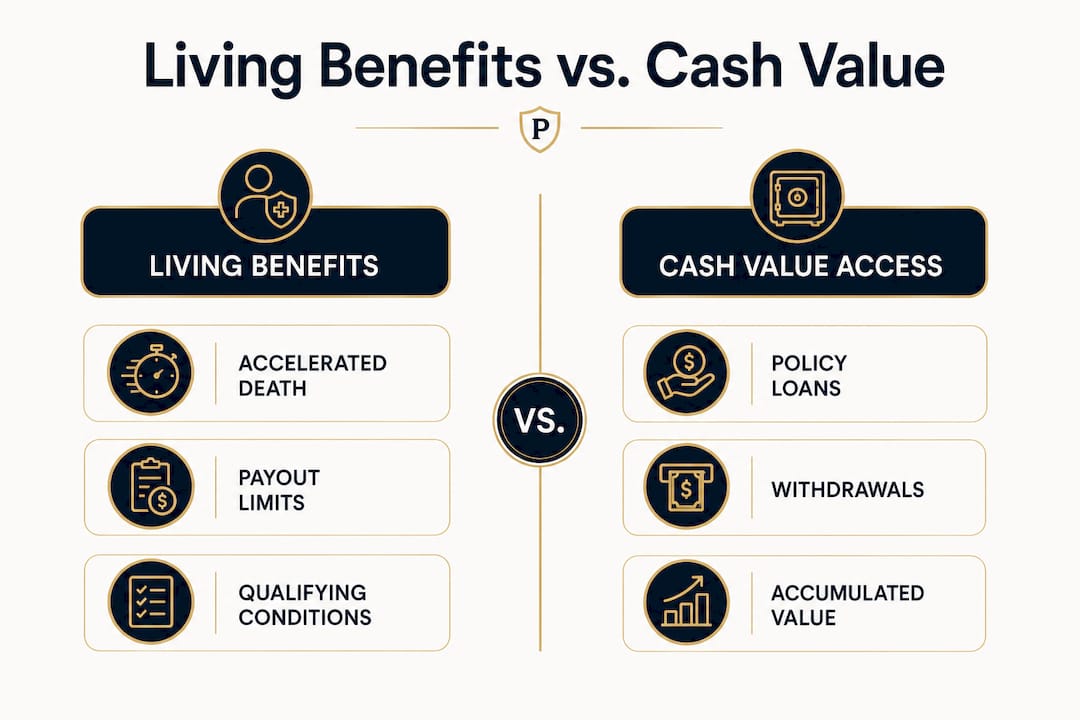
The critical distinction for retirement planning: cash-value access (policy loans and withdrawals from accumulated value) and accelerated death benefits (rider payouts drawn against the death benefit) are separate mechanisms with different tax treatment and different effects on what your beneficiaries receive.
State insurance departments and NAIC model regulations set the qualifying conditions, payout limits, and interest-charge limits that govern ADB riders. Always consult your state DOI’s guidance alongside any carrier illustration.
How living-benefit riders actually work inside an IUL
Living benefits work differently than loans or withdrawals. When you exercise an ADB rider, you’re accelerating the death benefit — and that acceleration operates like a lien: the amount paid out, plus any interest or administrative charges the carrier applies, is deducted from the remaining death benefit.
Here’s the mechanics sequence inside an IUL:
- Index crediting: Your cash value earns interest tied to an external index (commonly the S&P 500), subject to a cap rate and participation rate set by the carrier. A 0% floor protects against index losses, but caps limit upside.
- COI and rider charges: Each month, the insurer deducts cost-of-insurance charges (based on your age, health, and net amount at risk) plus any rider fees. These charges reduce the cash value available for accumulation and future loans.
- Rider trigger: To activate a chronic-illness or LTC rider, you must submit clinical documentation proving you meet the ADL threshold. Terminal illness riders typically require physician certification of a qualifying prognosis.
- Payout method: Terminal and critical illness ADBs are usually paid as a lump sum. LTC riders typically pay monthly. The carrier may offer a choice; each option carries different fee structures.
- Effect on remaining policy: Every dollar accelerated reduces the death benefit. If the policy also has an outstanding loan balance, the interaction between the loan, the ADB payout, and remaining cash value can accelerate lapse risk.
Policy loans from an IUL are generally income-tax-free as long as the policy remains in force and is not a MEC. Withdrawals up to your cost basis (premiums paid) are also typically tax-free; amounts above basis may be taxable. MEC status changes all of that — distributions from a MEC are taxed as income first, with a 10% penalty if taken before age 59½.
Pro Tip: Ask your advisor to run a side-by-side comparison: policy loan income stream vs. ADB payout stream. The tax treatment, effect on death benefit, and lapse risk differ enough that the “right” choice depends entirely on your health trajectory and income needs at the time.
Two warnings worth repeating: First, IUL illustrations are not guarantees. Non-guaranteed values assume index credits at a hypothetical rate that may never materialize. Second, if premiums aren’t increased to offset rising COI charges as you age, the policy can lapse — wiping out both the death benefit and the tax-advantaged cash value you’ve built.

What do living benefits actually cost inside an IUL?
Direct costs are the ones most buyers underestimate. Some carriers include the ADB rider at no extra charge; others charge an additional premium or deduct a processing fee when the rider is exercised. Neither structure is automatically better — what matters is the net effect on your illustrated cash value over 20–30 years.
Direct costs to quantify:
- Rider fees (flat annual charge or percentage of death benefit)
- Processing or administrative fees charged at the time of ADB exercise
- Increased COI as you age, which accelerates cash-value drain in later policy years
- Any interest the carrier charges on the ADB “lien” against the remaining death benefit
Indirect costs that don’t show up as line items:
- Reduced death benefit for beneficiaries after an ADB payout
- Lower cash value available for policy loans if rider charges have been deducting for years
- Higher lapse probability if illustrated index credits are not achieved and premiums aren’t adjusted
Payouts can range from 25% to 100% of the death benefit depending on policy language — some policies set the maximum at 50% or 75% for chronic illness, while terminal illness riders may allow up to 100%. Review the specific rider language in your policy to confirm the applicable cap.
Underwriting matters here too. Older applicants or those with pre-existing conditions may face higher base premiums, excluded riders, or reduced payout caps. A rider that looks affordable at age 45 may carry a materially different cost structure at age 55.
Pro Tip: When comparing illustrations from different carriers, ask each one to show the rider charge schedule across all policy years — not just year one. Rider costs that look negligible early can compound into significant cash-value drag by the time you need the income.
What should you verify before relying on living benefits for retirement income?
Most people ask the wrong questions when reviewing a policy. Here’s what actually matters:
- Is the rider included or charged separately? Confirm in writing whether the ADB or chronic illness rider is part of the base policy or requires an added premium. If charged only on exercise, ask exactly how the fee or reduction is calculated.
- What are the exact trigger definitions? Request the full rider language, not the summary. ADL definitions vary by carrier; vague or subjective triggers can make access difficult when you need it most.
- What payout options exist? Lump sum vs. monthly payments carry different tax and cash-flow implications. Ask whether you can choose at the time of claim.
- What does the illustrated impact look like? Demand a policy illustration that shows cash value, death benefit, and projected loan income both with and without the rider charges across all policy years.
- What are the guaranteed vs. non-guaranteed values? The difference between these two columns in an illustration is where retirement income projections can fall apart. Never plan around the non-guaranteed column alone.
- What are the caps, participation rates, and loan interest rates? These three variables drive the actual income the policy can produce. Get them in writing.
- What happens in a worst-case scenario? Ask the advisor to model a scenario with lower index credits and higher COI than illustrated. If the policy lapses in that scenario, the retirement income plan fails.
Pro Tip: Request the policy’s “guaranteed illustration” as a standalone document. If the guaranteed scenario shows the policy lapsing before your projected retirement income period ends, the non-guaranteed version is not a plan — it’s a bet.
When shopping for policies, comparing life insurance illustrations across carriers side-by-side is one of the most practical steps you can take before committing to any structure.
How to implement the Dual Purpose Retirement Strategy™ with IUL and living benefits
Implementation requires advisor-led modeling of cash-value growth, rider costs, and tax consequences before committing to any premium structure.
- Eligibility review: A licensed advisor assesses your age, health, existing retirement accounts (401(k), IRA), income, and risk tolerance to determine whether an IUL-based strategy is suitable.
- Premium budgeting: Determine the premium level that maximizes cash-value accumulation without triggering MEC status. This is a precise calculation — overfunding by even a small amount changes the tax treatment of every future distribution.
- Illustration modeling: Run both guaranteed and non-guaranteed scenarios across multiple index-credit assumptions. The gap between them is the risk you’re accepting.
- Sensitivity testing: Model what happens if index credits come in 2–3 percentage points below the illustrated rate, or if COI charges increase faster than projected. A strategy that only works under optimistic assumptions isn’t a strategy.
- Suitability assessment: The advisor documents why this structure fits your situation. Permanent policies typically cost materially more than term on a per-dollar-of-coverage basis; that premium differential must be justified by the tax and income benefits modeled.
- Ongoing policy audits: Annual reviews to check whether the policy is on track, whether COI increases require premium adjustments, and whether the rider structure still fits your health and income needs.
Consider a simplified example: a client in their mid-50s with a funded 401(k) wants a second tax-advantaged income stream for retirement. An IUL policy is structured to accumulate cash value over 10–15 years, with policy loans providing tax-free income in retirement. A chronic illness rider is added so that if a qualifying health event occurs, accelerated benefits provide a separate income layer without disrupting the loan-based income stream. The modeled outcome shows two distinct income sources from the same premium dollar — the core premise of the Dual Purpose Retirement Strategy™.
The Dual Purpose Retirement Strategy™ is designed for clients who have already maximized traditional tax-advantaged accounts and are looking for a complementary structure — not a replacement for a 401(k) or IRA.
Progressiveplanner packages this entire process as the Dual Purpose Retirement Strategy™, including illustration review, rider cost disclosure, and suitability documentation. When modeling long-term care costs alongside retirement cash flow needs, having both income streams mapped in a single plan changes what’s possible.
This article is general information, not personalized financial or legal advice. Consult a licensed insurance or financial advisor and review a full policy illustration before making any decisions about your specific situation.
Key Takeaways
Living-benefit riders on an IUL can create a second tax-advantaged income stream, but only when rider costs, MEC limits, and worst-case illustrated scenarios are fully modeled before purchase.
| Point | Details |
|---|---|
| ADB reduces the death benefit | Every accelerated payout is deducted dollar-for-dollar from what beneficiaries receive. |
| Rider costs vary by carrier | Some carriers include ADB riders at no charge; others charge fees at exercise or add a premium. |
| MEC risk is real | Overfunding an IUL past IRS limits changes the tax treatment of all distributions. |
| Demand both illustration columns | Non-guaranteed projections can look compelling; the guaranteed column shows the actual floor. |
| Progressiveplanner’s structured path | The Dual Purpose Retirement Strategy™ models both income streams with full rider cost and suitability disclosure. |
When living benefits belong in a retirement plan
Most advisors present living benefits as a safety net. That framing undersells what they can do inside a well-structured IUL — and oversells what they do in a poorly structured one.
The Dual Purpose Retirement Strategy™ works best for clients who have already funded their 401(k) and IRA to the limit and are looking for a tax-advantaged complement, not a replacement. It is not the right tool for someone who needs maximum death benefit coverage at the lowest possible cost, or for someone whose budget doesn’t support the premium level required to keep the policy from lapsing under adverse conditions.
What builds trust in this process isn’t the illustration software. It’s the advisor’s willingness to show you the worst-case scenario first, disclose every rider charge, and tell you plainly when the strategy doesn’t fit. That’s the standard Progressiveplanner holds its consultations to.
See how the Dual Purpose Retirement Strategy™ works for your situation
Most retirement income reviews focus on one bucket. Progressiveplanner’s approach starts with a different question: what if the same premium dollar funded two separate tax-advantaged income streams, with a living-benefit layer built in for health events that would otherwise derail the plan?

A free retirement income review with Progressiveplanner includes a full illustration comparison (guaranteed vs. non-guaranteed), a rider cost breakdown across all policy years, and a suitability assessment that tells you plainly whether an IUL-based strategy fits your situation. You’ll leave with a modeled projection, not a sales pitch.
To get started, request your retirement income review at Progressiveplanner. The consultation is structured around your existing accounts, your income goals, and the specific living-benefit riders that match your health profile and retirement timeline.
Authoritative sources for further reading
- ALDOI — Questions and Answers on Accelerated Benefits: Alabama DOI’s plain-language Q&A on ADB mechanics, ADL trigger standards, and interest-charge limits under state model regulations.
- MassMutual — What Are Living Benefits in a Life Insurance Policy?: Industry-level overview of rider types, how ADBs work, and the distinction between chronic illness and LTC riders.
- Aflac — What Is an Accelerated Death Benefit Rider?: Carrier-level explanation of ADB mechanics, lump-sum vs. monthly payout structures, and typical tax treatment.
- Aflac — Living Benefits of Life Insurance: Covers cash-value access, MEC risk, and the tax treatment of loans vs. withdrawals in permanent policies.
- III.org — Why Should I Buy Life Insurance?: Insurance Information Institute overview of life insurance use cases, including cash-value accumulation as a tax-deferred savings vehicle.
- MoneyGeek — Is Life Insurance Worth It?: Analysis of permanent vs. term cost trade-offs and the importance of modeling guaranteed vs. non-guaranteed illustration scenarios.
- Progressiveplanner — Dual Purpose Retirement Strategy™: The firm’s structured methodology for using IUL policies to create two tax-advantaged retirement income streams, including consultation and illustration review process.