
IUL for Retirement: When It Supplements Your 401(k)

An indexed universal life (IUL) policy can realistically supplement your retirement savings, but it rarely makes sense as a standalone replacement for a 401(k) or Roth IRA. Two facts drive that verdict: policy loans can be tax-free under IRC Section 72(e) as long as the policy stays in force, and a 0% floor protects your cash value from index losses in down years. Those two features are genuinely useful. The catch is that internal costs, crediting caps, and complexity make an IUL a second-priority tool for most people.
Before you go further, here are three concrete next steps:
- Capture your employer match first. The 401(k) employer match is an immediate, high-return benefit with no equivalent in an IUL. Fund it to the match limit before allocating dollars anywhere else.
- Compare projected after-tax income. Ask any advisor to show you side-by-side after-tax income from an IUL versus your current 401(k) and a Roth IRA, using the same dollar amount and time horizon.
- Request specific policy documents. Before signing anything, ask for the full illustration (guaranteed vs. non-guaranteed columns), the guaranteed maximum cost table, and the carrier’s historical crediting rates.
Table of Contents
- What is an indexed universal life (IUL) policy?
- How does an IUL build cash value and how do you access it?
- How does the tax treatment work, and what is a LIRP?
- IUL vs. 401(k) vs. Roth IRA vs. annuity: which should you prioritize?
- Pros and cons of using an IUL for retirement
- What fees and costs should you check in an IUL illustration?
- Who is an IUL actually right for?
- How should you structure an IUL to generate retirement income?
- What red flags should stop you from buying an IUL?
- A simple numeric example: IUL vs. Roth IRA vs. 401(k) outcomes
- How Progressiveplanner’s Dual Purpose Retirement Strategy™ implements IULs
- How to decide: checklist and ten questions to ask an advisor
- How does inflation affect IUL cash value and retirement income reliability?
- What happens if the policy lapses or underperforms, and how do you plan for it?
- How to integrate an IUL within a broader retirement strategy
- Key Takeaways
- What most people get wrong about IULs as retirement tools
- See how Progressiveplanner structures an IUL for your retirement
- Authoritative sources and further reading
What is an indexed universal life (IUL) policy?
An IUL is a permanent life insurance policy that combines a death benefit with a cash-value account credited based on the performance of a stock market index, such as the S&P 500, without directly investing in that index.
The dual purpose is what makes it relevant for retirement planning. The insurance component protects your family while you’re accumulating wealth. The cash-value component can grow tax-deferred and, when structured correctly, be accessed in retirement through policy loans that are treated as loans rather than income.
Five terms appear in every IUL illustration, and you need to understand them before evaluating any offer:
- Cap: The maximum credited rate in a given period. If the index gains 18% but your cap is 10%, you receive 10%.
- Participation rate: The percentage of the index gain applied before the cap. A 90% participation rate on a 12% index gain credits 10.8% before the cap is applied.
- Floor: The minimum credited rate, commonly 0%, which prevents your cash value from losing ground due to index declines.
- Cash value: The accumulated account inside the policy from which you can borrow or withdraw.
- Loan provisions: The terms governing how you borrow against cash value, including interest rates and whether loans are fixed or variable.
How does an IUL build cash value and how do you access it?
When you pay a premium, the insurer deducts the cost of insurance (COI) and administrative fees, then credits the remainder to your cash-value account. That account earns interest based on index performance, subject to the cap and participation rate. In years when the index falls, the floor prevents a negative credit, though internal costs still apply regardless of market performance.
Caps commonly range from 8%–12%, which means strong bull markets produce capped gains while weak markets produce zero credits. The net result over time is a smoothed return that sits below what a direct index fund would deliver.
Three ways to access cash value:
- Policy loans: You borrow against the cash value. The loan is not taxable income while the policy remains in force. Unpaid loans reduce the death benefit and, critically, can trigger a lapse if the loan balance grows too large relative to the cash value.
- Withdrawals (partial surrenders): You remove cash value permanently. Withdrawals up to your cost basis are tax-free; amounts above it are taxable as ordinary income.
- Full surrender: You cancel the policy. Any gain above your cost basis becomes taxable income, and surrender charges may apply for the first 10–15 years.
The lapse risk deserves a direct warning. If rising COI charges, a high loan balance, and a period of low crediting converge, the policy can lapse. When it does, the entire outstanding loan balance becomes taxable income in that year. That is not a theoretical risk. It has happened to retirees who borrowed heavily and stopped monitoring their policy. Ongoing re-illustration and active loan management are not optional.
How does the tax treatment work, and what is a LIRP?
The tax mechanics are what make an IUL attractive as a Life Insurance Retirement Plan (LIRP). Cash value grows tax-deferred inside the policy. When you take policy loans in retirement, those loans are not reported as income as long as the policy remains in force, per IRC Section 72(e). The death benefit passes to beneficiaries income-tax-free under IRC Section 101(a). And unlike a traditional 401(k), an IUL has no required minimum distributions (RMDs), which means you control the timing of every distribution.
That RMD distinction matters more than it sounds. A retiree with a large traditional 401(k) faces mandatory taxable withdrawals starting at age 73, which can push them into a higher bracket and affect Medicare premiums. An IUL used as a LIRP provides a tax-free income layer that can offset those forced distributions.
The critical risk to the tax advantage is Modified Endowment Contract (MEC) status. If you fund a policy too aggressively relative to its death benefit, the IRS reclassifies it as a MEC. Once that happens, loans and withdrawals are taxed on a last-in, first-out basis, and a 10% penalty applies before age 59½. The tax-free loan benefit disappears entirely. Avoiding MEC status requires careful calibration of the premium-to-death-benefit ratio from day one.
Key rule: A properly structured IUL keeps the death benefit at the minimum allowed for a given premium level, preserving the tax-free loan treatment and staying out of MEC territory.
IUL vs. 401(k) vs. Roth IRA vs. annuity: which should you prioritize?
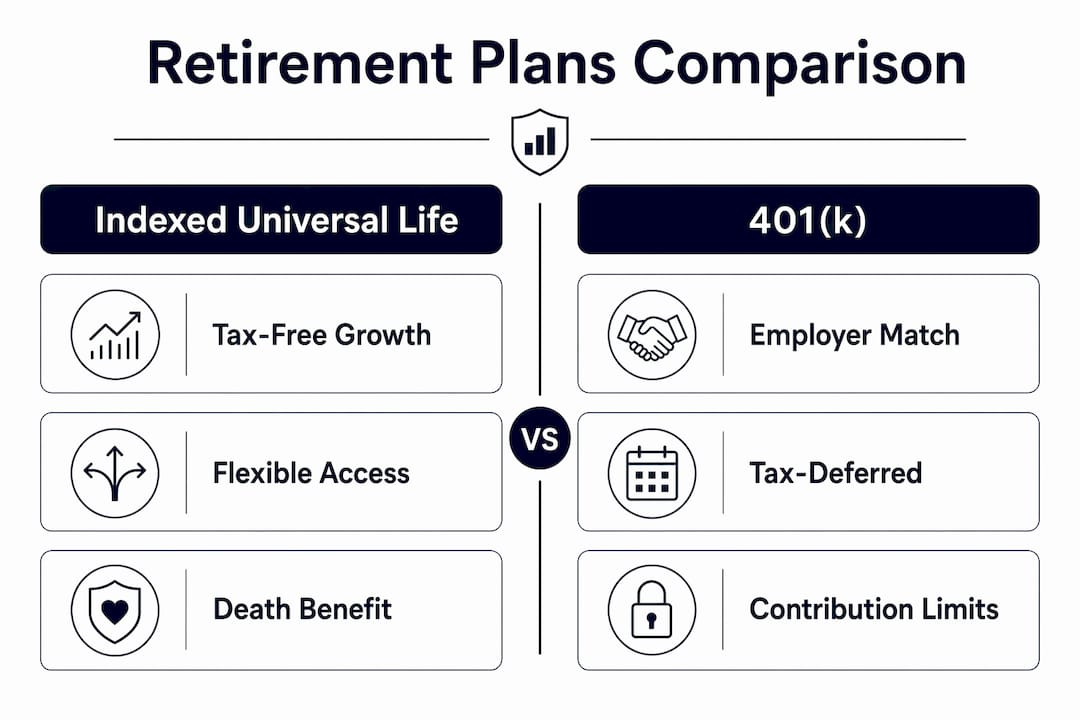
Start with one rule: capture the employer match in your 401(k) before allocating dollars to an IUL. That match is an immediate return with no equivalent elsewhere. After the match, the decision depends on your income, tax outlook, and whether you need permanent life insurance.

| Dimension | IUL | Traditional 401(k) | Roth IRA | Annuity |
|---|---|---|---|---|
| Tax treatment | After-tax premiums; tax-deferred growth; tax-free loans (if in force) | Pre-tax contributions; taxable distributions | After-tax; tax-free qualified withdrawals | Varies (pre- or after-tax); taxable distributions |
| Growth potential | Capped at 8%–12%; 0% floor | Uncapped market returns | Uncapped market returns | Fixed or variable; often lower ceiling |
| Fees and charges | High: COI, admin, rider, surrender charges (2%–4% annually) | Low-to-moderate: fund expense ratios, plan admin | Very low: index funds as low as 0.03% | Moderate-to-high: mortality, expense, surrender |
| Liquidity / early access | Policy loans at any age, no 10% IRS penalty | 10% penalty before age 59½ (exceptions apply) | Contributions anytime; earnings penalized before 59½ | Surrender charges; penalties before 59½ |
| Guarantees / insurer risk | 0% floor; subject to insurer solvency | ERISA protections; SIPC does not apply | SIPC does not apply; FDIC if in bank IRA | Insurer guarantee; state guaranty fund limits apply |
| Employer match / limits | No match; no IRS contribution limit (MEC rules apply) | Match available; $22,500 limit | No match; $7,500 limit ($8,600 if 50+) | No match; varies by product |
| Legacy / death benefit | Yes, income-tax-free | Taxable to beneficiaries | Inherited; IRS rules apply | Depends on product; often no death benefit |
Who should prioritize each vehicle:
- 401(k) to the match: Everyone with an employer match. Non-negotiable first step.
- Roth IRA next: Single earners below $168,000 or married couples below $252,000 should max the Roth before considering an IUL. Lower fees and uncapped growth make it the better pure-retirement vehicle for most people.
- IUL as a supplement: High earners above Roth income limits, those who have maxed both accounts, or anyone who needs permanent life insurance alongside tax diversification.
- Annuity alongside IUL: Annuities and IULs are often used together. Annuities provide a guaranteed income floor; IULs provide flexible, tax-free income and a death benefit. The two serve different goals and can complement each other in a broader plan.
For a deeper look at the 401(k) vs. Roth IRA prioritization decision before layering in an IUL, the 401(k) vs. Roth IRA comparison at Wealth Assimilation walks through the trade-offs clearly.
Pros and cons of using an IUL for retirement
Pros:
- Tax-free policy loans in retirement (when the policy stays in force and avoids MEC status)
- 0% floor protects cash value from index losses in down years
- No RMDs, giving you full control over distribution timing
- Permanent death benefit, income-tax-free to beneficiaries
- No IRS contribution limits (subject to MEC rules), useful for high earners who have maxed other accounts
- Early access to cash value via loans without the 10% IRS penalty that applies to 401(k)/IRA early withdrawals
Cons:
- Caps limit upside to a moderate range in strong markets; a Roth IRA captures full index gains
- Internal costs of 2%–4% annually reduce effective returns significantly
- COI charges rise with age, compressing cash value growth in later years
- MEC risk if the policy is overfunded relative to the death benefit
- Complexity of illustrations makes it easy to be misled by optimistic projections
- Policy lapse with outstanding loans triggers a potentially large taxable event
Pro Tip: Many illustrations use cap and participation assumptions at or near current carrier maximums. Always ask for a scenario where the cap drops 2–3 percentage points from the illustrated rate. That sensitivity test reveals how fragile the projected income stream really is.
What fees and costs should you check in an IUL illustration?
Internal costs are the single biggest reason IUL returns diverge from what an illustration suggests. Every dollar going to fees is a dollar not compounding in your cash value.
The main cost types to understand: cost of insurance (COI) covers the mortality charge for the death benefit and rises every year as you age; premium loads are a percentage deducted from each premium before it reaches the cash value account; administrative fees are flat monthly charges; rider charges apply to optional features like overloan protection or chronic illness riders; and surrender charges penalize early policy cancellation, typically lasting over a long initial period.
COI increases are the sleeper risk. In the early years of a policy, COI is modest. By your 70s and 80s, it can consume a meaningful portion of your cash value, especially if crediting rates are low. The guaranteed maximum cost table in the illustration shows the worst-case COI trajectory. If an agent does not provide that table, ask for it explicitly.
Documents to request before committing to any IUL:
- Full illustration with guaranteed and non-guaranteed columns side by side
- Guaranteed maximum cost table (shows worst-case COI at every age)
- Loan interest schedule (fixed vs. variable rate, and the spread)
- Historical carrier crediting rates for the specific index strategy you are being shown
- Best-case, expected, and worst-case projection scenarios
- MEC testing scenarios showing the maximum premium for your chosen death benefit
Who is an IUL actually right for?
An IUL works best as a retirement supplement for a specific profile, not as a universal savings tool.
Suitability checklist:
- High earner who has already maxed a 401(k) and Roth IRA (or earns above the Roth income limit)
- Consistent funding capacity over a 10+ year horizon; irregular premiums create lapse risk
- Genuine need for permanent life insurance alongside accumulation
- Interest in tax diversification: having a tax-free income source alongside taxable 401(k) distributions
- Estate planning goals where a tax-free death benefit adds value
Who should skip an IUL (for now):
- Savers who have not yet captured their full employer 401(k) match
- Anyone who cannot commit to consistent premiums over a long horizon
- Lower-to-middle income earners who are still eligible for a Roth IRA at low cost
- People who want a simple, low-fee account without ongoing monitoring requirements
One timing note: starting earlier compounds better, but mid-career designs in your 40s are viable with careful structuring. The key variable is how many years the cash value has to grow before distributions begin. A 10-year runway is a rough minimum; 20+ years is where the tax-free income advantage becomes most pronounced.
How should you structure an IUL to generate retirement income?
The design choices made at policy inception determine whether an IUL functions as a retirement income tool or an expensive life insurance policy with modest savings attached.

The most important structural decision is the premium-to-death-benefit ratio. A max-funded IUL uses the minimum death benefit allowed for a given premium level. That keeps COI charges low, directs more premium to cash value, and stays below the MEC threshold. An agent who leads with a large death benefit and modest premium is designing for insurance sales, not retirement income.
Loan structure matters almost as much. Fixed-rate loans provide predictability; variable-rate loans can erode cash value faster than projected if rates rise. Understand whether your policy uses a wash loan (where the credited rate and loan rate are equal, so the borrowed cash value continues to earn), because that structure significantly affects long-term income projections.
For index allocation, most policies offer multiple strategies. Diversifying across two or three crediting methods (different indices or segment durations) reduces the risk that one poor-performing strategy dominates your results.
Avoid cost-heavy riders that do not directly support accumulation. An overloan protection rider is worth considering because it prevents lapse when loan balances grow large in retirement. Most other riders add COI without adding cash value.
Once distributions begin, the policy needs active monitoring. Request a re-illustration every two to three years. If the projected policy lapse date moves closer, you may need to reduce loan amounts, add premium, or adjust the death benefit.
What red flags should stop you from buying an IUL?
Not every IUL offer is worth pursuing. These warning signs should give you pause:
- Illustration shows only non-guaranteed values. If the agent does not show the guaranteed column, walk away. The guaranteed column reveals what happens under worst-case cost and crediting assumptions.
- No historical carrier crediting data. Cap rates are not fixed. Carriers can and do reduce them. An agent who cannot provide the carrier’s actual crediting history for the past 10 years is hiding something.
- Projections assume consistent high caps. An illustration that shows 10%–12% crediting every year for 30 years is not realistic. Ask what the carrier’s average credited rate has been historically.
- Vague loan interest language. If the illustration does not specify whether loan interest is fixed or variable and what the current and maximum rates are, the income projections are unreliable.
- Missing guaranteed maximum cost table. Without this, you cannot model what happens to cash value if COI rises to its contractual maximum.
- No overloan protection provision. For a policy designed to distribute income for 20–30 years, overloan protection is a structural safeguard, not an optional add-on.
The lapse-and-tax cliff is the worst outcome. If a retiree borrows heavily, COI rises with age, crediting drops, and the policy lapses, the entire outstanding loan balance becomes taxable income in one year. That can produce a tax bill large enough to offset years of tax-free income. The risk is manageable with proper design and monitoring. It is catastrophic when ignored.
A simple numeric example: IUL vs. Roth IRA vs. 401(k) outcomes
The Mutual of Omaha illustration below uses a 35-year-old male who funds an IUL policy with $6,000 annually until age 70, a 35-year accumulation period. It is a carrier-provided illustration, not a guarantee, and assumes a 6.69% annual credited rate.
| Scenario | Annual contribution | Years funded | Assumed return / credit | Estimated cash value at 70 | Annual tax-free income |
|---|---|---|---|---|---|
| IUL (illustrated) | $6,000 | 35 | 6.69% credited | $631,000+ | ~$50,000/year |
| Roth IRA (index fund) | $7,500/year (2026 limit) | 35 | Uncapped market return | Higher potential; no death benefit | Tax-free; no RMDs |
| Traditional 401(k) | — | 35 | Uncapped market return | Higher potential; larger contributions | Taxable at ordinary income rates |
Key assumptions and caveats:
- The IUL illustration assumes consistent 6.69% annual crediting. Caps of 8%–12% mean this is achievable in moderate markets but not guaranteed.
- The Roth IRA comparison uses the 2026 contribution limit of $7,500 ($8,600 if age 50+). A Roth invested in low-cost index funds carries fees as low as 0.03% versus 2%–4% annually for an IUL.
- The 401(k) contribution limit is substantially higher, allowing more capital allocation, plus the advantage of an employer match.
- Sensitivity note: If the IUL cap drops from 10% to 7%, the illustrated income stream shrinks materially. If variable loan interest rises 1–2 percentage points during the distribution phase, the policy’s projected lapse date moves forward. Neither scenario is extreme. Both are worth modeling before committing.
The IUL’s advantage in this comparison is not raw accumulation. It is the combination of tax-free income, no RMDs, and a death benefit. For a high earner who has already maxed the 401(k) and Roth, that combination adds genuine value. For someone still below the Roth income limit with room to contribute, the Roth wins on cost and simplicity.
For a broader view of how to combine these vehicles into a coherent income plan, the retirement income bucket strategy at Wealth Assimilation shows how tax-free, taxable, and guaranteed income sources can be sequenced in retirement.
How Progressiveplanner’s Dual Purpose Retirement Strategy™ implements IULs
Progressiveplanner’s Dual Purpose Retirement Strategy™ is built on one core idea: the same dollar can create two tax-advantaged income streams instead of one. By pairing an IUL with an existing 401(k) or IRA, the strategy positions the IUL’s tax-free loan income alongside the qualified plan’s tax-deferred accumulation, addressing both future tax liability and market downside risk from a single savings effort.
What clients typically receive in a review:
- A side-by-side after-tax income comparison showing projected income from the existing retirement account versus a combined IUL and qualified-plan approach
- A full policy illustration with guaranteed and non-guaranteed columns, cost tables, and loan schedules
- Funding scenarios that test MEC limits and model the effect of different premium levels on retirement income
- An ongoing monitoring framework covering re-illustration intervals and loan management guidelines
Progressiveplanner works with licensed insurance and financial advisors to structure IUL policies for retirement income, not just death benefit coverage. The design emphasis is on max-funded policies with minimum death benefit ratios, overloan protection, and realistic crediting assumptions.
Realistic limits to state clearly: IUL outcomes depend on insurer solvency, carrier crediting decisions, and consistent premium funding. Illustrations are projections, not guarantees. Underwriting approval is required, and health status affects eligibility and cost. This content is general information, not personalized financial or tax advice. Confirm current IRS rules and your specific situation with a qualified professional.
How to decide: checklist and ten questions to ask an advisor
Document checklist before any IUL commitment:
- Full illustration: guaranteed column and non-guaranteed column, side by side
- Guaranteed maximum cost table showing worst-case COI at every policy year
- Loan provisions: fixed vs. variable rate, current rate, maximum contractual rate
- Carrier historical crediting rates for the specific index strategy (10-year minimum)
- MEC testing scenarios: maximum annual premium for your chosen death benefit
- Best-case, expected, and worst-case projection scenarios at different cap assumptions
- Surrender charge schedule showing penalties by policy year
Ten questions to ask your advisor:
- What is the minimum death benefit for my planned premium, and is the policy designed to that minimum?
- Is the loan interest fixed or variable, and what is the maximum contractual loan rate?
- Can you show me the guaranteed maximum cost table and walk me through the worst-case cash value projection?
- What has this carrier’s actual average credited rate been for this index strategy over the past 10 years?
- What happens to the projected policy lapse date if the cap drops 3 percentage points from the illustrated rate?
- Does this policy include overloan protection, and what triggers it?
- What is the projected loan interest accumulation during the distribution phase, and how does it affect the death benefit?
- What are the surrender charges, and in what year do they expire?
- What are the guaranteed values at age 80 and 90 under the worst-case cost and crediting scenario?
- How often will you re-illustrate the policy once distributions begin, and what monitoring triggers a design adjustment?
Read every illustration with three scenarios in front of you: best case, expected, and worst case. If an agent provides only one scenario, that is itself a red flag. Independent modeling from a fee-only advisor who does not earn a commission on the sale adds a layer of objectivity that is worth the cost.
How does inflation affect IUL cash value and retirement income reliability?
Inflation creates a quiet but persistent drag on IUL retirement income. Policy loans produce a fixed nominal dollar amount. If inflation runs at 3%–4% annually over a 20-year retirement, the purchasing power of a $50,000 annual loan declines substantially by the later years.
The 0% floor protects against nominal loss in down markets, but it does not protect against real purchasing power erosion. A year where the index returns 0% and inflation runs at 4% is a year where your effective retirement income lost ground. Crediting caps compound this problem: in high-inflation environments, equity markets often produce returns well above the cap, meaning the IUL captures only a fraction of the inflation hedge that direct equity exposure would provide.
One practical response is to design the policy with a slightly higher initial loan amount and plan to reduce distributions in later years, or to pair the IUL with an inflation-adjusted income source such as Social Security or a cost-of-living-adjusted annuity. The IUL’s tax-free income is most valuable in the early retirement years when tax bracket management matters most. Relying on it as the sole income source through a 30-year retirement without an inflation adjustment plan is a structural gap worth addressing in the design phase.
What happens if the policy lapses or underperforms, and how do you plan for it?
Policy lapse is the worst-case scenario for an IUL used as a retirement income vehicle. It can happen through a combination of factors: sustained low crediting (years of 0% or near-0% credits), rising COI charges in the insured’s 70s and 80s, and a loan balance that grows faster than the cash value supports.
When a policy lapses with outstanding loans, the IRS treats the loan balance as a distribution. If that balance is $300,000 and you are in the 24% bracket, the tax bill arrives in a single year with no ability to spread it. That outcome can wipe out years of tax-free income in one filing.
Contingency planning steps:
- Set a re-illustration trigger: if the projected lapse date falls within 10 years of your current age, take action immediately.
- Reduce loan amounts before the policy reaches a critical cash value threshold rather than waiting for the insurer to notify you.
- Consider adding premium if cash value is declining faster than projected.
- Understand the overloan protection rider’s trigger conditions so you know when it activates and what it costs.
Underperformance short of lapse is more common and more manageable. If crediting runs below the illustrated rate for several years, the projected income stream shrinks. A policy designed with conservative assumptions (lower cap, higher cost) has more buffer than one illustrated at maximum crediting. That is another reason to insist on worst-case projections before purchase.
How to integrate an IUL within a broader retirement strategy
An IUL works best as one layer in a multi-vehicle retirement plan, not as the whole plan. The sequencing logic is straightforward: tax-deferred accumulation in a 401(k) captures the employer match and reduces current taxable income; a Roth IRA (or backdoor Roth for high earners) provides tax-free growth with uncapped returns; and an IUL adds a third layer of tax-free income with downside protection and a death benefit.
Each vehicle covers a different risk. The 401(k) addresses accumulation efficiency. The Roth addresses tax-free growth without insurance costs. The IUL addresses tax diversification, legacy planning, and the specific risk of RMD-driven bracket creep in retirement. Annuities can sit alongside all three, providing a guaranteed income floor that none of the other vehicles offer.
The practical integration question is funding priority. Most financial planners recommend the sequence: 401(k) to the match, then Roth IRA to the limit, then IUL with remaining capacity. For high earners above the Roth income limit, the sequence becomes: 401(k) to the match, then IUL or backdoor Roth depending on whether permanent insurance is needed.
One integration risk to manage: over-allocating to an IUL at the expense of liquid savings. Policy loans are accessible, but they are not the same as a liquid emergency fund. Maintaining three to six months of expenses in a separate liquid account remains necessary even when an IUL is part of the plan.
Key Takeaways
An IUL can generate meaningful tax-free retirement income, but only when it supplements a funded 401(k) and Roth IRA, is structured with minimum death benefit ratios, and is actively monitored throughout the distribution phase.
| Point | Details |
|---|---|
| Prioritize the employer match | Fund your 401(k) to the full employer match before allocating any dollars to an IUL. |
| IUL as a tax diversification tool | IUL policy loans can be tax-free under IRC 72(e), adding a tax-free income layer alongside taxable 401(k) distributions. |
| Caps and costs reduce returns | IUL fees run 2%–4% annually and caps of 8%–12% limit upside; a Roth IRA in index funds costs as little as 0.03%. |
| Lapse risk is real | If a policy lapses with outstanding loans, the full loan balance becomes taxable income in that year. |
| Progressiveplanner’s approach | Progressiveplanner’s Dual Purpose Retirement Strategy™ structures IULs alongside existing retirement accounts to create two tax-advantaged income streams from the same savings. |
What most people get wrong about IULs as retirement tools
The conventional framing of an IUL as either a retirement miracle or a scam misses the actual decision. It is neither. It is a specialized tool with a specific use case: high earners who need permanent life insurance, have maxed their qualified accounts, and want a tax-free income layer that is not subject to RMDs. For that profile, a well-designed IUL adds real value. For everyone else, the fees and complexity outweigh the benefits.
What gets underestimated is the monitoring requirement. An IUL is not a policy you fund and forget. The crediting environment changes. COI charges rise. Loan balances compound. A policy that looked healthy at 65 can be in trouble at 78 if no one has looked at it in a decade. The advisors who sell IULs well are the ones who build re-illustration schedules and loan management checkpoints into the client relationship from day one. The ones who do not are the ones whose clients end up with unexpected tax bills in their 80s.
The other underestimated factor is the MEC risk at inception. Overfunding a policy by even a small amount in the early years can trigger MEC reclassification and eliminate the tax-free loan benefit permanently. Getting the premium-to-death-benefit ratio right from the start is not a detail. It is the foundation the entire strategy rests on.
See how Progressiveplanner structures an IUL for your retirement
Most retirement reviews focus on one account. Progressiveplanner’s Dual Purpose Retirement Strategy™ is built around a different question: how do you make the same dollar work in two tax-advantaged directions at once?

High earners, those approaching Roth income limits, and anyone who wants a tax-free income layer alongside their 401(k) are the people this strategy is designed for. A free retirement income review includes a side-by-side after-tax income comparison, a full IUL illustration audit with guaranteed and non-guaranteed columns, and funding scenarios that test MEC limits and model realistic crediting assumptions. You leave the review knowing exactly what an IUL would add to your specific plan, and what it would cost.
Schedule your free retirement income review at Progressiveplanner to see the numbers side by side.
Authoritative sources and further reading
- Internal Revenue Service (IRS): Primary source for IRC Section 72(e) (policy loan tax treatment), IRC Section 101(a) (death benefit income tax exclusion), and MEC classification rules. Start here for any tax question about IUL policy loans or death benefits.
- FINRA: The Financial Industry Regulatory Authority publishes investor guidance on life insurance products, including red flags in illustrations and how to evaluate insurance-based retirement products.
- SIPC: Clarifies which accounts carry SIPC protection (brokerage accounts) and which do not (insurance products like IULs), relevant when comparing IUL risk to brokerage-held retirement accounts.
- Mutual of Omaha — IUL Retirement Example: A carrier-provided numeric illustration showing how a 35-year-old funding $6,000 annually can accumulate $631,000+ in cash value and draw $50,000 per year in tax-free income. Useful as a concrete benchmark, with the understanding that it reflects illustrated, not guaranteed, values.
- Progressiveplanner — Dual Purpose Retirement Strategy™: For readers who want a personalized illustration audit and side-by-side income comparison, this is the starting point for a free retirement income review.