
Roth Conversion Ladder: Your 5-Year Retirement Playbook

A Roth conversion ladder is a multi-year plan that converts slices of pre-tax retirement accounts into a Roth IRA each year, then waits five tax years for each slice to become available penalty-free and tax-free. The single most important constraint: each conversion starts its own five-year clock beginning January 1 of the tax year you convert, regardless of which month you actually execute it.
Before you do anything else:
- Inventory your accounts. List every pre-tax balance (traditional IRA, 401(k), SEP IRA) and every after-tax or taxable balance you could use as bridge money.
- Identify bridge funds. You need five years of living expenses covered by non-Roth sources before the first conversion matures.
- Run a one-year tax projection. Size your first conversion to a specific marginal bracket before you move a dollar.
Table of Contents
- What a Roth conversion ladder actually is
- How the ladder mechanics actually work
- Step-by-step implementation with a worked example
- Tax traps you need to know before you convert
- Common mistakes that derail a ladder
- Is a Roth conversion ladder right for you?
- Alternatives and complementary strategies worth comparing
- Key Takeaways
- Why the ladder is more demanding than most guides admit
- Progressiveplanner’s Dual Purpose Retirement Strategy™ can work alongside your ladder
- Useful sources and further reading
What a Roth conversion ladder actually is
A Roth conversion ladder is not the same as making direct Roth contributions or executing a backdoor Roth. Direct contributions go into a Roth IRA from earned income, subject to annual limits and income caps. A backdoor Roth is a two-step workaround for high earners who exceed those income limits. A conversion ladder is different: you move existing pre-tax balances into a Roth IRA, pay ordinary income tax on the converted amount that year, and then wait for each tranche to mature.
The strategy works best for early retirees with large pre-tax balances and a multi-year runway before they need the money. It also suits anyone who expects their tax rate to rise later, whether from required minimum distributions, Social Security taxation, or Medicare surcharges. If you have a substantial pre-tax IRA pool but no employer 401(k) to absorb it, the pro-rata rule (explained below) can complicate things significantly.
How the ladder mechanics actually work
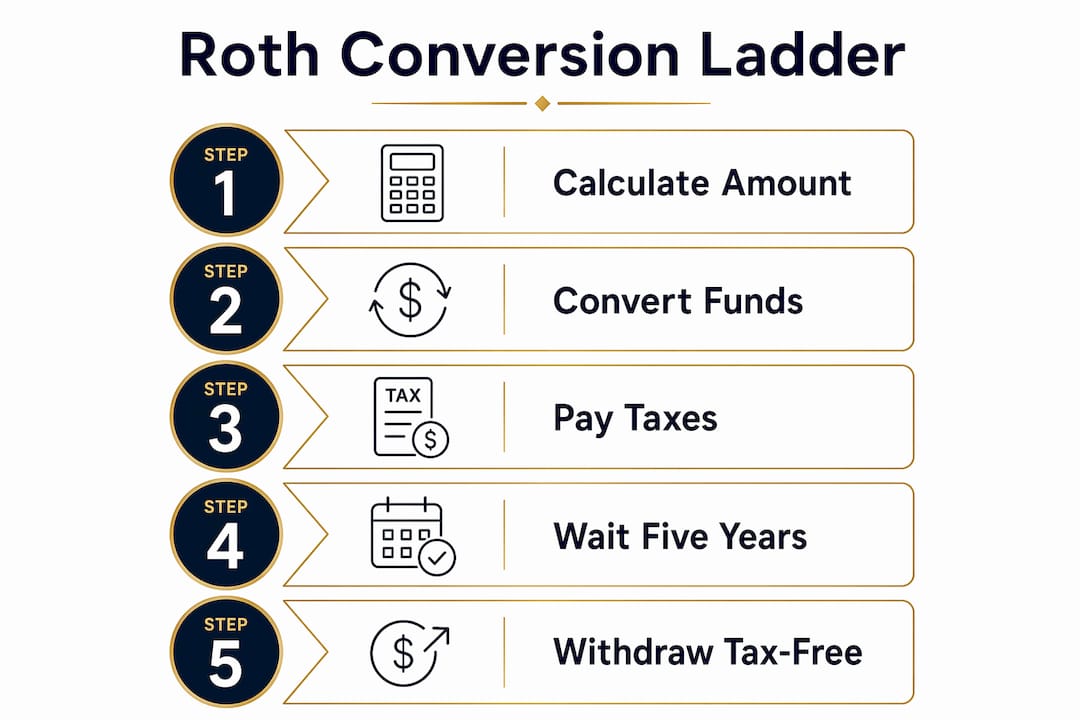
The five-year clock is the engine. Here is how it runs year by year:
- Year 1 (2026): Convert a portion from a traditional IRA to a Roth IRA. The clock starts January 1, 2026. This tranche unlocks January 1, 2031.
- Year 2 (2027): Convert another portion. Clock starts January 1, 2027. Unlocks January 1, 2032.
- Year 3–5: Repeat. Each conversion is independent.
- Year 6 (2031): The first tranche is available penalty-free. The ladder is now self-sustaining.
IRS ordering rules treat converted principal and Roth earnings differently. Converted principal follows its own five-year conversion clock. Roth earnings require both a five-year account-open period AND age 59½ before they come out tax-free. Pull earnings early and you owe income tax plus a 10% penalty.
For the five-year gap, common bridge sources include cash savings, money market funds, taxable brokerage accounts, prior Roth contributions (which can always be withdrawn tax-free), and 72(t) SEPP payments. Reverse mortgages are another option some retirees use for liquidity; home equity strategies can supplement bridge funding when other liquid assets are thin. Part-time income works too, though it affects your MAGI.

Pro Tip: Convert in December if you want to maximize the calendar year, but pay the resulting tax bill from a taxable account. Withholding taxes from the converted amount itself counts as an early distribution if you are under 59½, triggering the 10% penalty on the withheld portion.
Step-by-step implementation with a worked example
The six-step checklist:
- Roll your 401(k) to a traditional IRA (or keep pre-tax IRA funds in a 401(k) to sidestep the pro-rata rule).
- Run a tax projection to find your target bracket ceiling for the year.
- Convert the calculated amount directly from the traditional IRA to the Roth IRA.
- Pay the tax bill from a separate taxable account, not from the converted funds.
- File Form 8606 to document the conversion and establish your basis.
- Repeat annually. Set a calendar reminder so you never miss a year.
Worked example: an annual conversion amount sized to stay within your tax bracket, single filer, 2026
| Conversion Year | Amount Converted | Approx. Taxable Income (after standard deduction) | Approx. Federal Tax on Conversion | Unlock Year |
|---|---|---|---|---|
| 2026 | an amount sized to fit your bracket | your corresponding taxable income | your estimated tax | corresponding year |
| 2027 | an amount sized to fit your bracket | your corresponding taxable income | your estimated tax | corresponding year |
| — | an amount sized to fit your bracket | your corresponding taxable income | your estimated tax | corresponding year |
| — | an amount sized to fit your bracket | your corresponding taxable income | your estimated tax | corresponding year |
| — | an amount sized to fit your bracket | your corresponding taxable income | your estimated tax | corresponding year |
Assumes no other income, 2026 standard deduction of ~$14,600 for a single filer, and the 12% bracket applied to the taxable portion. Actual figures depend on your full income picture.
Keep a running log of each conversion date, amount, and the Form 1099-R you receive. The IRS does not track your ladder for you.
Tax traps you need to know before you convert
Conversions increase your MAGI, which can reduce or eliminate ACA premium tax credits. Converting $40,000 in a year when you are relying on marketplace subsidies could cost more in lost credits than you save in future taxes. Model this before you convert.
The pro-rata rule is the other major trap. If you hold pre-tax IRA balances, the IRS treats all your traditional IRAs as one pool. You cannot cherry-pick only after-tax basis to convert. The practical fix: roll pre-tax IRA funds into an employer 401(k) before you start converting, clearing the IRA pool so conversions draw from after-tax basis only.
There is no annual dollar cap on conversions, but converting too much in one year pushes you into a higher bracket. The discipline is sizing each conversion to fill a target bracket, typically 12% or 22%, without crossing into the next one. Converting during a down market is a legitimate tactic: you convert more shares for the same dollar amount, and those shares appreciate tax-free inside the Roth.
Medicare IRMAA surcharges kick in at higher MAGI thresholds, so retirees approaching Medicare age need to model conversion amounts against those brackets too.
Pro Tip: Keep a dedicated “tax-pay” account in a taxable brokerage. Fund it before conversion season each year so you are never tempted to withhold from the converted amount.
Common mistakes that derail a ladder
Missing a year. A skipped conversion creates a permanent gap in the payout stream five years later. There is no catch-up. Set an annual calendar reminder and treat the conversion like a bill.
Underfunding the bridge. The most common failure mode. If you run out of bridge money in year three, you either pull from the Roth early (penalty) or stop converting (gap). Build the full five-year bridge before you start.
Withholding taxes from the conversion. Covered above, but worth repeating: that withheld amount is treated as a distribution. Under 59½, it gets hit with the 10% penalty.
Ignoring the pro-rata pool. Starting conversions with a large pre-tax IRA balance and no 401(k) to absorb it means every conversion carries a taxable pro-rata share. Fix the pool first.
Signs you need an advisor immediately: a pre-tax IRA balance over $500,000 with no employer plan, ACA subsidy reliance, complex state tax exposure, or a SIMPLE IRA within its two-year holding period.
Is a Roth conversion ladder right for you?
Work through these before committing:
- Do you have at least five years before you need the converted funds? If not, the ladder cannot mature in time.
- Can you fund five years of living expenses from non-Roth sources?
- Do you expect your tax rate to stay the same or rise in retirement?
- Is your state income tax manageable on conversion income?
- Will conversions push you above ACA subsidy thresholds?
- Do you have a taxable account to pay conversion taxes without touching the converted funds?
Red flags: heavy pre-tax IRA balances with no 401(k) destination, ACA subsidy reliance at the conversion amounts you need, or no liquid taxable assets to cover the tax bill.
Questions to bring to your advisor:
- How will annual conversions affect my MAGI and ACA credits?
- Can we roll my pre-tax IRA into my 401(k) to clear the pro-rata pool?
- What is the optimal annual conversion size given my bracket and state taxes?
Alternatives and complementary strategies worth comparing
| Strategy | Best For | Key Constraint | Tax Profile |
|---|---|---|---|
| Roth conversion ladder | Early retirees with large pre-tax balances | 5-year gap; bridge funding required | Tax-free withdrawals after seasoning |
| Backdoor Roth | High earners above contribution limits | Pro-rata rule if pre-tax IRAs exist | Tax-free growth; annual contribution limits apply |
| Delay distributions | Those with sufficient taxable income | RMDs eventually force withdrawals | Deferred, not eliminated |
| IUL-based Dual Purpose | Tax diversification + downside protection | Premium funding discipline | Tax-advantaged loans; no contribution income limits |
Progressiveplanner’s Dual Purpose Retirement Strategy™ uses an Indexed Universal Life policy alongside traditional retirement accounts to create two tax-advantaged income streams from the same savings. Where a Roth ladder requires a five-year gap and a funded bridge, an IUL policy can provide tax-advantaged access to cash value without a seasoning clock, and it adds downside protection a Roth account does not carry. For clients with large pre-tax pools, complex pro-rata situations, or ACA subsidy constraints, the IUL component can act as the bridge itself, or as a long-term complement once the ladder is running.
Disclosure: the Dual Purpose Retirement Strategy™ is Progressiveplanner’s proprietary client offering. Suitability depends on individual circumstances and licensing.
Key Takeaways
A Roth conversion ladder succeeds or fails on two things: a fully funded five-year bridge and consistent annual execution.
| Point | Details |
|---|---|
| Five-year clock starts January 1 | A December conversion still counts from Jan 1 of that tax year; plan accordingly. |
| Bridge funding is non-negotiable | Cover five years of expenses from taxable or prior Roth contribution sources before starting. |
| Size conversions to your bracket | Fill the 12% or 22% bracket ceiling each year; never convert into a higher bracket unintentionally. |
| Pay taxes from a taxable account | Withholding from converted funds triggers a 10% penalty if you are under 59½. |
| Progressiveplanner’s Dual Purpose Strategy™ | An IUL-based complement that can serve as bridge funding or a parallel tax-advantaged income stream. |
Why the ladder is more demanding than most guides admit
The Roth conversion ladder is presented in most financial media as a clean, mechanical process. Convert, wait five years, withdraw. What those guides understate is the operational weight: you need a funded bridge, a tax-pay account, annual Form 8606 filings, and the discipline to convert every single year without exception. Miss one year and you have a permanent income gap five years out. That is not a recoverable error.
The other thing most guides skip: the ladder works brilliantly in isolation but gets complicated fast when you add ACA subsidies, a large pre-tax IRA pool, or state income taxes. Those interactions are where most DIY ladders break down. The math on a $40,000 annual conversion looks clean on paper. Add a $200,000 pre-tax IRA with no 401(k) destination and the pro-rata rule turns every conversion into a partial tax event you did not model for.
The clients who execute this well treat it like a financial instrument with tolerances, not a set-and-forget account move. They model it annually, adjust for income changes, and keep the bridge funded before they touch the conversion lever.
Progressiveplanner’s Dual Purpose Retirement Strategy™ can work alongside your ladder
The Roth ladder is a powerful tool. But it leaves a five-year gap at the start, demands a funded bridge, and gets complicated when pre-tax IRA balances are large. Progressiveplanner’s Dual Purpose Retirement Strategy™ addresses exactly those gaps by pairing an IUL policy with your existing retirement accounts, creating a second tax-advantaged income stream from the same savings dollar.

The IUL component can serve as your bridge fund, provide downside protection a Roth account does not offer, and generate tax-advantaged income without a five-year seasoning clock. To get started, schedule a retirement income review with Progressiveplanner. Bring your account balances, your most recent tax return, and a rough estimate of your bridge-funding capacity. The consultation is personalized; recommendations depend on your specific situation, licensing, and product suitability.
This content is general information, not personalized financial or tax advice. Confirm current IRS rules and your individual tax situation with a qualified professional before implementing any conversion strategy.
Useful sources and further reading
- How the Roth Conversion Ladder Works — Investopedia
- Roth Conversion Ladder Explained for FIRE — The College Investor
- Roth Conversion Ladder Guide — BridgeToRetired
- Roth Conversion Strategies and the Pro-Rata Rule — RetirePro
- Is a Roth IRA Conversion Right for You? — Vanguard
- How to Convert to a Roth and When to Do It — TIAA
- Roth Conversion Ladder: How It Works — NerdWallet
- Roth IRA Conversion Ladder: Real Numbers for 2026 — LifeLogic Media