
What Is IUL? Indexed Universal Life Explained

An Indexed Universal Life (IUL) policy is permanent life insurance that combines a death benefit with a cash-value account that credits interest linked to a stock-market index — such as the S&P 500 or NASDAQ-100 — rather than a fixed rate. The policy does not invest your money directly in the market. Instead, the insurer uses options to approximate index performance, which means you get some of the upside when markets rise and a floor (typically 0%) that limits losses when they fall.
Higher-income earners, pre-retirees, and people who have already maxed out their 401(k) and IRA contributions are the most common buyers. The appeal is straightforward: tax-deferred cash-value growth, a death benefit, and the ability to take tax-advantaged policy loans in retirement. That said, IUL is not a fit for everyone.
When an IUL might make sense:
- You’ve maxed out your 401(k) and IRA and want another tax-deferred savings vehicle
- You want a death benefit alongside retirement savings
- You’re in a high tax bracket and want tax diversification in retirement
- You have a long time horizon (15+ years) to let cash value compound
- Estate planning is a priority and you need a permanent death benefit
When it probably doesn’t:
- You need the lowest-cost life insurance (term is cheaper)
- You want guaranteed, predictable growth (whole life fits better)
- Your budget is tight and consistent premium funding is uncertain
- You’re within 5–10 years of retirement with limited time to build cash value
Table of Contents
- What is IUL and how does the policy actually work?
- How do caps and floors affect your money in a good year vs. a bad one?
- What are the real pros and cons of an IUL policy?
- What does an IUL actually cost, and why do policies lapse?
- How does IUL compare to term, whole life, VUL, and a 401(k)?
- How do you evaluate an IUL policy before you buy?
- How Progressiveplanner uses IUL inside the Dual Purpose Retirement Strategy™
- Key Takeaways
- The case for IUL is real, but so is the fine print
- What Progressiveplanner’s retirement income review covers
- Useful sources and further reading
What is IUL and how does the policy actually work?
Every dollar you pay in premium does three things before it touches your cash value. First, it covers the cost of insurance (COI), which is the charge for maintaining your death benefit. Second, administrative fees and any rider charges come out. Whatever remains flows into the cash-value account.

How interest gets credited
The insurer tracks a chosen index over a set period, then applies a crediting formula to determine how much interest your cash value earns. Three levers control that formula:
- Participation rate: The percentage of the index gain you receive. A participation rate less than 100% means you receive only a portion of the index gain before any cap applies.
- Cap rate: The ceiling on credited interest for a given period. If the cap is 9% and the index gains 15%, you receive 9%.
- Spread: Some policies subtract a spread (say, 2%) from the index gain instead of using a cap. A 10% gain minus a 2% spread credits 8%.
The most common crediting method is annual point-to-point: the insurer compares the index value at the start and end of a 12-month segment, applies the formula, and credits the result. Monthly averaging and monthly point-to-point are alternatives, each with different risk profiles. Caps and participation rates are not fixed for life; insurers can adjust them within contract limits, so what you see in an illustration today may not hold in year 15.
Other policy features worth knowing
- Flexible premiums: You can pay more or less than a target premium within IRS limits, but underfunding is a real lapse risk.
- Adjustable death benefit: You can increase or decrease coverage as your needs change, subject to underwriting.
- Fixed subaccounts: Most IUL policies include a fixed-rate account option alongside the indexed account.
- Loans and withdrawals: You can borrow against cash value, often tax-free when structured correctly, or take partial surrenders.
- Riders: Common add-ons include accelerated death benefit, long-term care, and no-lapse guarantee riders, each carrying an additional charge.
Pro Tip: Request the policy’s most recent annual report alongside any illustration. The illustration shows projections; the annual report shows what caps and participation rates the insurer actually applied last year. Those two documents together tell you far more than either one alone.
How do caps and floors affect your money in a good year vs. a bad one?
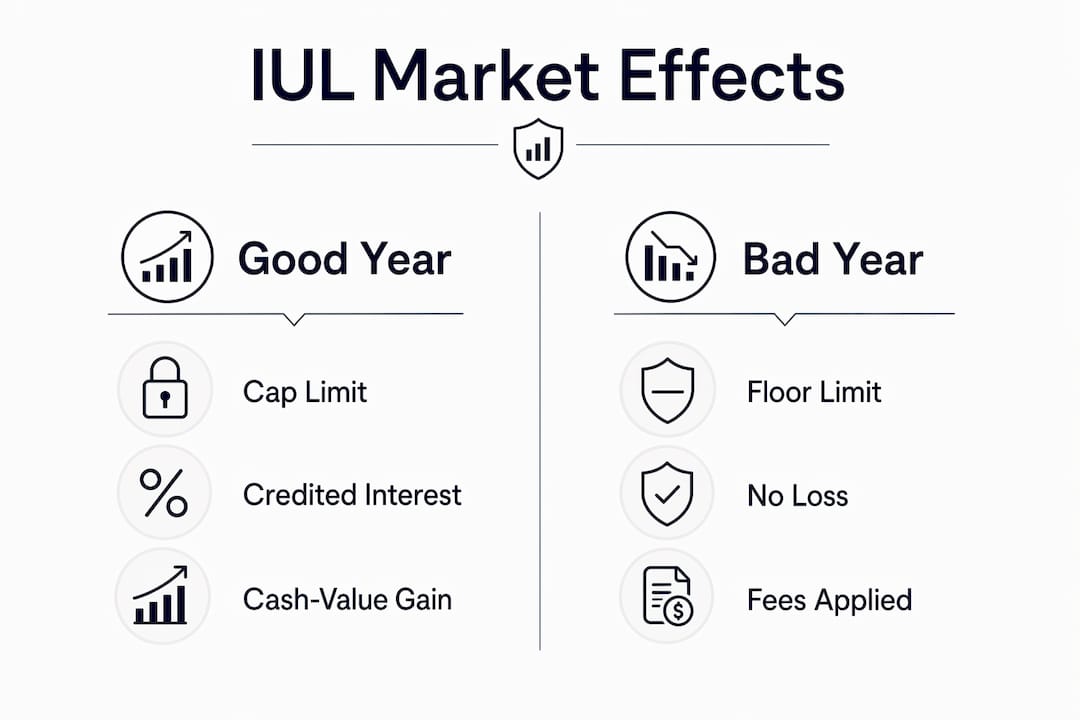
Concrete numbers make this clearer than any abstract explanation. The three scenarios below use a hypothetical policy with a 100% participation rate, a single-digit annual cap, a 0% floor, and $200 in monthly COI and fees.

Scenario 1: Strong market year
The index gains 18%. The cap limits credited interest to 9%. On a $50,000 cash-value balance, that’s $4,500 in credited interest. After $2,400 in annual COI and fees, net cash-value growth is roughly $2,100. You benefited from the market’s rise, but the cap cut your credited return in half.
Scenario 2: Down market year
The index falls 12%. The 0% floor means no negative interest is credited. But COI and administrative fees still apply regardless of index performance. On the same cash-value balance, fees and COI charges reduce cash value even when index returns are negative, even though the floor “protected” you from the index loss. The floor prevents a market-driven loss, not a fee-driven one.
Scenario 3: Modest market year
The index gains 5%. With a 100% participation rate and a 9% cap, the full 5% is credited: $2,500 on a $50,000 balance. After fees, net growth can be minimal in modest market years. Over a decade of similar modest years, the compounding impact of fees on a lightly-credited account can be significant.
One more factor that rarely gets mentioned in sales conversations: Dividends are excluded from IUL crediting. The insurer replicates index performance using options, not by holding the underlying stocks, as explained in our overview of institutional gold trading benefits. Historically, dividends have represented a meaningful portion of total stock-market returns, so credited IUL returns should be expected to trail raw index returns over long periods.
| Scenario | Index Return | Credited Interest | Annual Fees | Net Cash-Value Change |
|---|---|---|---|---|
| Strong year | +18% | +9% (capped) | $2,400 | +$2,100 |
| Down year | -12% | 0% (floored) | $2,400 | -$2,400 |
| Modest year | +5% | +5% | $2,400 | +$100 |
Figures are illustrative only. Actual results depend on your policy’s specific crediting formula, COI, and fee structure. These are non-guaranteed projections.
What are the real pros and cons of an IUL policy?
The genuine advantages
- Downside protection: The 0% floor means a market crash doesn’t directly wipe out your cash value the way it would in a variable product.
- Growth potential above fixed rates: In strong market years, credited interest can exceed what a whole life or fixed annuity would pay.
- Premium flexibility: You can adjust payments within IRS limits, which helps during income disruptions.
- Tax efficiency: Cash value grows tax-deferred, and policy loans can be tax-free when the policy is properly structured and doesn’t lapse.
- Permanent death benefit: Unlike term, the coverage doesn’t expire after 20 or 30 years.
The real drawbacks
- Complexity: Between crediting methods, participation rates, caps, spreads, riders, and COI schedules, IUL is one of the most complicated financial products a consumer can buy.
- Non-guaranteed caps and participation rates: The insurer can lower them. An illustration showing a 10% cap today is not a promise of a 10% cap in year 12.
- Fees erode cash value: COI, admin fees, rider charges, and premium loads all reduce the amount actually working for you.
- Illustrations can mislead: Projections often use current (favorable) caps and participation rates held constant for decades. That assumption rarely holds.
- Lapse risk: Underfunding the policy, taking excessive loans, or sustained low crediting can cause the policy to lapse, potentially triggering a taxable event on outstanding loans.
Pro Tip: On any illustration, find the column labeled “required premium to sustain the death benefit to age 90” (or similar). If that number is significantly higher than what you’re planning to pay, you’re looking at a policy that may lapse before you need it most.
What does an IUL actually cost, and why do policies lapse?
Cost is where most people get surprised. An IUL policy carries several distinct charges, and they don’t all stay flat.
The main cost components:
- Cost of insurance (COI): Charged monthly based on your age, health, and death benefit amount. COI rises every year as you age, which is the single biggest long-term funding risk.
- Administrative fees: A flat monthly or annual charge for policy maintenance, often $10–$30 per month.
- Rider charges: Each add-on rider (long-term care, waiver of premium, etc.) carries its own fee, deducted from cash value.
- Premium load: Some policies take a percentage off the top of each premium before it reaches cash value, commonly 5–10%.
- Surrender charges: If you cancel the policy in the early years (typically years 1–10), you forfeit a portion of your cash value. These charges can be steep in the first few years and taper off over time.
Why policies lapse
Flexible features increase lapse risk when not actively managed. The most common path to lapse: the policyholder underfunds the policy in early years, crediting is modest for a stretch, and rising COI eventually consumes more cash value than credited interest replenishes. At that point, the policy needs a large catch-up premium to survive, and many people can’t or don’t pay it.
Taking policy loans without a repayment plan accelerates this. An outstanding loan accrues interest, and if the loan balance plus interest approaches the cash value, the policy lapses with a potentially large tax bill attached.
The floor doesn’t protect you from fees. A 0% credited floor means the index loss isn’t passed to you, but monthly COI and administrative charges still come out of cash value. In a prolonged low-crediting environment, fees alone can steadily erode the account.
How does IUL compare to term, whole life, VUL, and a 401(k)?
IUL sits in a specific niche. Understanding where it fits requires comparing it honestly against the alternatives.
Primary use cases for IUL:
- Supplementing retirement income after maxing out qualified accounts
- Tax diversification (adding a tax-free income stream alongside taxable 401(k) distributions)
- Estate planning with a permanent death benefit
- Key-person coverage for business owners who need permanent protection
How the products stack up
| Best use case | Growth vs. protection | Fees | Guarantees | Tax treatment | |
|---|---|---|---|---|---|
| Term life | Pure death benefit, budget-conscious | No cash value | Lowest | Death benefit only (term period) | Premiums not deductible; benefit tax-free |
| Whole life | Permanent coverage + guaranteed growth | Moderate, guaranteed | High | Guaranteed cash value growth + dividend (non-guaranteed) | Tax-deferred growth; tax-free loans |
| IUL | Retirement supplement + permanent coverage | Higher potential, floored downside | Moderate-high | Floor (0%); caps/participation non-guaranteed | Tax-deferred growth; tax-free loans if structured correctly |
| VUL | Growth-oriented, risk-tolerant buyers | Highest potential, no floor | High | Death benefit only | Tax-deferred growth; tax-free loans if structured correctly |
| 401(k)/IRA | Primary retirement savings | Market-rate growth | Low | None (market risk) | Tax-deferred (traditional) or tax-free growth (Roth) |
A few distinctions worth calling out. IUL differs from Variable Universal Life (VUL) in one critical way: your cash value is not directly invested in the market. VUL subaccounts hold actual securities; IUL uses options to approximate index performance. That means IUL has no floor risk from direct stock holdings but also excludes dividends from crediting.
Compared to a 401(k) or IRA, IUL offers a different tax profile. Qualified accounts give you a tax deduction on contributions (traditional) or tax-free growth (Roth), but distributions are either taxed as ordinary income or subject to contribution limits. A properly structured IUL provides tax-free access via loans with no contribution ceiling beyond what the IRS allows for life insurance, and no required minimum distributions. The trade-off is higher fees and more complexity.
How do you evaluate an IUL policy before you buy?
Most people spend more time researching a car than a life insurance policy that will cost them tens of thousands of dollars. Here’s what to actually check.
Questions to ask your agent:
- What are the current cap rate, participation rate, and spread for each index option?
- How often can the insurer change those parameters, and what are the contract minimums?
- What is the full COI schedule by age, and what does it look like at age 70, 75, and 80?
- What are all fees: admin, rider, premium load, and surrender charges by year?
- What does the illustration assume for credited interest, and what does the policy look like at 4% and 2% credited rates?
- Does the policy have a secondary no-lapse guarantee, and what are its conditions?
Red flags to watch for:
- Illustrations that assume the current (high) cap rate held constant for 30+ years
- No clear disclosure of how caps and participation rates can change
- Pressure to overfund without a written explanation of why
- Riders stacked on top of riders with vague benefit descriptions
- An agent who can’t explain the crediting method in plain language
Documents to collect before signing:
- The full policy illustration (guaranteed and non-guaranteed columns)
- The policy contract, including the crediting method disclosure
- The insurer’s most recent annual report for the product
- A stress-test illustration run at 0%, 2%, and 4% credited interest
Frequently asked questions
How much does an IUL cost per month? Premiums vary widely based on age, health, death benefit amount, and how aggressively you fund the cash-value component. A healthy 40-year-old might pay anywhere from a few hundred to several thousand dollars monthly depending on the target death benefit and funding strategy. There is no single “standard” premium.
Can you lose money in an IUL? You can’t lose cash value due to index losses alone, because the 0% floor prevents negative crediting. But fees and COI are deducted regardless, so net cash value can still decline in years with low or zero credited interest.
What happens if you cancel an IUL early? Surrender charges apply in the early years, often years 1–10, and can significantly reduce the cash value you receive. Any outstanding policy loans at surrender may also trigger a taxable event.
Does health affect IUL approval and cost? Yes. IUL policies require underwriting, and your health status directly affects both approval and COI rates. Better health means lower COI, which means more of your premium reaches cash value.
Pro Tip: Always ask for a “stress-test” illustration that runs conservative credited rates (2–4%) alongside the standard projection. If the policy lapses or requires dramatically higher premiums at those rates, that’s the scenario you need to plan for, not the optimistic one.
How Progressiveplanner uses IUL inside the Dual Purpose Retirement Strategy™
Most retirement planning treats savings as a single stream: money goes into a 401(k) or IRA, grows tax-deferred, and comes out as taxable income in retirement. Progressiveplanner’s Dual Purpose Retirement Strategy™ is built on a different premise. The same savings dollar is structured to generate two distinct tax-advantaged income streams rather than one.
The IUL policy is the second stream. While a 401(k) or IRA handles the primary accumulation, an IUL policy runs alongside it, building cash value with downside protection and providing tax-free loan access in retirement. The result is a retirement income picture that isn’t entirely dependent on ordinary income tax rates or required minimum distributions.
Client profiles Progressiveplanner typically recommends this strategy to:
- High-income earners who have maxed out qualified accounts and want additional tax-deferred growth
- Pre-retirees concerned about future tax rate increases on 401(k) distributions
- Business owners seeking both key-person coverage and a retirement supplement
- Individuals with estate planning needs who want a permanent death benefit alongside retirement savings
The strategy is not a one-size-fits-all product. Progressiveplanner’s process starts with a retirement income review that compares projected outcomes under a traditional single-stream approach against the dual-stream model, so clients can see the difference in projected after-tax income before committing.
Pro Tip: When combining an IUL with a 401(k) or IRA, set realistic expectations for the IUL’s cash-value growth in the first 5–7 years. Early-year fees and COI mean the policy builds slowly at first. The long-term compounding advantage becomes meaningful in years 10 and beyond, which is why starting earlier matters.
Key Takeaways
An IUL policy’s long-term value depends almost entirely on how well it’s funded, monitored, and stress-tested against conservative crediting assumptions — not on the optimistic numbers in a sales illustration.
| Point | Details |
|---|---|
| IUL definition | Permanent life insurance with a death benefit and index-linked cash value, subject to caps, floors, and participation rates. |
| Illustrations are non-guaranteed | Caps and participation rates can change; always stress-test at 2–4% credited interest before committing. |
| Fees apply even at 0% crediting | COI and admin fees reduce cash value regardless of index performance, so a 0% floor doesn’t mean zero loss. |
| Best fit: high-income, long horizon | IUL works best for those who’ve maxed qualified accounts and have 15+ years for cash value to compound. |
| Progressiveplanner’s approach | The Dual Purpose Retirement Strategy™ pairs an IUL with existing retirement accounts to create two tax-advantaged income streams from the same savings. |
The case for IUL is real, but so is the fine print
IUL gets oversold more often than it gets misunderstood, and that’s a meaningful distinction. The product itself is legitimate. Permanent coverage, index-linked growth with a floor, tax-deferred accumulation, and tax-free loan access in retirement are real features with real value for the right buyer. The problem is that the right buyer is a narrower group than most sales conversations suggest.
Where I see people go wrong is in treating the illustration as a forecast. An illustration is a mathematical projection built on today’s caps and participation rates, held constant for decades. Insurers can and do lower those rates. A policy illustrated at a 10% cap today might credit at 6% in year 15. That gap, compounded over time alongside rising COI, is the difference between a policy that performs and one that lapses.
The profiles where IUL genuinely earns its complexity: a 45-year-old earning $300,000+ who has maxed a 401(k) and wants tax diversification; a business owner who needs permanent key-person coverage and wants the cash value working toward retirement; someone with a taxable estate who needs a permanent death benefit. For a 35-year-old with inconsistent income and a modest savings rate, term insurance and a Roth IRA will almost always serve them better.
One line that belongs in every IUL conversation: policy illustrations are not guarantees. They are projections based on assumptions that may not hold. Confirm current policy terms with your insurer and a licensed financial professional before making any decision.
What Progressiveplanner’s retirement income review covers

If you’ve read this far, you already understand more about IUL than most people who own one. The next question is whether it fits your specific retirement picture, and that requires running actual numbers against your existing accounts.
Progressiveplanner’s free retirement income review does exactly that. You bring your current 401(k) or IRA statements, any existing life insurance policies, and a rough sense of your retirement income target. The review compares your projected after-tax income under a traditional single-stream approach against the Dual Purpose Retirement Strategy™, which layers an IUL alongside your existing accounts to create a second tax-advantaged income stream.
The consultation includes a policy illustration stress-test at conservative credited rates, a personalized funding plan that accounts for rising COI over time, and a clear side-by-side of guaranteed versus non-guaranteed values. No pressure, no opaque projections. Just a clear picture of what the numbers look like under realistic assumptions.
To get the most from the conversation, bring your most recent retirement account statements, any existing life insurance policy documents, and a recent pay stub or income summary. Book your free retirement income review at Progressiveplanner and see what the dual-stream approach looks like for your situation.
Pro Tip: When you sit down for the consultation, ask specifically for a scenario that runs 3% credited interest and assumes COI increases of 5% annually after age 60. If the policy still works under those assumptions, you have a plan built on realistic numbers.
Useful sources and further reading
The sources below were used in building this article and are worth bookmarking for your own research.
- Investopedia — Indexed Universal Life Insurance: Detailed mechanics of IUL crediting, premium allocation, and tax treatment. A strong starting point for understanding the product structure.
- NerdWallet — Indexed Universal Life Insurance: Clear breakdown of floors, caps, and participation rates with consumer-friendly comparisons to other life insurance types.
- Forbes Advisor — IUL Insurance Explained: Covers lapse risk, the non-guaranteed nature of caps and participation rates, and advisor warnings about underfunding.
- MassMutual Blog — What Is Indexed Universal Life Insurance?: Explains the options-based replication strategy, dividend exclusion, and why credited returns trail raw index returns.
- Progressiveplanner — Dual Purpose Retirement Strategy™: Progressiveplanner’s own explanation of how IUL integrates with existing retirement accounts to create two tax-advantaged income streams.
For final authority on any specific policy, request the full policy contract, the insurer’s most recent annual report for the product, and a complete illustration with both guaranteed and non-guaranteed columns. Those documents, not any third-party summary, govern what your policy actually does.
This article is general educational information, not professional financial or legal advice. Consult a licensed financial advisor or insurance professional to evaluate whether an IUL policy is appropriate for your specific situation.