
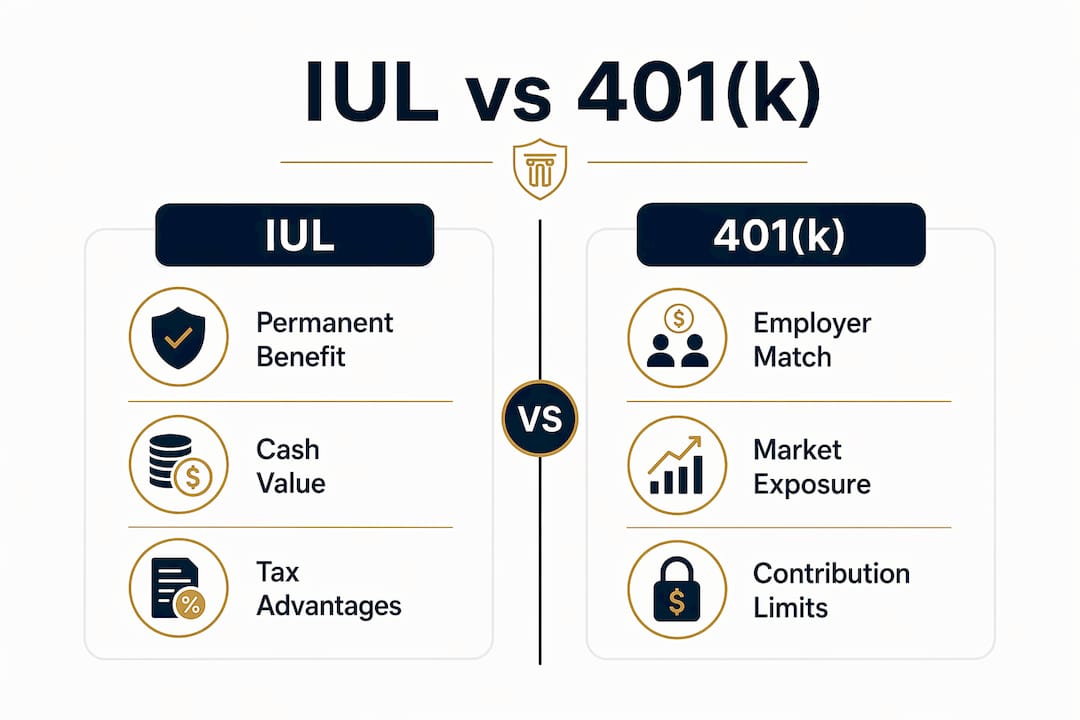
IUL vs 401(k): Which One Belongs in Your Retirement Plan?

A 401(k) should be your primary retirement vehicle. Capture the employer match first, get the low-cost market exposure, and only then ask whether an IUL makes sense on top of it. For most people, the answer is no. For high earners who’ve already maxed out tax-advantaged accounts and need either permanent life insurance coverage or a way to shelter additional dollars from future taxes, the answer can be yes.
Here’s the short version of when each one wins:
When a 401(k) clearly wins:
- You have an employer match available (that’s an immediate, guaranteed return no insurance product can replicate)
- You want simple, low-cost market exposure through index funds
- Your retirement tax rate is likely to be lower than your working rate
- A Roth 401(k) is available to you (this removes most of the tax argument for an IUL)
When an IUL can add value as a supplement:
- You’ve maxed your 401(k) and IRA and still have excess taxable income to shelter
- You need permanent life insurance coverage regardless
- You expect a high tax rate in retirement and want tax-free loan income
- You want downside protection and no required minimum distributions (RMDs)
The recommended sequence: capture the employer match → max your 401(k) and IRA → explore Roth conversion options → only then evaluate an IUL for the remaining gap. For tax treatment specifics, jump to the tax comparison section. For a side-by-side fee breakdown, go to the fees section. For a worked numeric example, the scenario section shows the math.
Table of Contents
- What is an IUL policy and how does it actually work?
- What is a 401(k) and what are the 2026 contribution limits?
- How does IUL interest crediting actually affect your returns?
- How do taxes, withdrawals, and RMDs compare between an IUL and a 401(k)?
- How do IUL fees compare to 401(k) costs?
- IUL vs 401(k) pros and cons: the quick version
- Who should use a 401(k), an IUL, or both?
- What do the numbers actually look like? Two illustrative scenarios
- Key Takeaways
- Why the conventional wisdom on IULs gets this wrong
- How Progressiveplanner puts this strategy to work for you
- Useful sources and further reading
What is an IUL policy and how does it actually work?
An Indexed Universal Life (IUL) policy is permanent life insurance with a cash value account that earns interest linked to a market index, typically the S&P 500, subject to policy-defined rules. It is not a direct investment in the index. The insurer uses options contracts to provide index-linked credits, which is why the mechanics look different from owning an index fund.

Every premium you pay gets split. A portion covers the cost of insurance (COI), which is the actual mortality charge, plus administrative fees and any rider costs. The remainder goes into the cash value account. In the early years of a policy, COI and fees consume a larger share of each dollar, which slows cash accumulation. This is one reason why IUL designs intended for retirement income need to be structured carefully from day one.
Core IUL features at a glance:
- Death benefit: Paid income-tax-free to beneficiaries under IRC Section 101(a)
- Cash value growth: Credited interest linked to an index, subject to caps and floors
- Tax treatment of inside buildup: Grows tax-deferred; accessed via loans, not withdrawals, to stay tax-free
- No RMDs: The IRS does not require distributions from life insurance cash value
- Medical underwriting: Required; carriers set practical limits on how much premium you can pay relative to the death benefit
How caps, floors, and participation rates work in plain terms:
Suppose the S&P 500 returns 15% in a given year. Your policy has a 70% participation rate and a 10% cap. You first apply the participation rate: 15% × 70% = 10.5%. Then the cap kicks in: your credited rate is 10%, not 10.5%. In a year when the index drops 20%, the 0% floor means you’re credited 0% rather than losing 20%. You don’t gain, but you don’t lose principal either.
Policy illustrations from carriers show hypothetical credited rates based on historical index performance. Those numbers are not guarantees. Caps can change annually at the carrier’s discretion, and COI charges rise as you age. Always ask for both the illustrated rate and the guaranteed minimum scenario before evaluating any policy.
What is a 401(k) and what are the 2026 contribution limits?
A 401(k) is an employer-sponsored retirement savings plan that lets you defer a portion of your salary into a tax-advantaged account. You choose from a menu of investment options the plan provides, typically mutual funds and index funds. Contributions reduce your taxable income today (traditional) or go in after-tax for tax-free withdrawals later (Roth).

The 2026 contribution limit is $24,500 for employee deferrals, with a catch-up contribution of an additional $7,500 for those 50 and older, bringing the total to $32,000. The employer match sits on top of that and is effectively free money with an immediate 50–100% return on the matched dollars, depending on your plan’s formula.
Traditional vs. Roth 401(k):
- Traditional: Contributions are pre-tax, growth is tax-deferred, and withdrawals in retirement are taxed as ordinary income
- Roth: Contributions are after-tax, growth is tax-free, and qualified withdrawals are tax-free
Access rules you need to know:
- Loans are permitted up to 50% of your vested balance or $50,000, whichever is less
- Hardship withdrawals are allowed in specific circumstances but are taxed as income
- Early withdrawals before age 59½ trigger a 10% penalty plus ordinary income tax, with limited exceptions such as disability or substantially equal periodic payments
- RMDs begin at age 73 under current law, forcing taxable distributions whether you need the income or not
The employer match is the single most powerful feature of a 401(k). No IUL, no Roth IRA, and no brokerage account gives you an immediate guaranteed return on your contribution the way a 50-cent or dollar-for-dollar match does.
How does IUL interest crediting actually affect your returns?
The credited rate you receive in an IUL is the product of three variables working together: the participation rate, the cap rate, and the crediting strategy. Understanding how they interact is the difference between a realistic expectation and a disappointed client.
The four key terms:
- Participation rate: The percentage of the index gain that counts before the cap. A 70% participation rate on a 12% index year gives you 8.4% before the cap applies.
- Cap rate: The maximum credited rate in any given period, regardless of index performance. Common caps run in the 8–12% range, though carriers adjust them based on option costs and interest rates.
- Spread/asset-based fee: Some policies subtract a spread (e.g., 2%) from the index gain instead of using a cap. A 10% index year minus a 2% spread = 8% credited.
- 0% floor: Your credited rate cannot go below zero in a floor-protected strategy. You don’t lose principal to index declines, but you also don’t earn anything in a down year.
Crediting strategies matter more than most buyers realize. Annual point-to-point is the most common: the index is measured at the start and end of a 12-month segment, and the gain (subject to cap and participation) is credited once. Monthly average strategies smooth out volatility but often produce lower credits in strong bull markets. Monthly point-to-point strategies can amplify gains but also hit the cap more frequently.
The 0% floor is primarily a sequence-of-returns protection tool. It reduces downside exposure in years like 2008 or 2022, but the cap and participation mechanics mean you’ll never fully capture a strong bull market either. Over a long accumulation period, the net credited rate tends to run meaningfully below the index’s gross return.
Pro Tip: A max-funded IUL sets the death benefit at the IRS minimum relative to your premium, directing as much money as possible into cash value. This design is critical for accumulation goals, but it requires careful management to stay below the 7-pay test threshold and avoid Modified Endowment Contract (MEC) status. Always ask your advisor to show you the policy at both the illustrated and guaranteed rates.
How do taxes, withdrawals, and RMDs compare between an IUL and a 401(k)?
This is where the two products diverge most sharply, and where the decision often gets made.
| Feature | IUL | Traditional 401(k) |
|---|---|---|
| Primary purpose | Permanent death benefit + cash value accumulation | Retirement savings and investment growth |
| Contribution tax treatment | After-tax (no deduction) | Pre-tax (reduces taxable income now) |
| Growth tax treatment | Tax-deferred inside the policy | Tax-deferred |
| Withdrawals | Tax-free via policy loans while in force; surrenders taxed above basis | Taxed as ordinary income |
| Loans | Policy loans are not taxable events if policy stays in force | Taxable if not repaid; treated as distribution if employment ends |
| Early access penalty | No IRS 10% penalty; surrender charges may apply | 10% penalty before age 59½ (with exceptions) |
| RMDs | None | Required starting at age 73 |
| Beneficiary treatment | Death benefit passes income-tax-free | Inherited accounts subject to income tax on distributions |
The policy loan mechanics deserve a closer look. When you borrow against your IUL’s cash value, the insurer lends you money using the cash value as collateral. The cash value continues to earn credited interest on the full amount, while you pay a loan interest rate (often 5–6%). The net cost is the spread between the two rates. As long as the policy stays in force, the loan is never a taxable event. The risk: if the policy lapses with an outstanding loan, the entire loan balance becomes taxable income in that year. That’s a large, sudden tax bill that can arrive at the worst possible time.
The 7-pay test determines whether your policy becomes a Modified Endowment Contract (MEC). If you fund the policy too quickly in the first seven years, it crosses the MEC threshold, and loans and withdrawals become taxable (and subject to the 10% penalty before 59½), eliminating most of the tax advantage. Max-funding an IUL for accumulation requires staying just below this line, which is why policy design and ongoing monitoring matter so much.
RMDs starting at age 73 force taxable income from a traditional 401(k) whether you need it or not. For retirees in a high bracket, those forced distributions can push Social Security benefits into higher taxation tiers and increase Medicare IRMAA surcharges. An IUL has no such requirement, which is why some high-net-worth retirees use it specifically to manage taxable income in retirement.
A Roth 401(k) changes this calculus significantly. It offers tax-free withdrawals with full market upside and low fees, which removes the primary tax argument for adding an IUL. If your employer offers a Roth 401(k) and you’re not in the highest tax bracket, exhaust that option before considering an IUL for tax-free income.
For deeper tax-diversification planning, tax planning resources can help you model how different income streams interact in retirement.
How do IUL fees compare to 401(k) costs?
Fees are where the IUL vs 401(k) comparison gets uncomfortable for IUL advocates. The cost structures are fundamentally different, and the gap compounds over decades.
Typical IUL charges:
- Cost of insurance (COI): Rises with age; can become significant in your 60s and 70s if the policy is underfunded
- Administrative fees: Monthly flat charges, often $10–$20/month
- Rider costs: Charges for additional features like long-term care riders or enhanced death benefit options
- Surrender charges: Can run 10–15% in early years, declining over a 10–15 year surrender period
- Spread or cap reduction: Indirect cost built into the crediting mechanics
Typical 401(k) costs:
- Fund expense ratios: Often below 0.20% for index funds; actively managed funds run higher
- Plan administration fees: Vary by employer plan; often passed to participants as a small annual percentage
- No mortality charges: 401(k) investments carry no COI equivalent
A simple illustration of fee drag: Assume $500/month going into each vehicle over 30 years with a 7% gross annual return. In a 401(k) with a 0.15% expense ratio, the drag is minimal. In an IUL with combined internal costs running 2–3% annually (COI, admin, and the implicit cost of the cap reducing credited returns), the net return might land closer to 4–5%. Over 30 years, that difference in compounding is substantial. The higher costs of IUL policies versus low-cost index funds are a documented reason why a 401(k) typically generates more gross accumulation.
The fee drag doesn’t mean an IUL is always the wrong choice. It means the IUL needs to deliver something the 401(k) can’t, specifically tax-free income at a high retirement tax rate, downside protection, or a death benefit, to justify the cost difference.
IUL vs 401(k) pros and cons: the quick version
IUL advantages:
- Tax-free income via policy loans (if policy stays in force)
- No RMDs, giving you full control over retirement income timing
- 0% floor protects cash value from index losses
- Death benefit passes income-tax-free to beneficiaries
- No IRS contribution limits (though carriers set practical premium limits)
- Useful for estate planning and legacy goals
IUL disadvantages:
- Higher costs (COI, admin, surrender charges) reduce net returns
- Upside is capped; you won’t fully participate in strong bull markets
- Requires medical underwriting; not available to everyone
- Policy lapse with outstanding loans triggers a large taxable event
- Complex product; illustration assumptions can be misleading
- Not a substitute for a 401(k) match
401(k) advantages:
- Employer match is an immediate, guaranteed return
- Low-cost index funds with full market upside
- Simple, transparent structure
- High contribution limits with catch-up provisions
- Roth option available in most plans
- ERISA protections and fiduciary standards apply
401(k) disadvantages:
- RMDs begin at 73, forcing taxable income
- Withdrawals taxed as ordinary income (traditional)
- Limited investment menu set by employer
- 10% early withdrawal penalty before 59½
- Death benefit: account balance passes to heirs but is subject to income tax on distributions
Where a Roth 401(k) changes the picture: A Roth 401(k) offers tax-free withdrawals with full market exposure and low fees. For most earners who have Roth access, it closes the tax gap between a 401(k) and an IUL without the complexity or cost of an insurance product. The IUL’s tax argument is strongest when a Roth 401(k) is unavailable or when the saver has already maxed both traditional and Roth options.
Who should use a 401(k), an IUL, or both?
The decision isn’t binary. Most people should use a 401(k) as their foundation and only consider an IUL after they’ve exhausted the tax-advantaged options that come first.
The recommended decision sequence:
- Contribute to your 401(k) up to the full employer match. This is non-negotiable. No other financial product gives you a 50–100% immediate return.
- Max your IRA or Roth IRA (2026 limit: $7,500 if you’re 50 or older; check income limits for Roth eligibility).
- Return to your 401(k) and max the employee deferral ($24,500 in 2026, or $32,000 with catch-up).
- Consider a Roth conversion or backdoor Roth if your income exceeds direct Roth contribution limits.
- Evaluate an IUL if you still have excess income to shelter, need permanent life insurance, or want a tax-free income source with no RMD obligation.
Scenario-based guidance:
- Young saver (25–35, moderate income): Stick with the 401(k) and Roth IRA. The IUL’s COI is low at this age, but the accumulation period is long enough that low-cost market exposure almost always wins on gross returns.
- Mid-career high earner (45–55, income above $200K): After maxing retirement accounts, an IUL can shelter additional dollars, provide downside protection, and create a tax-free income stream that doesn’t trigger RMDs or push Social Security into higher taxation.
- Pre-retiree with sequence-of-returns risk (58–65): The 0% floor in an IUL is genuinely valuable here. A bad market in the first few years of retirement can permanently impair a portfolio. An IUL’s floor doesn’t solve this entirely, but it reduces the damage.
- High-net-worth estate planning (net worth above $5M): The income-tax-free death benefit and no-RMD structure make an IUL a legitimate estate planning tool, especially for legacy goals.
Red flags when evaluating an IUL:
- Illustrations using aggressive credited-rate assumptions (above 6–7% net) without showing the guaranteed scenario
- High surrender charges with no clear exit strategy
- Insufficient premium capacity relative to the death benefit (policy won’t accumulate efficiently)
- Health issues that make underwriting difficult or expensive
- An advisor who presents the IUL as a replacement for a 401(k) rather than a supplement
Financial planning resources can help you map out the sequencing before you commit to any product.
What do the numbers actually look like? Two illustrative scenarios
These scenarios use simplified assumptions to show the directional difference. They are not personalized projections.
Assumptions:
- Contribution: $1,000/month ($12,000/year) over 25 years
- 401(k) gross return: 7% annually (diversified index fund)
- 401(k) expense ratio: 0.15%
- IUL net credited rate: 5% (after caps, participation, COI, and admin fees)
- No employer match modeled (to isolate the accumulation comparison)
- Retirement tax rates tested: 22% and 32%
| Scenario | Ending Balance | Tax Rate at Withdrawal | After-Tax Spendable |
|---|---|---|---|
| Traditional 401(k) | ~$810,000 | 22% | ~$632,000 |
| Traditional 401(k) | ~$810,000 | 32% | ~$551,000 |
| IUL (tax-free loans) | ~$530,000 | 0% (loans) | ~$530,000 |
What the table shows: At a 22% retirement tax rate, the 401(k) still produces more after-tax income despite the tax hit, because the higher gross accumulation outweighs the tax cost. At a 32% rate, the gap narrows considerably. The break-even retirement tax rate where IUL’s tax-free distributions can overcome the 401(k)'s higher gross accumulation is commonly modeled near 30%.
Scenario A: Middle-income saver. A household earning $120,000 contributes to a 401(k) with a 4% employer match and expects to retire in the 22% bracket. The 401(k) wins clearly on after-tax income. An IUL adds complexity and cost without a proportionate benefit.
Scenario B: High-income saver. A household earning $350,000 has maxed the 401(k) and both IRAs. They expect a 33–35% effective rate in retirement due to RMDs, Social Security, and investment income. Here, a max-funded IUL creates a tax-free income stream that the 401(k) cannot, and the after-tax comparison shifts in the IUL’s favor.
The Roth 401(k) caveat: If the high-income saver in Scenario B had access to a Roth 401(k) throughout their career, the tax-free accumulation at full market returns would likely outperform the IUL on both gross and after-tax income. The IUL’s tax case is strongest when Roth options are exhausted or unavailable.
Key Takeaways
A 401(k) with employer match is the right starting point for nearly every retirement saver; an IUL earns its place only as a supplement for high earners who’ve exhausted tax-advantaged accounts and need tax-free income, downside protection, or a permanent death benefit.
| Point | Details |
|---|---|
| Start with the match | Capture the full employer 401(k) match before funding any other vehicle. |
| Fees compound against you | IUL internal costs typically run 2–3% annually versus under 0.20% for 401(k) index funds. |
| IUL is a supplement, not a replacement | An IUL makes sense after maxing retirement accounts, not instead of them. |
| RMDs change retirement income math | 401(k) RMDs begin at 73 and force taxable income; an IUL has no such requirement. |
| Progressiveplanner’s Dual Purpose Retirement Strategy™ | Integrates 401(k) matching with a structured IUL to create two tax-advantaged income streams from the same savings. |
Why the conventional wisdom on IULs gets this wrong
Most articles frame the IUL vs 401(k) debate as a product competition. It isn’t. They’re solving different problems, and the mistake isn’t choosing the wrong one. It’s treating them as interchangeable.
The IUL marketing narrative often leans on the tax-free income story, and that story is real, but it’s incomplete. What the brochure rarely shows you is the COI drag in your 60s, the cap behavior during a strong bull market, or what happens to your tax bill if the policy lapses with an outstanding loan. Those aren’t edge cases. They’re predictable outcomes of a product that’s been underfunded, poorly designed, or inadequately monitored.
The 401(k) has its own blind spot: RMDs. Forced distributions at 73 can push a retiree into a higher bracket, increase Medicare premiums, and make Social Security partially taxable. For someone with a large traditional 401(k) and no other income control levers, that’s a real problem. An IUL doesn’t fix it entirely, but it creates a tax-free income source you can draw from in high-tax years while letting the 401(k) sit.
The advisors who use these tools well treat the IUL as a precision instrument, not a default recommendation. They design it max-funded, they monitor the COI trajectory, and they model the break-even tax rate before recommending it. They also tell clients when a Roth 401(k) makes the IUL unnecessary, because sometimes it does. That kind of honest sequencing, starting with the match, exhausting Roth options, and only then evaluating an IUL, is what separates a good retirement plan from an expensive one.
How Progressiveplanner puts this strategy to work for you
Most retirement plans shelter savings in a single bucket. Progressiveplanner’s Dual Purpose Retirement Strategy™ is built around a different premise: the same dollar can create two tax-advantaged income streams instead of one.

The strategy starts where every good plan starts, with the 401(k) employer match, then layers in a carefully structured IUL designed for maximum cash value accumulation. The result is a tax-diversified retirement income plan: one stream from your 401(k) (pre-tax or Roth), one from your IUL’s tax-free policy loans, with the 0% floor providing downside protection along the way. This approach is built for high earners, pre-retirees managing sequence-of-returns risk, and anyone who wants a permanent death benefit alongside their retirement income.
The first step is a free retirement income review. Progressiveplanner’s advisors will model your current 401(k) trajectory, identify whether you’ve exhausted your Roth options, and run a side-by-side projection showing what a supplemental IUL could add to your after-tax retirement income. Bring your most recent 401(k) statement and a rough sense of your expected retirement tax bracket. Request your free review and see the numbers for your specific situation.
This article is general educational information, not personalized financial or tax advice. Consult a licensed financial advisor or tax professional for guidance specific to your situation.
Useful sources and further reading
- IRS: 2026 401(k) contribution limits — Official source for current employee deferral limits, catch-up amounts, and IRA limits.
- IRS: Hardships, early withdrawals, and loans — Governs the rules for 401(k) loans and hardship distributions, including repayment requirements.
- IRS: Exceptions to the 10% early withdrawal penalty — Lists qualifying exceptions including disability, SEPP, and separation from service after 55.
- Western & Southern: Modified Endowment Contract and the 7-pay test — Explains how overfunding an IUL triggers MEC status and changes the tax treatment of loans and withdrawals.
- FINRA: Insurance products overview — Regulator-level explanation of life insurance as an investment product, including suitability considerations.
- MoneyGeek: IUL vs 401(k) — Covers the core differences, RMD rules, and suitability guidance for each product type.
- SmartAsset: IUL vs 401(k) fee comparison — Useful for understanding the cost differential between IUL internal charges and 401(k) expense ratios.
Bring these sources to your advisor conversation. The IRS pages give you the legal tax rules; the FINRA page helps you evaluate suitability disclosures; and the fee comparison sources give you benchmarks to test any illustration you receive against real-world cost expectations.