
Is IUL Worth It? A Balanced Retirement Guide

Indexed universal life insurance can be worth it — but only for the right person, with the right policy design, and a genuine commitment to managing it for decades. For high-income earners who have already maxed their 401(k) and Roth IRA and want an additional tax-advantaged bucket with no contribution ceiling, IUL offers something traditional retirement accounts simply cannot: market-linked cash value growth with a floor that prevents direct losses, plus tax-free access through policy loans. That combination is genuinely useful. It is also genuinely expensive, complex, and easy to get wrong.
Here is the short version of what you need to know before deciding:
- Worth considering if: You have maxed other tax-advantaged accounts, need permanent life insurance, want a retirement income buffer, and can commit to overfunding for 15 or more years.
- Not worth it if: You are primarily looking for cheap death benefit coverage, have not yet maxed your 401(k) or IRA, or need flexibility to reduce premiums in the near term.
- The critical variable: Policy design and ongoing management matter as much as the product itself. A poorly designed IUL can lapse at the worst possible time.
- The tax advantage is real: Cash value grows tax-deferred, and policy loans are generally tax-free without triggering IRS reporting.
- Returns are capped: Most policies cap credited interest at 8–12%, meaning you will not capture the full upside of a strong bull market.
Progressiveplanner’s Dual Purpose Retirement Strategy™ is built specifically around these strengths, using IUL to create two tax-advantaged income streams from the same savings dollar. The sections below break down every dimension of this decision.
Table of Contents
- What is an indexed universal life insurance policy?
- Pros and benefits of IUL policies
- Cons and drawbacks of IUL policies
- Who should consider an IUL, and when is it worth it?
- What do IUL costs and returns actually look like?
- Why ongoing management is non-negotiable with IUL
- How Progressiveplanner’s Dual Purpose Retirement Strategy™ enhances IUL value
- How IUL affects estate planning
- When IUL works and when it does not: real scenarios
- Progressiveplanner can help you build a smarter retirement income plan
- Key Takeaways
What is an indexed universal life insurance policy?
IUL is a permanent life insurance policy with a cash value component tied to the performance of a market index, most commonly the S&P 500. Unlike a variable policy, the cash value is not directly invested in the market. Instead, the insurer credits interest based on index performance, subject to a floor and a cap.
Key terms you will encounter in every IUL illustration:
- Premium: The payment you make into the policy. IUL premiums are flexible within limits, unlike whole life’s fixed schedule.
- Cash value: The savings component that accumulates inside the policy, grows tax-deferred, and can be accessed via loans.
- Floor: The minimum credited interest rate, almost always 0%, meaning a bad index year does not directly reduce your cash value balance.
- Cap: The maximum credited rate per period, typically ranging from 8% to 12%, though carriers can and do change this after issue.
- Participation rate: The percentage of index gain applied before the cap. An 80% participation rate on a 15% index gain produces a 12% effective gain before the cap is applied.
- Cost of insurance (COI): The charge for the actual death benefit coverage, which increases as you age.
- Surrender charges: Penalties for exiting the policy early, often applying for 10 to 15 years after issue.
The floor is the feature most prominently marketed. A 20% market drop does not reduce your cash value directly. What the pitch often omits: COI charges, administrative fees, and premium loads are deducted regardless of credited interest. In a flat or zero-credit year, those charges still reduce your account balance. The floor protects against index losses, not against internal policy costs.
IUL sits between whole life (guaranteed, predictable, lower upside) and variable universal life (no cap, no floor, direct market exposure). It is, at its core, an insurance contract designed for tax benefits rather than a pure investment vehicle. That distinction shapes everything about how it should be evaluated.
Pros and benefits of IUL policies
The case for IUL is strongest when you look at what it does that no other single product replicates.
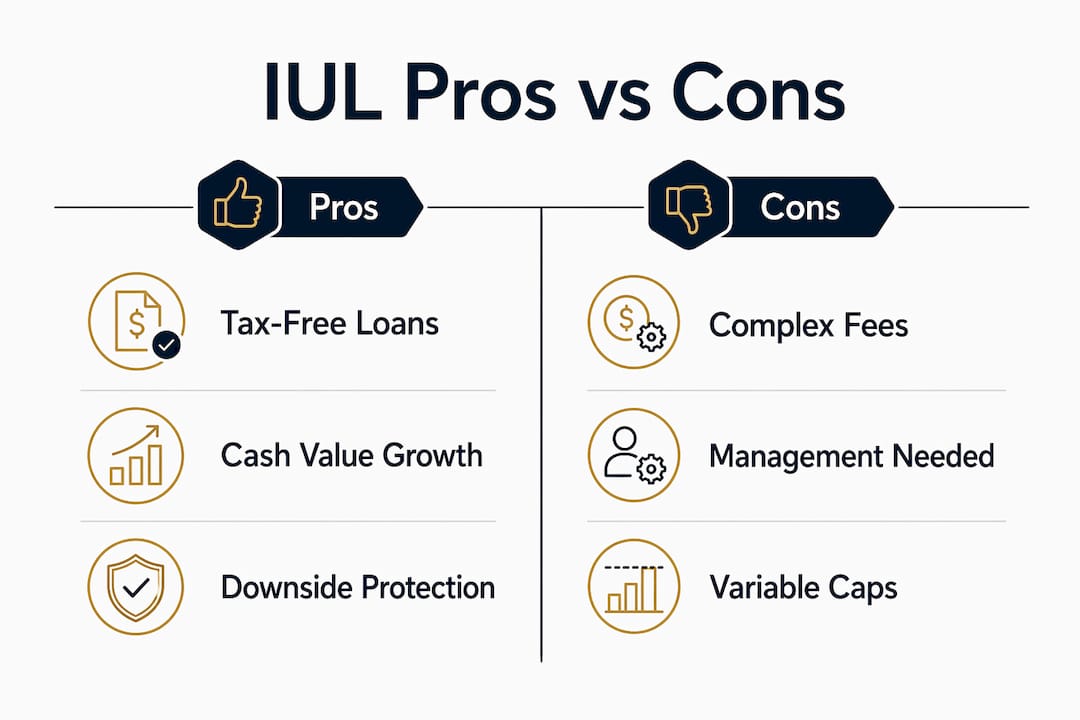
- Tax-deferred growth with tax-free access: Cash value accumulates without annual tax drag, and loans against that value generally do not trigger IRS reporting or capital gains tax. For high earners in the 37% bracket, that difference compounds significantly over 20 years.
- Downside protection: The 0% floor means a year like 2022, when the S&P 500 dropped roughly 18%, credits you zero rather than a loss. Your balance still shrinks from internal charges, but not from index performance.
- No contribution limits: Unlike a 401(k) capped at its annual limit or a Roth IRA at its annual limit, an IUL has no IRS-imposed ceiling on how much you can put in (subject to MEC rules). That makes it genuinely useful for high earners who have already filled every other bucket.
- No required minimum distributions (RMDs): Traditional IRAs and 401(k)s force withdrawals starting at age 73. IUL cash value has no such requirement, giving you more control over taxable income in retirement.
- Permanent death benefit: Unlike term insurance, coverage does not expire. Beneficiaries receive the death benefit income-tax-free, which has real estate planning value.
- Flexible premiums: You can pay more in strong income years and less when cash flow tightens, within policy limits. That flexibility suits business owners and commission-based earners.
- Retirement income buffer: If markets are down when you retire, you can draw from IUL cash value via loans instead of selling equities at a loss. This “volatility buffer” is one of the most practical retirement uses of the product.
- Potential for higher credited interest than whole life: Whole life typically credits a fixed rate around 2–4%. A well-designed IUL in a strong market year can credit up to the cap, often 8–12%.
- Estate planning advantages: The death benefit passes outside probate and is generally income-tax-free to heirs, making IUL a useful tool for wealth transfer.
Pro Tip: The tax-free loan feature is most powerful when the policy is designed for maximum cash accumulation rather than maximum death benefit. Ask your advisor to show you an illustration specifically optimized for cash value, not just coverage.
Cons and drawbacks of IUL policies
The risks are real, and they are not always disclosed clearly in sales presentations.
- High front-loaded costs: Internal expenses are heaviest in the first 10 years. Administration fees, COI charges, and premium loads can consume a significant portion of early cash value, delaying meaningful net growth until year 12 or later.
- Caps limit upside in bull markets: With a 10% cap and 80% participation rate, a 20% market gain credits only 8% to your policy. In a sustained bull run, that gap between market performance and credited interest is substantial.
- Caps and participation rates are not guaranteed: Carriers can lower caps after issue. Many did exactly that during the low-interest-rate environment of 2010 to 2021. A policy illustrated at a 12% cap can become a 7% cap policy a decade later without any breach of contract.
- Surrender charges create illiquidity: Exiting early typically triggers penalties for 10–15 years. Buyers who surrender in the first decade almost always lose money relative to premiums paid.
- Policy lapse risk: If the policy is underfunded and credited rates underperform, rising COI charges can eat through cash value and cause the policy to lapse. A lapse triggers a tax bill on all previously shielded gains.
- Non-fiduciary sales environment: Most IUL agents are not held to fiduciary standards the way registered investment advisors are. An agent earns substantially higher commission selling IUL than selling term insurance, which creates an incentive to recommend it even when it is not the best fit.
- Loans reduce the death benefit: Unpaid policy loans accrue interest and reduce the amount your beneficiaries receive. If the policy lapses with an outstanding loan, the loan balance becomes taxable income.
- Complexity invites misunderstanding: Caps, participation rates, crediting methods, and illustrated versus guaranteed columns are genuinely difficult to parse. Marketing materials often emphasize current-rate illustrations while burying the guaranteed column, which shows what happens if credited rates drop.
- Not suitable as a short-term vehicle: IUL requires a 15-plus year horizon to overcome front-loaded costs and generate meaningful cash value. Anyone who might need the money sooner should not be in this product.
The most dangerous thing about an IUL is the risk of it imploding. If the policy underperforms for years and you only paid the minimum suggested when you were 40, you might get a bill in your 70s for thousands of dollars just to keep the policy in force. This is not a theoretical risk — it is a documented pattern in underfunded policies.
Who should consider an IUL, and when is it worth it?
The honest answer is that IUL is a specialized tool, not a general-purpose retirement account. It fits a specific profile well and fits most other profiles poorly.
IUL tends to make sense for:
- High-income earners who have already maxed their 401(k), Roth IRA, and possibly a backdoor Roth, and are looking for an additional tax-advantaged vehicle.
- Business owners who have exhausted defined benefit plan options and need another tax-sheltered bucket.
- Individuals who need permanent life insurance anyway and want the cash value component to serve a retirement income function.
- People with a long time horizon, specifically 15 or more years, who can commit to consistent overfunding without interruption.
- Those who want a volatility buffer in retirement, using policy loans to avoid selling equities during market downturns.
- Individuals focused on tax diversification, wanting income sources that do not increase adjusted gross income and trigger Medicare premium surcharges (IRMAA).
- Estate planning situations where a tax-free death benefit and probate avoidance have meaningful value.
IUL is generally not the right fit for:
- Anyone who has not yet maxed their 401(k) and IRA. The math usually favors term life plus traditional retirement accounts first.
- People primarily seeking the lowest-cost death benefit. A 30-year term policy covers that need at a fraction of the cost.
- Individuals who may need to reduce or stop premiums within the first decade.
- Those uncomfortable actively monitoring a financial product over decades.
Progressiveplanner’s Dual Purpose Retirement Strategy™ is designed specifically for the first group, using IUL to create a second tax-advantaged income stream alongside existing retirement accounts. The strategy addresses two risks that traditional accounts leave exposed: future tax liability on 401(k) distributions and sequence-of-returns risk during market downturns.
For a practical framework on how IUL fits within a broader retirement income plan, the retirement income bucket strategy offers useful context on segmenting income sources by time horizon and risk.

What do IUL costs and returns actually look like?
The fee structure is where many buyers get surprised. Understanding it upfront is the difference between a policy that performs and one that quietly erodes.
| Fee Type | Typical Range | Impact on Returns |
|---|---|---|
| Premium load | — | Reduces effective contribution from day one |
| Administrative fee | — | Modest but consistent drag on cash value |
| Cost of insurance (COI) | Increases with age | Major risk factor in underfunded policies |
| Asset management charge | — | Compounds as cash value grows |
| Surrender charge | 10–15% in year one, declining | Locks capital for 10–15 years |
Well-designed and consistently funded IUL policies can deliver 6–8% annual returns over long time horizons, with downside protection and tax-free access. That is a meaningful outcome. The question is always whether the tax savings justify the fee load versus simply investing in a taxable brokerage account or maximizing existing retirement accounts.
The comparison that matters most: take the IUL premium, subtract the cost of a comparable term policy, and invest the difference in a maxed 401(k) and Roth IRA. For a 40-year-old male in good health, a $1 million term policy costs significantly less per month. An IUL structured for similar coverage with meaningful accumulation generally requires much higher monthly premiums. The gap, invested in broadly diversified index funds, typically compounds faster than the IUL’s credited rate after internal costs, especially for buyers who still have room in their 401(k) and IRA.
Where IUL’s math flips in its favor: once those accounts are maxed and the marginal dollar would otherwise go into a taxable account, the tax-deferred growth and tax-free loan access become genuinely competitive. Policy loans avoid capital gains tax entirely, unlike selling appreciated assets in a brokerage account. Over a 20-year horizon, that tax differential can offset a substantial portion of the fee load.
One more cost consideration: credited interest caps are not fixed. A policy illustrated at a 12% cap today can become a 7% or 8% cap policy a decade from now. Always ask for the guaranteed column in any illustration, not just the current-rate projection.
Why ongoing management is non-negotiable with IUL
IUL is not a set-it-and-forget-it product. That is not a caveat — it is a fundamental feature of how the product works.
Active monitoring is critical because the cost of insurance rises every year as you age. In a well-funded policy, cash value growth absorbs those rising charges comfortably. In an underfunded policy, especially after a stretch of low credited interest, COI charges can outpace growth and begin consuming principal. Left unaddressed, that trajectory ends in a lapse, which triggers taxes on all previously sheltered gains and eliminates the death benefit precisely when it may be needed most.
What active management actually looks like in practice:
- Reviewing annual policy statements to verify cash value is tracking projected values.
- Adjusting premium payments upward if credited rates have underperformed for multiple years.
- Reassessing death benefit levels as needs change, since a lower death benefit reduces COI charges.
- Understanding the impact of any policy loans on long-term projections.
The regulatory environment adds another layer. IUL is governed by state insurance regulation and the carrier’s ongoing discretion over caps, participation rates, and charges. The National Association of Insurance Commissioners’ Actuarial Guideline 49-A, which took effect in 2022, tightened illustrated rate assumptions, but illustrated projections are still not guarantees. The carrier retains discretion to change caps without breaching the contract.
The agent relationship matters here too. Because most IUL agents are not fiduciaries, their obligation is suitability, not your best interest. That is a meaningful distinction. Before purchasing, ask for the full illustration including the guaranteed column, ask specifically what happens to cash value if the cap drops by three percentage points, and consider getting a second opinion from a fee-only advisor who does not earn a commission on the answer.
If a policy does reach a point where lapse or surrender seems likely, understanding your options matters. A life settlement versus lapse comparison can reveal whether surrendering is actually the worst financial outcome, since selling the policy to a third party sometimes recovers more than the surrender value.
Pro Tip: Ask your advisor to run a “stress test” illustration showing what happens to cash value if the credited rate averages 4% instead of the current-rate assumption. If the policy lapses in that scenario, the design needs adjustment before you sign.
How Progressiveplanner’s Dual Purpose Retirement Strategy™ enhances IUL value
Most people approach retirement savings with a single-bucket mentality: maximize the 401(k), maybe add a Roth IRA, and hope the tax situation works out. The problem is that all of those dollars face the same risks simultaneously — market downturns hit the whole stack at once, and RMDs force taxable distributions regardless of whether it is a good time to sell.
Progressiveplanner’s Dual Purpose Retirement Strategy™ is built around a different structure. The same savings dollar is deployed to create two distinct tax-advantaged income streams: one from traditional retirement accounts and one from a properly designed IUL policy. When markets are down, the IUL cash value serves as the income source, allowing the investment portfolio to recover without forced liquidation. When markets are strong, the portfolio grows uninterrupted.
This is not a theoretical benefit. Clients who implement the strategy report improved projected retirement income compared to single-bucket approaches, along with greater flexibility in managing taxable income year to year. The IUL component also provides a death benefit that passes income-tax-free to heirs, adding an estate planning dimension that a 401(k) alone does not offer.
The strategy works because it is designed for maximum cash accumulation, not maximum death benefit. That design choice, combined with consistent overfunding and active management, is what separates a high-performing IUL from one that quietly underperforms for decades.
How IUL affects estate planning
The death benefit in an IUL policy passes to beneficiaries income-tax-free, and because life insurance proceeds generally bypass probate, heirs receive the money faster and without the legal costs and delays of estate administration. For high-net-worth individuals, that combination of speed and tax efficiency is meaningful.
IUL also offers flexibility that traditional estate planning tools do not. The death benefit can be adjusted over time within policy limits, and the cash value can serve as a liquidity reserve during the insured’s lifetime, reducing the need to liquidate other estate assets to cover expenses. In states that provide creditor protection for life insurance cash value, the policy also shields accumulated wealth from potential claims.
One practical application: using IUL to equalize inheritances. If a business owner plans to pass the business to one child, an IUL death benefit can provide an equivalent inheritance to other heirs without forcing a business sale or creating family conflict. The policy funds the equalization without touching operating assets.
The loan feature adds another dimension. Borrowing against cash value during retirement does not reduce the taxable estate the way spending down a brokerage account would, since the death benefit remains in force (reduced by the outstanding loan balance). That distinction matters in larger estates where estate tax exposure is a consideration.
When IUL works and when it does not: real scenarios
Two scenarios illustrate the difference between a well-suited IUL buyer and a poorly suited one.
Scenario A: The high earner who benefits
A 45-year-old physician earning $400,000 annually has maxed her 401(k) and backdoor Roth IRA every year for a decade. She is in the 37% federal bracket and faces IRMAA surcharges on Medicare premiums in retirement if her adjusted gross income stays high. She needs permanent life insurance for estate equalization between two children. An IUL designed for maximum cash accumulation, funded consistently at $3,000 per month for 20 years, gives her a third tax-advantaged bucket with no contribution limit, tax-free retirement income via loans that does not appear on her tax return, and a death benefit that handles the estate equalization. The fees are real, but the tax savings over 20 years at her bracket outweigh them substantially.
Scenario B: The buyer who should not be in IUL
A 38-year-old teacher earning $72,000 per year has $15,000 in a 401(k) and no Roth IRA. An agent recommends an IUL with a $600 monthly premium, emphasizing the downside protection and tax-free loans. The teacher has not maxed her 401(k) ($23,500 annual limit) or her Roth IRA ($7,000 annual limit). The $600 per month going into the IUL would produce more retirement income if directed to those accounts first, where employer matching and lower fees compound the advantage. The IUL’s front-loaded costs mean meaningful cash value will not materialize for 12 or more years. If she needs to reduce premiums in year six due to a life change, the policy is at risk of lapse. This is the scenario where IUL causes real financial harm.
The difference between these two scenarios is not the product. It is the fit between the product and the buyer’s actual financial situation.
Progressiveplanner can help you build a smarter retirement income plan
Most retirement planning stops at one tax-advantaged bucket. Progressiveplanner is built around the idea that the same savings dollar can do more.

The Dual Purpose Retirement Strategy™ uses a properly designed IUL alongside your existing 401(k) or IRA to create two independent income streams, one taxable and one tax-free, from the same savings effort. That structure gives you a buffer against market downturns, a lever to manage taxable income in retirement, and a death benefit that passes to heirs without probate or income tax. Clients who implement the strategy report meaningfully higher projected retirement income compared to single-bucket approaches, with greater flexibility to respond to whatever the market does.
If you have already maxed your traditional retirement accounts and want to understand whether IUL fits your specific situation, a free retirement income review with Progressiveplanner is the right next step. Visit progressiveplanner.com to see how the Dual Purpose Retirement Strategy™ could apply to your numbers.
Key Takeaways
IUL is worth it for high earners who have maxed traditional retirement accounts and can commit to overfunding a properly designed policy for 15 or more years, but it is the wrong tool for most middle-income buyers who still have room in a 401(k) or IRA.
| Point | Details |
|---|---|
| IUL suits a specific profile | High earners with maxed 401(k) and IRA accounts benefit most; middle-income buyers usually do better with term life plus traditional accounts. |
| Costs are front-loaded | Fees including COI, admin charges, and surrender penalties are heaviest in the first 10 years, delaying meaningful cash value growth. |
| Returns range 6–8% in well-run policies | Well-designed IUL policies can deliver 6–8% annual returns with downside protection and tax-free loan access over long horizons. |
| Active management prevents lapse | Rising COI charges can consume cash value in underfunded policies; annual reviews and premium adjustments are required, not optional. |
| Progressiveplanner’s strategy doubles the income stream | The Dual Purpose Retirement Strategy™ deploys IUL alongside existing retirement accounts to create two tax-advantaged income sources from the same savings. |