
The Social Security Tax Torpedo: What Retirees Must Know

What is the Social Security tax torpedo?
The Social Security tax torpedo is a sharp, sudden spike in your effective marginal tax rate that hits when rising income causes more of your Social Security benefits to become taxable. It is not a penalty or a separate tax. It is a structural quirk in the tax code that can push your real marginal rate well above your stated bracket, sometimes without any warning.
Here is the core mechanism. The IRS uses a figure called provisional income to determine how much of your Social Security benefit gets taxed. Provisional income equals your adjusted gross income, plus any tax-exempt interest, plus half of your annual Social Security benefits. As that number climbs past two specific thresholds, the taxable portion of your benefit jumps, and your tax bill rises faster than your income does.
The thresholds, set by the IRS and unchanged for decades:
- Single filers: No benefits taxed below $25,000 in provisional income; up to 50% of benefits taxed between $25,000 and $34,000; up to 85% taxed above $34,000.
- Married filing jointly: No benefits taxed below $32,000; up to 50% taxed between $32,000 and $44,000; up to 85% taxed above $44,000.
The word “torpedo” fits because the rate spike is not gradual. Cross the second threshold and each additional dollar of income triggers 85 cents of additional taxable Social Security on top of the dollar itself. That compression is what drives effective marginal rates far above the statutory bracket.
Who gets hit hardest? Middle-income retirees with adjusted gross income roughly between $30,000 and $50,000 bear the worst of it, because they are the ones crossing from the 50% to the 85% taxation zone. High earners already have 85% of their benefits taxed regardless, so additional income does not trigger the same spike. Very low earners never reach the thresholds. The torpedo is a middle-income problem.

Table of Contents
- How the Social Security tax torpedo affects your taxes
- Other hidden taxes that compound retirement tax burdens
- Ways to address and mitigate the Social Security tax torpedo
- Understanding the tax torpedo in the context of your overall retirement plan
- How Progressiveplanner addresses the tax torpedo for retirement income
- Key Takeaways
How the Social Security tax torpedo affects your taxes
Calculating provisional income step by step
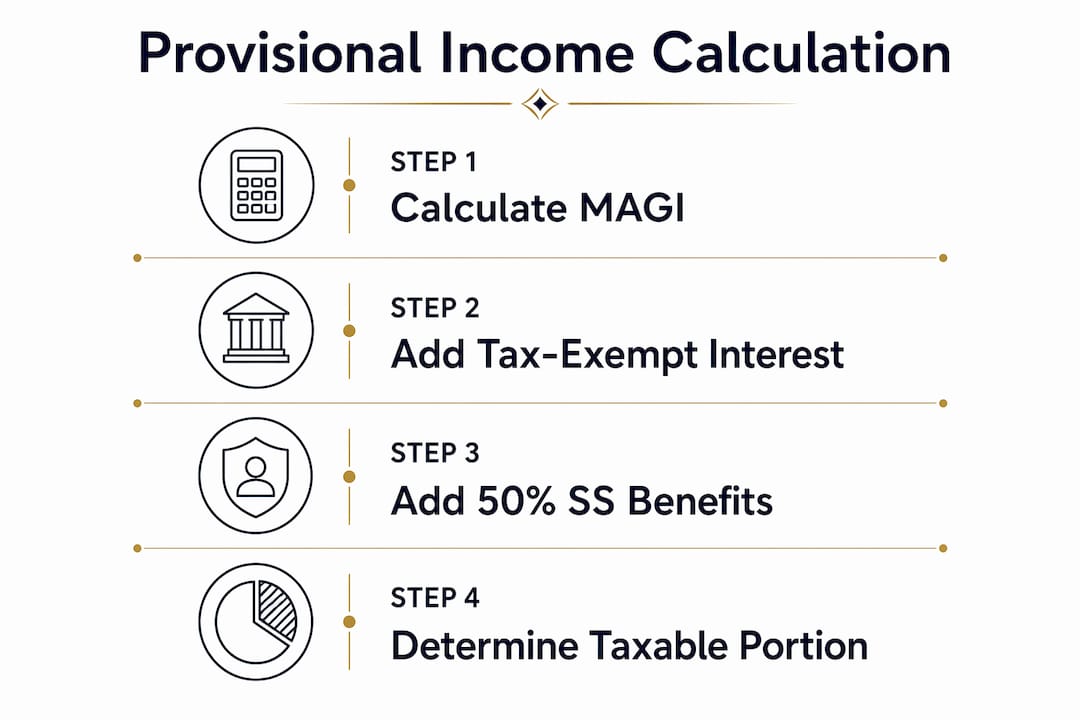
The formula is straightforward, but the implications are not. Start with your modified adjusted gross income (MAGI), which includes wages, pension income, IRA withdrawals, and capital gains. Add any tax-exempt interest, such as municipal bond income. Then add half of your gross Social Security benefit. That total is your provisional income.
A critical detail: every dollar you pull from a traditional 401(k) or IRA counts fully toward provisional income. Social Security itself counts at only 50%. That asymmetry is exactly why delaying benefits and drawing down tax-deferred accounts first can reduce the torpedo’s impact, a point covered in the strategies section below.
The marginal rate math
The torpedo’s bite shows up clearly in the numbers. At the 12% statutory bracket, the effective marginal rate can jump to 22.2% inside the torpedo zone, because each additional dollar of income makes 85 cents of Social Security taxable, adding 85% of 12% on top of the base rate. At the 22% bracket, the effective rate can reach roughly 40.7% by the same logic.
| Provisional income range (single) | Statutory bracket | Effective marginal rate |
|---|---|---|
| Below $25,000 | — | — |
| $25,000–$34,000 | 12% | — |
| $34,000–$44,000 | 12% | 22.2% (85% inclusion phase-in) |
| Above $44,000 | 22% | 22% (85% already fully included) |
The table above illustrates the rate spike in the transition zones. Notice that once 85% inclusion is fully locked in, the effective rate drops back to the statutory rate. The torpedo fires during the phase-in, not after it.
Pro Tip: Don’t confuse your tax bracket with your actual marginal rate in retirement. If your provisional income sits in the torpedo zone, the real cost of each additional dollar of income, whether from a CD, a part-time job, or an IRA withdrawal, can be nearly double what your bracket suggests.
Other hidden taxes that compound retirement tax burdens
The Social Security tax torpedo rarely travels alone. Three additional taxes can layer on top of it, pushing effective rates even higher for retirees who are not watching.
Alternative Minimum Tax (AMT)
The AMT is a parallel tax system that limits the benefit of certain deductions. While it primarily targets higher earners, retirees with large capital gains, significant itemized deductions, or certain tax preference items can still trigger it. When AMT applies alongside the torpedo, the combined effect on taxable income can be severe.
Net Investment Income Tax (NIIT)
The NIIT adds a 3.8% surcharge on net investment income for single filers with modified AGI above $200,000 and joint filers above $250,000. Retirees with substantial dividend income, rental income, or capital gains from selling a home or investment property can find themselves paying this tax on top of their regular rate and the torpedo effect.
IRMAA: the Medicare premium surcharge
The Income-Related Monthly Adjustment Amount (IRMAA) is perhaps the most overlooked retirement tax. When your modified AGI crosses certain thresholds, Medicare Part B and Part D premiums increase substantially. These surcharges are based on income from two years prior, so a large Roth conversion or asset sale in 2024 can raise your Medicare premiums in 2026 with no warning. IRMAA brackets are tiered, and the jumps between tiers can be steep.
Key points on these compounding taxes:
- AMT, NIIT, and IRMAA each have their own income thresholds, separate from the Social Security torpedo thresholds.
- A single large income event, such as selling a rental property, can trigger all three simultaneously.
- IRMAA surcharges are not deductible, making them a true dollar-for-dollar cost increase.
- Planning around one tax without accounting for the others can shift the problem rather than solve it.
Ways to address and mitigate the Social Security tax torpedo
The torpedo is not inevitable. Several strategies can reduce its impact, but they require planning before the income hits, not after.
Delay claiming Social Security benefits
Waiting until age 70 to claim Social Security increases your monthly benefit by up to 24% compared to claiming at full retirement age, reflecting an 8% increase for each year you delay past full retirement age, up to age 70. Beyond the larger check, delaying also reduces provisional income during the years before you claim, because Social Security’s 50% inclusion factor means a higher benefit later creates less provisional income per dollar than an equivalent IRA withdrawal would.

The Journal of Financial Planning’s research on income sequencing shows that a married couple delaying benefits to 70 can reduce annual taxes by thousands of dollars by substituting higher Social Security income for lower IRA withdrawals, shrinking provisional income in the process.
Execute Roth IRA conversions strategically
Roth conversions reduce future required minimum distributions (RMDs), which directly lowers future provisional income. Converted balances in a Roth IRA grow tax-free and are not subject to RMDs, so they do not push you into the torpedo zone in later years. Roth withdrawals also do not count toward provisional income at all, giving you a tax-free income source that leaves your Social Security taxation untouched.
Pro Tip: A large single-year Roth conversion can spike your provisional income and ironically trigger the very torpedo you are trying to avoid. Spread conversions across multiple years, ideally in the window between retirement and when RMDs begin, to stay below the thresholds each year.
Use Qualified Charitable Distributions (QCDs)
If you are 70½ or older, a Qualified Charitable Distribution lets you transfer up to $105,000 per year directly from your IRA to a qualified charity. The amount counts toward your RMD but never appears in your adjusted gross income, which means it does not add to provisional income. For retirees who give to charity anyway, a QCD is one of the cleanest ways to reduce the torpedo’s reach.
Sequence your income sources deliberately
The order in which you draw from different accounts matters as much as the amounts. Drawing from taxable accounts first, then tax-deferred accounts, then Roth accounts is a common framework, but the right sequence depends on where your provisional income sits relative to the torpedo thresholds. Some retirees benefit from drawing down traditional IRAs aggressively in their early retirement years, before Social Security begins, to reduce future RMDs.
Additional mitigation approaches worth considering:
- Keep tax-exempt interest income in check. Municipal bond interest counts toward provisional income even though it is not taxed directly.
- Avoid bunching income events, such as large capital gains and IRA withdrawals, into the same tax year.
- Consider tax-loss harvesting to offset capital gains that would otherwise push provisional income higher.
- Evaluate whether a tax-efficient retirement strategy that creates multiple income streams can reduce reliance on taxable withdrawals.
Understanding the tax torpedo in the context of your overall retirement plan
The myth of the lower retirement tax bracket
Many retirees expect their tax rate to drop once they stop working. That assumption is often wrong. Pensions, Social Security, RMDs, and investment income can combine to keep taxable income at or above working-year levels. Retirement tax bracket assumptions made without accounting for all income sources can be costly, and the torpedo makes the gap between expectation and reality even wider.
What the One Big Beautiful Bill Act changes and what it does not
The One Big Beautiful Bill Act (OBBBA), enacted as P.L. 119-21, stabilized the tax brackets that were set to expire under the Tax Cuts and Jobs Act, removing the feared “tax cliff” that had worried many retirees. It also introduced a new senior deduction of up to $6,000 per eligible individual, available for tax years 2025 through 2028, for taxpayers age 65 and older with work-authorized Social Security numbers. The deduction phases out starting at $75,000 of modified AGI for singles and $150,000 for joint filers.
Here is the critical limitation: the senior deduction applies after taxable Social Security benefits are calculated. It does not change the provisional income thresholds, does not alter the 50% or 85% inclusion formulas, and does not reduce the torpedo’s marginal rate spike. It reduces overall taxable income, which can lower the tax owed on a given amount of income, but it does not defuse the torpedo mechanism itself.
Key planning principles for managing the torpedo year over year
Proactive, year-by-year planning is the only reliable defense against surprise tax spikes in retirement. A one-time review at retirement is not enough, because income sources, RMD amounts, and tax law all shift over time.
Core principles to keep in mind:
- The torpedo thresholds ($25,000/$34,000 for singles, $32,000/$44,000 for joint filers) have not been indexed for inflation since they were set in the 1980s and 1990s, meaning more retirees fall into the torpedo zone every year.
- Tax-exempt interest from municipal bonds is not a safe harbor. It counts toward provisional income and can push you into a higher inclusion tier.
- RMDs from traditional IRAs and 401(k)s are mandatory and fully count toward provisional income, making early Roth conversion planning especially valuable.
- The torpedo interacts with IRMAA on a two-year lag, so income decisions made today affect Medicare premiums in future years.
- Treating Social Security, IRA withdrawals, and investment income as separate decisions, rather than as parts of one coordinated plan, is the most common and costly mistake retirees make.
The OBBBA’s stable brackets are genuinely helpful context. The once-feared broad bracket increases from the TCJA expiration are no longer the primary concern. The structural problem, the torpedo embedded in Section 86 of the Internal Revenue Code, remains fully intact and unchanged by recent legislation.
How Progressiveplanner addresses the tax torpedo for retirement income
The Social Security tax torpedo is a structural problem that requires a structural solution, not a one-time fix. Retirees who rely solely on a traditional 401(k) or IRA face a predictable trap: every dollar withdrawn from those accounts counts fully toward provisional income, feeding the torpedo year after year.

Progressiveplanner’s Dual Purpose Retirement Strategy™ is built specifically around this problem. By incorporating Indexed Universal Life (IUL) policies alongside traditional retirement accounts, the strategy creates two tax-advantaged income streams from the same savings. IUL cash value withdrawals and policy loans do not count as taxable income and do not appear in provisional income calculations, which means they can fund retirement spending without pushing Social Security benefits further into the taxable zone. That is the concrete contrast with a single-bucket approach: one income stream that feeds the torpedo, and one that does not.
For retirees and near-retirees who are already in or approaching the torpedo zone, a free retirement income review with Progressiveplanner can show exactly how much of your projected Social Security benefit is at risk and what a two-stream income structure could change. Visit progressiveplanner.com to schedule your review and see a side-by-side income comparison built around your specific numbers.
Key Takeaways
The Social Security tax torpedo remains one of the most costly and least understood structural tax problems facing middle-income retirees, and it is not addressed by recent legislation.
| Point | Details |
|---|---|
| Provisional income drives the torpedo | AGI plus tax-exempt interest plus half of Social Security benefits determines how much of your benefit is taxed. |
| Effective marginal rates spike sharply | At the 12% bracket, the effective marginal rate can reach 22.2% inside the torpedo zone due to the 85% inclusion phase-in. |
| Middle-income retirees are most exposed | Households with AGI roughly between $30,000 and $50,000 face the steepest torpedo impact as they cross the 50%-to-85% inclusion threshold. |
| Delaying benefits and Roth conversions help | Waiting until age 70 increases monthly benefits by up to 24% and reduces provisional income during pre-claim years; staggered Roth conversions lower future RMDs. |
| Progressiveplanner’s dual-stream approach | IUL-based income does not count toward provisional income, reducing Social Security taxation without cutting retirement spending. |