
What Is a LIRP? Life Insurance Retirement Plan Explained

A Life Insurance Retirement Plan, or LIRP, is a permanent life insurance policy used to build cash value that supplements retirement income alongside traditional accounts like a 401(k) or IRA. The policy serves two purposes at once: it pays a death benefit to your beneficiaries and accumulates a cash value account you can draw from during retirement. That dual function is what separates a LIRP from a standard term policy, which expires and builds nothing.
A few key characteristics define how a LIRP works:
- Only permanent life insurance policies qualify. Term life has no cash value component.
- Contributions are not tax-deductible because a LIRP is not an IRS-qualified plan. It operates under insurance tax rules, not 401(k) or IRA rules.
- Cash value grows tax-deferred inside the policy, and you can access it tax-free through loans or withdrawals up to your cost basis.
- LIRPs complement traditional retirement accounts rather than replace them. The 2025 401(k) limit sits at $23,500 and the IRA limit at $7,000, so high earners who have maxed those out often look to a LIRP for additional tax-advantaged savings.
- The death benefit remains in place throughout the policy’s life, providing a financial safety net for dependents.
How does a LIRP accumulate cash value and work in retirement?
Every premium payment you make gets split two ways. One portion covers the cost of insurance, administrative fees, and any riders attached to the policy. The rest flows into the cash value account, where it grows over time according to the policy type.
How that cash value grows depends on which kind of permanent policy you hold. A whole life policy credits interest at a guaranteed rate set by the insurer. A universal life policy ties growth to a declared interest rate that can shift. A variable universal life policy invests in sub-accounts similar to mutual funds, so returns fluctuate with market performance.
Accessing that accumulated value in retirement typically happens one of three ways:
- Policy loans: You borrow against the cash value at a stated loan interest rate. The loan is not taxable as long as the policy stays in force, and you are not required to repay it on a fixed schedule.
- Withdrawals up to basis: You can withdraw an amount equal to the total premiums you have paid (your cost basis) without triggering income tax.
- Withdrawals above basis: Any amount pulled out beyond your basis is taxable as ordinary income.
The tax-free nature of policy loans is one of the most misunderstood features of a LIRP. The loan itself is not income. But if the policy lapses while a loan is outstanding, the IRS treats the entire outstanding balance as taxable income in the year of lapse. Keeping the policy funded is not optional — it is the mechanism that protects the tax benefit.
Policy loans do reduce the death benefit by the outstanding loan amount, so there is a real trade-off between drawing income now and preserving the legacy benefit later. Most LIRP strategies account for this by projecting both scenarios in the policy illustration before purchase.
What types of permanent life insurance work as a LIRP?
Three policy types dominate LIRP strategies, and they differ meaningfully in how cash value grows, how much flexibility you have, and how much risk you carry.
- Whole life: Fixed premiums, guaranteed cash value growth, and a guaranteed death benefit. The most predictable of the three, but also the least flexible. Growth rates tend to be conservative.
- Universal life (UL): Flexible premiums within limits and interest-based cash value growth. You can adjust premium payments and the death benefit over time, which makes UL more adaptable to changing income.
- Variable universal life (VUL): Combines flexible premiums with investment sub-accounts. Cash value can grow faster in strong markets but can also decline. VUL carries the most risk of the three.
- Indexed universal life (IUL): A variation of universal life where cash value growth is linked to a market index like the S&P 500, subject to a cap and a floor. The floor (often 0%) means you do not lose cash value in a down market, while the cap limits upside in a strong year.
| Policy Type | Premium Flexibility | Growth Mechanism | Downside Risk |
|---|---|---|---|
| Whole life | Fixed | Guaranteed interest | None |
| Universal life | Flexible | Declared interest rate | Minimal |
| Variable universal life | Flexible | Investment sub-accounts | High |
| Indexed universal life | Flexible | Index-linked with floor/cap | Low to moderate |
IUL policies are the most commonly used in advanced LIRP strategies because they offer a middle path: growth potential tied to market performance without direct exposure to market losses. Whole life suits people who want certainty above all else. VUL suits those comfortable with investment risk inside an insurance wrapper.

What are the tax implications of a life insurance retirement plan?
The tax treatment of a LIRP is one of its most appealing features, but also one of its most nuanced. Getting it wrong can turn a tax advantage into a tax liability.
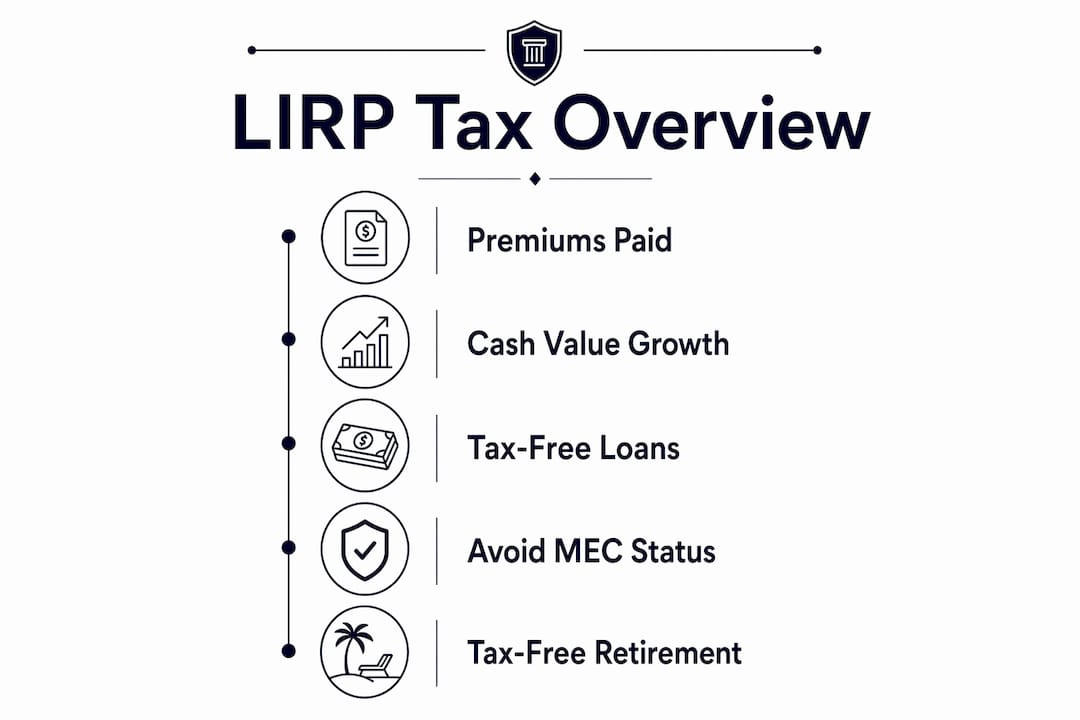
- No deduction on contributions: Because a LIRP is not a qualified plan, premiums are paid with after-tax dollars. There is no upfront deduction the way a traditional 401(k) provides.
- Tax-deferred growth: Cash value accumulates inside the policy without annual income tax on the gains, similar to how a Roth IRA grows tax-free.
- Tax-free access: Withdrawals up to your cost basis and policy loans are generally not taxable as long as the policy remains in force.
- Modified Endowment Contract (MEC) risk: If you overfund a policy too quickly, the IRS reclassifies it as a Modified Endowment Contract. A MEC loses the favorable loan and withdrawal treatment. Withdrawals from a MEC are taxed on a last-in, first-out basis, meaning gains come out first and are taxable. Loans from a MEC are also treated as distributions and taxed accordingly.
- Policy lapse risk: If a policy lapses with an outstanding loan balance, the IRS treats that balance as taxable income in the lapse year. This is the single biggest tax trap in LIRP planning.
Avoiding MEC status requires careful policy design, specifically limiting how fast premiums are paid relative to the death benefit. A properly structured LIRP keeps premiums just below the MEC threshold, which is why working with an advisor who understands policy design is not a luxury.
When should you consider a LIRP for retirement planning?
A LIRP is not the right tool for everyone. It works best in specific financial situations, and using it outside those situations often means paying more in insurance costs than you gain in tax benefits.
The clearest candidates are high-income earners who have already maxed out traditional accounts and want additional tax-advantaged savings. If you are contributing the maximum allowed to a 401(k) and IRA and still have savings capacity, a LIRP gives you a place to grow money tax-deferred with tax-free access in retirement.
Other situations where a LIRP makes sense:
- Estate planning: The death benefit passes to heirs income-tax-free, making a LIRP a useful legacy tool for people with taxable estates.
- Business owners: Those without access to employer-sponsored plans sometimes use LIRPs as a primary supplemental savings vehicle.
- People with dependents: The death benefit provides financial protection while the cash value builds retirement income simultaneously.
- Long planning horizons: Cash value takes years to accumulate meaningfully. A LIRP started at 35 or 40 has far more time to compound than one started at 55.
Potential drawbacks deserve equal attention. Insurance costs inside a permanent policy are real and ongoing. Financial experts note that for average investors, those costs can outweigh the cash value growth compared to simply investing in a taxable brokerage account. Complexity is another factor. Policy illustrations can be difficult to interpret, and projections depend on assumptions that may not hold.
Pro Tip: Ask any agent showing you a LIRP illustration to run a “stress test” scenario at a lower credited rate than the illustrated rate. If the policy still performs acceptably at a reduced rate, it is more likely to hold up over time.
How Progressiveplanner’s Dual Purpose Retirement Strategy™ uses LIRPs differently
Most people treat retirement savings as a single bucket: money goes into a 401(k) or IRA, grows, and gets drawn down in retirement. Progressiveplanner’s Dual Purpose Retirement Strategy™ takes a different approach by making the same dollar work in two places at once.
The strategy uses Indexed Universal Life policies to create two separate tax-advantaged income streams from the same savings. One stream comes from the traditional retirement account. The second comes from the IUL’s cash value, accessed through tax-free policy loans in retirement. Because IUL policies link cash value growth to a market index with a floor protecting against losses, the strategy addresses two of the most common retirement risks: market downturns and future tax increases.
The core insight behind the Dual Purpose Retirement Strategy™ is that tax diversification in retirement is just as important as investment diversification. Having one income stream from a pre-tax account and a second from a tax-free source gives you flexibility to manage your taxable income in retirement, which can affect Medicare premiums, Social Security taxation, and your overall tax bracket.
| Strategy Element | Traditional 401(k) Only | Dual Purpose Strategy™ |
|---|---|---|
| Tax treatment at withdrawal | Taxable as ordinary income | One taxable, one tax-free |
| Market downside exposure | Full exposure | IUL floor limits losses |
| Death benefit | None | Included in IUL policy |
| Contribution limits | IRS annual caps | No IRS cap on IUL premiums |
The IUL component also provides downside protection that a standard brokerage account does not. In a year when the index drops, the floor keeps the cash value from declining, which matters most for people close to or in retirement.
Pro Tip: Working with a specialist who understands both IUL policy design and retirement income planning is critical. A generalist insurance agent may not know how to structure the policy to avoid MEC status while maximizing cash value accumulation.
What does a LIRP actually cost?
Cost transparency is one area where LIRPs often fall short in the sales process. Several layers of fees exist inside a permanent life insurance policy, and they directly reduce the cash value available for retirement.
Cost of insurance (COI): This is the charge for the death benefit itself. It increases as you age because the probability of a claim rises. In a VUL or IUL, the COI is deducted monthly from the cash value account.
Administrative fees: Insurers charge ongoing fees to maintain the policy, typically a flat monthly amount or a percentage of the account value.
Surrender charges: Most permanent policies carry surrender charges for the first several years, often 10–15 years. Surrendering the policy during this period means forfeiting a portion of the cash value.
Rider fees: Optional features like long-term care riders, waiver of premium, or guaranteed insurability add cost. Each rider has its own charge deducted from cash value.
Expense loads on premiums: Some policies deduct a percentage of each premium payment before it reaches the cash value account, similar to a front-end load on a mutual fund.
The total drag from these costs is why policy design matters so much. A LIRP structured to minimize the death benefit relative to premiums paid keeps the COI low, which leaves more money in the cash value account to grow. Overpaying for death benefit inside a LIRP is one of the most common and costly mistakes.

What questions should you ask before buying a LIRP?
Buying a permanent life insurance policy is a long-term commitment, and the wrong policy can cost you far more than the tax benefits are worth. These are the questions that separate a well-suited LIRP from a poor one.
Is the policy designed for cash value accumulation or death benefit? A LIRP optimized for retirement income minimizes the death benefit to reduce insurance costs. A policy sold primarily as life insurance protection may not be structured for maximum cash value growth.
What is the illustrated rate, and what does the policy look like at a lower rate? Illustrations often use the maximum credited rate allowed. Ask for projections at a rate two or three points lower to see how the policy holds up under less favorable conditions.
What are the total fees over the first 20 years? Request a full fee disclosure, including COI, administrative charges, and any surrender schedule. Compare the total cost against the projected cash value to assess whether the math works.
Does the policy avoid MEC status at your planned funding level? Your agent should be able to confirm the maximum premium you can pay annually without triggering MEC classification.
What is the insurer’s financial strength rating? A permanent life policy is a decades-long contract. The insurer needs to be financially sound enough to honor it. Ratings from AM Best, Moody’s, or S&P provide an independent assessment.
What happens if you need to reduce or stop premium payments? Life changes. Understand whether the policy can sustain itself on reduced premiums and for how long before the cash value depletes.
Common misconceptions and pitfalls to avoid with LIRPs
The gap between how LIRPs are sometimes sold and how they actually perform creates real financial harm for people who go in without clear expectations.
Misconception: A LIRP is an investment account. It is not. The primary function of the underlying policy is life insurance protection. Cash value growth is a secondary feature, and the costs of maintaining the death benefit reduce the net return on that growth. Treating a LIRP as a pure investment vehicle leads to disappointment.
Misconception: Policy loans are free money. Loans accrue interest, and unpaid loan interest compounds against the cash value. If the loan balance grows faster than the cash value, the policy can lapse, triggering the tax event described earlier.
Misconception: Any permanent policy works as a LIRP. Policy design determines whether a LIRP succeeds or fails. A policy sold with a large death benefit and minimal premium funding will not accumulate meaningful cash value. The structure has to be intentional from the start.
Pitfall: Underfunding the policy. Cash value grows from the premiums you pay above the cost of insurance. Paying the minimum required premium keeps the policy alive but leaves little for cash value accumulation. A LIRP needs consistent, above-minimum funding to perform as a retirement tool.
Pitfall: Ignoring the surrender period. If your financial situation changes in the first 10–15 years and you need to access the full cash value or cancel the policy, surrender charges can significantly reduce what you receive.
Pitfall: Conflating LIRP with Roth IRA alternatives. A LIRP and a Roth IRA both offer tax-free income in retirement, but they work very differently. A Roth IRA has no insurance costs, no surrender charges, and no death benefit. A LIRP provides a death benefit and has no IRS contribution cap, but carries ongoing insurance costs. They serve different purposes and can complement each other rather than substitute for one another.
Key Takeaways
A LIRP works best as a supplement to maxed-out traditional accounts, using permanent life insurance cash value to create tax-free retirement income alongside a 401(k) or IRA.
| Point | Details |
|---|---|
| LIRP definition | A permanent life insurance policy that builds cash value for supplemental retirement income while maintaining a death benefit. |
| Tax treatment | Contributions are not deductible, but cash value grows tax-deferred and can be accessed tax-free through loans or withdrawals up to basis. |
| Contribution limits | No IRS cap on LIRP premiums, unlike the 2025 401(k) limit of $23,500 and IRA limit of $7,000. |
| MEC risk | Overfunding a policy too quickly triggers Modified Endowment Contract status, eliminating the favorable tax treatment on loans and withdrawals. |
| Best candidates | High-income earners who have maxed traditional accounts and want additional tax-diversified retirement income with a death benefit. |